California Quitclaim Deed (LLC Grantor)
County Specific Legal Forms Validated as recently as October 14, 2026 by our Forms Development Team
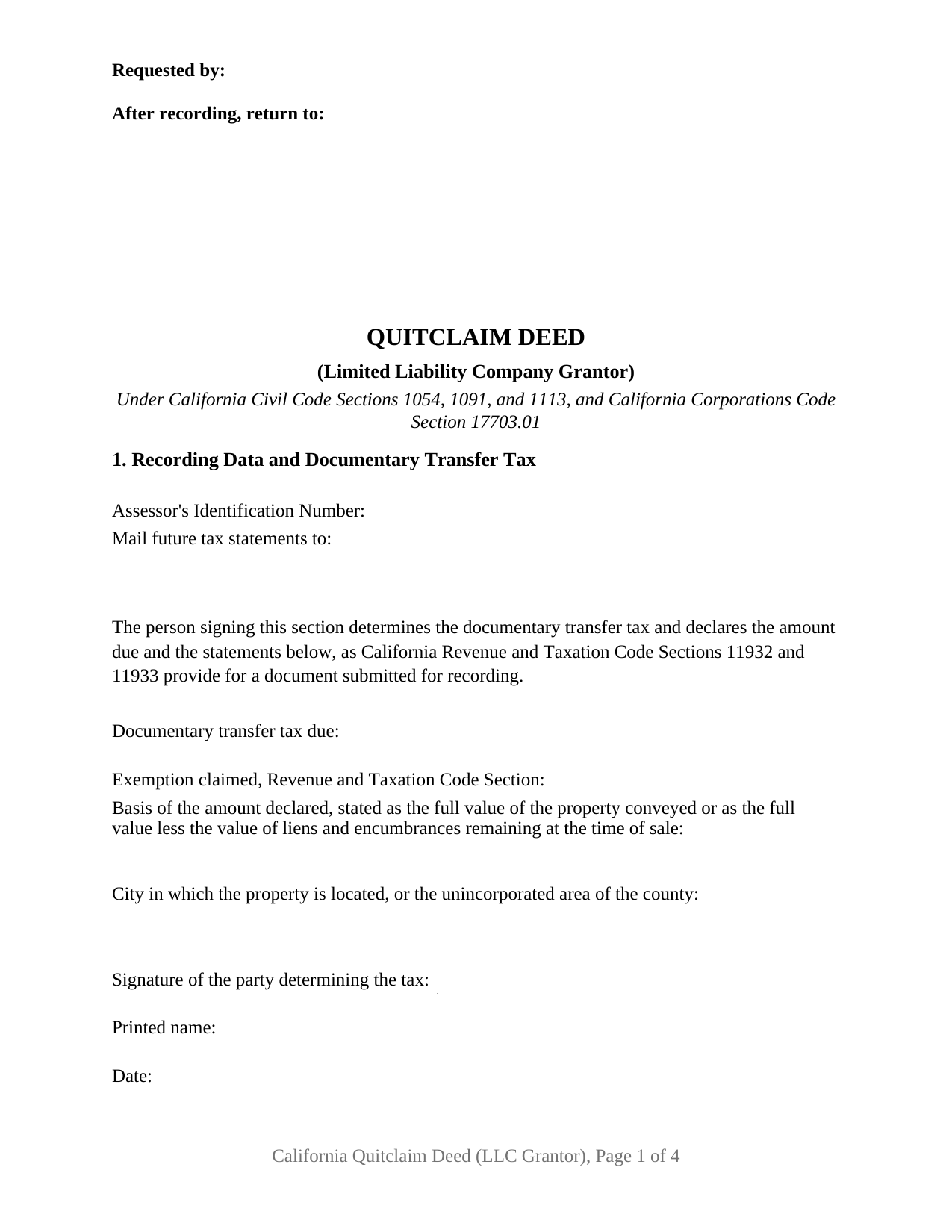
About the California Quitclaim Deed (LLC Grantor)
How to Use This Form
- Select your county from the list
- Download the county-specific form
- Fill in the required information
- Have the document notarized if required
- Record with your county recorder's office
What Others Like You Are Saying
"amazingly fast! Thank you!"
"It is a difficult challenge -- trying to take the needless jargon out of legal transactions so ordin…"
"The information/forms/and ease of filling in the blanks provided me with the confidence to "do …"
"The information seems complete and accurate. The form was easy to use and save. I'll let you know if…"
"I was very impressed with the speed at which information was retrieved on my very first search. Unfo…"
4.8/5 from 4,828 reviews. Read all
A limited liability company signs nothing by itself. When one releases an interest in California real property, the recorded page has to carry two identities at once, the company that holds the interest and the person whose hand is on the line, joined by a stated capacity. This form prepares the California quitclaim deed in that configuration: a limited liability company named as grantor, one authorized person signing for it, and no warranty of title of any kind.
The Capacity Line Is Where This Deed Does Its Work
Corporations Code Section 17701.04 makes a limited liability company an entity distinct from its members, and Section 17701.05 gives it, subject to its articles of organization, all the powers of a natural person in carrying out its business activities. Section 17703.01 then supplies the agency that turns one person's signature into the act of the company, and it branches on a single fact: a company is member managed unless its articles of organization state that it is manager managed. In the first case every member is an agent of the company for its business or affairs, and executing an instrument in the company's name binds it; in the second, every manager holds that agency and a member acting solely as a member does not. Section 6 of this deed carries both entries, the signer's capacity and the company's management structure, so the record shows which branch of the statute the signature rests on. The same section adds that an act in contravention of a restriction on authority does not bind the company as to a person with actual knowledge of it.
One Company, One Signature, One Certificate
Section 2 names the company, its jurisdiction of organization, and its mailing address, which places a company organized outside California. Section 8 repeats the company name above a single signature line, with blanks for the printed name, the date, and the title, the customary California entity signature form. One acknowledgment certificate follows, headed by the boxed notice Civil Code Section 1189 places at the top of every certificate taken in this state. Companies present patterns of their own in California's grantor indexes: a company distributing a parcel to its members in the proportions in which they hold membership interests, a company releasing whatever interest it holds to an affiliated entity after a restructuring, and a company clearing a chain of title where an earlier deed reached a superseded name. The form recites one company as grantor. A corporation, a partnership, a trustee, and an individual each sign through a capacity structure other than the blanks here describe, and the grantee section names the party taking from the company.
A Release, Not a Promise
Nothing is warranted. The two covenants Civil Code Section 1113 attaches to a conveyance ride on the word grant, and a quitclaim, often typed as a quit claim deed, does not use it. The operative section states the rest: what passes is the interest the company holds when the deed is delivered, and title acquired later stays outside it.
Transfer Tax on the Way Out of an Entity
Section 1 gathers what the recording counter reads first: the assessor's parcel number, the address for future tax statements that Government Code Section 27321.5 puts on page one, and the documentary transfer tax declaration of Revenue and Taxation Code Sections 11932 and 11933, closed by the signature of whoever determined the tax. Entity transfers have their own exemption. Revenue and Taxation Code Section 11925, subdivision (d), imposes no tax by reason of a transfer between a legal entity and individuals, or between legal entities, that results solely in a change in the method of holding title where the proportional ownership interests in the realty remain the same immediately after the transfer. The guide takes up that provision, the county rate of 55 cents for each 500 dollars, the transfer taxes some charter cities add, and the Preliminary Change of Ownership Report that reaches the assessor with the deed.
Three files ship with this configuration: the fillable quitclaim deed, a completed example filled in for a Kern County transfer from a company to its two members, and a plain language guide that works through each numbered section, the certificate, the fees, and what the recorder checks at intake. All of it describes California law in general terms, and none of it is legal advice about a company or a parcel.
Important: County-Specific Forms
Our quitclaim deed (llc grantor) forms are specifically formatted for each of the 58 counties in California.
After selecting your county, you'll receive forms that meet all local recording requirements, ensuring your documents will be accepted without delays or rejection fees.