California Quitclaim Deed (Married Couple as Grantors)
County Specific Legal Forms Validated as recently as October 14, 2026 by our Forms Development Team
About the California Quitclaim Deed (Married Couple as Grantors)
How to Use This Form
- Select your county from the list
- Download the county-specific form
- Fill in the required information
- Have the document notarized if required
- Record with your county recorder's office
What Others Like You Are Saying
"So easy to download and print. Also the examples are very helpful."
"Excellent Service! Fast and friendly. Thank you will use again!"
"Great documents! with complete instructions and the CTC as well. I work with a lot of recordings and…"
"The website and information is fine. The proof in the pudding, of course, is whether the forms I use…"
"Deeds.com made it so easy to file my paper work with the county. It saved me half a days travel and …"
4.8/5 from 4,828 reviews. Read all
When California spouses give up an interest in real property together, the record shows one instrument doing the work of two owners: a quitclaim deed that names both spouses as grantors, recites that they are married to each other, and carries a signature line and a notary certificate for each of them. This form prepares the California quitclaim deed in that married couple configuration, releasing whatever interest the couple holds to the grantee named in the deed, without any warranty of title.
Married Grantors and the Community Property Presumption
The marriage matters on the grantor side because of how California characterizes ownership. Family Code Section 760 makes property acquired by a married person during the marriage, while domiciled in the state, community property except as otherwise provided, and the California Supreme Court's decision in In re Brace confirmed how far that presumption reaches even when the recorded title reads differently. A conveyance of community real property is a two spouse act under Family Code Section 1102, and a deed executed by one spouse alone leaves the record asking where the other spouse stands. The married couple configuration answers on the face of the instrument: the grantor section recites the marriage, both spouses execute, and the release reaches whatever interest either of them holds, community or separate, however the characterization might later be argued.
A Release Without Covenants
California folded its everyday title promise into a single word. A conveyance drawn on the word grant picks up the two implied covenants of Civil Code Section 1113; a quitclaim, often typed as a quit claim deed, leaves that word out, so nothing is promised about the state of the title. The deed prints the rest of the classic quitclaim posture in its operative section: each grantor conveys the right, title, and interest held at delivery, and title a grantor acquires afterward does not follow the deed. What the couple holds passes; what they do not hold was never promised.
Two Spouse Grantor Blocks, Two Certificates
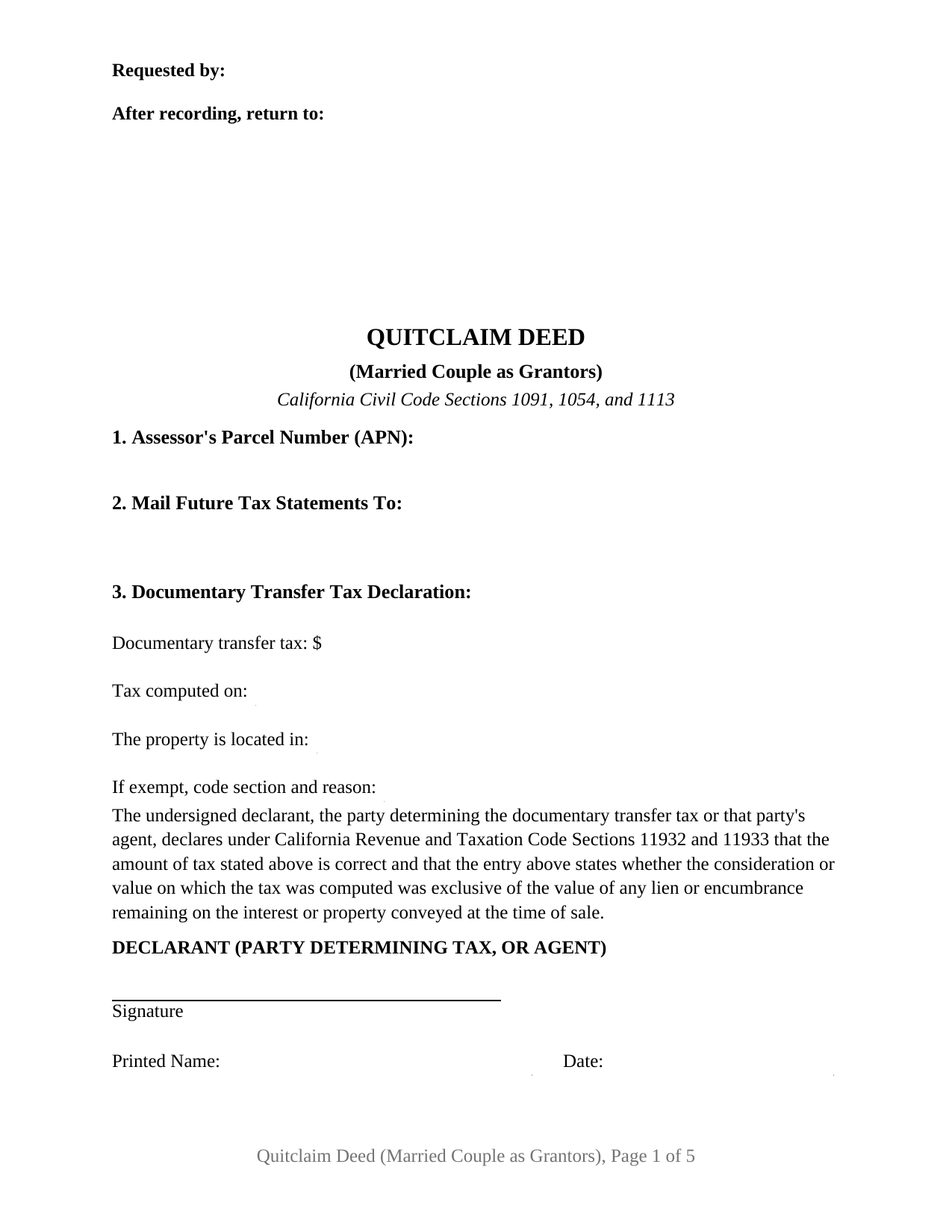
Section 4 of the form carries the configuration: a grantor block for each spouse under a recital that the grantors are married to each other and that both join in the deed. Two signature lines follow the operative section, and a notary certificate follows for each signer, headed by the boxed identity notice California places at the top of certificates taken in the state. A documentary transfer tax declaration prints in the body with its own line for the party who determines the tax. Couples presenting this pattern appear throughout California's grantor indexes: spouses selling a community parcel to a buyer, a couple releasing their interest in family land to a relative, and spouses in a long marriage consolidating fractional interests they picked up over the years into a single grantee's name.
The form recites its two grantors as spouses. A sole owner, and two co-owners who are not married to each other, present grantor patterns outside these blocks, and the form is not set up as a transfer between the spouses themselves: the grantee section names a party taking from the couple.
Recording and the Notice That Follows
The deed records with the recorder of the county where the land lies, and its first page arrives arranged for intake: the reserved recording space, the requester and return entries, the parcel number, the future tax statement address, and the transfer tax declaration. One recording consequence is newer than the rest. Under a 2025 statute, every California county is to establish a recorder notification program by January 1, 2027, and after implementation the recorder mails notice to the parties who executed a recorded deed or quitclaim deed, within 30 days, at the tax bill address on file. Both spouses on this deed are executing parties, so that anti fraud notice runs to each of them.
The package contains the deed as a fillable PDF, a completed example worked through an Alameda County sale, and a plain language guide to every section, the signing before the notary, and the county recording process. It describes the law that governs the instrument in general terms and is not legal advice about any couple's title.
Important: County-Specific Forms
Our quitclaim deed (married couple as grantors) forms are specifically formatted for each of the 58 counties in California.
After selecting your county, you'll receive forms that meet all local recording requirements, ensuring your documents will be accepted without delays or rejection fees.