California Quitclaim Deed (Trustee Grantee)
County Specific Legal Forms Validated as recently as October 6, 2026 by our Forms Development Team
About the California Quitclaim Deed (Trustee Grantee)
How to Use This Form
- Select your county from the list
- Download the county-specific form
- Fill in the required information
- Have the document notarized if required
- Record with your county recorder's office
What Others Like You Are Saying
"So very easy to follow & the cost of the packet was reasonable."
"Website is very user friendly and provided a variety of forms to download for use"
"What a wonderful and easy task using deeds.com. I searched on line for the proper procedure to file …"
"Very easy process to have this document recorded through Deeds.com! The amount of time it saved me w…"
"Just what my parents and I have been looking for to do a Quit Deed to transfer property into my name…"
4.8/5 from 4,828 reviews. Read all
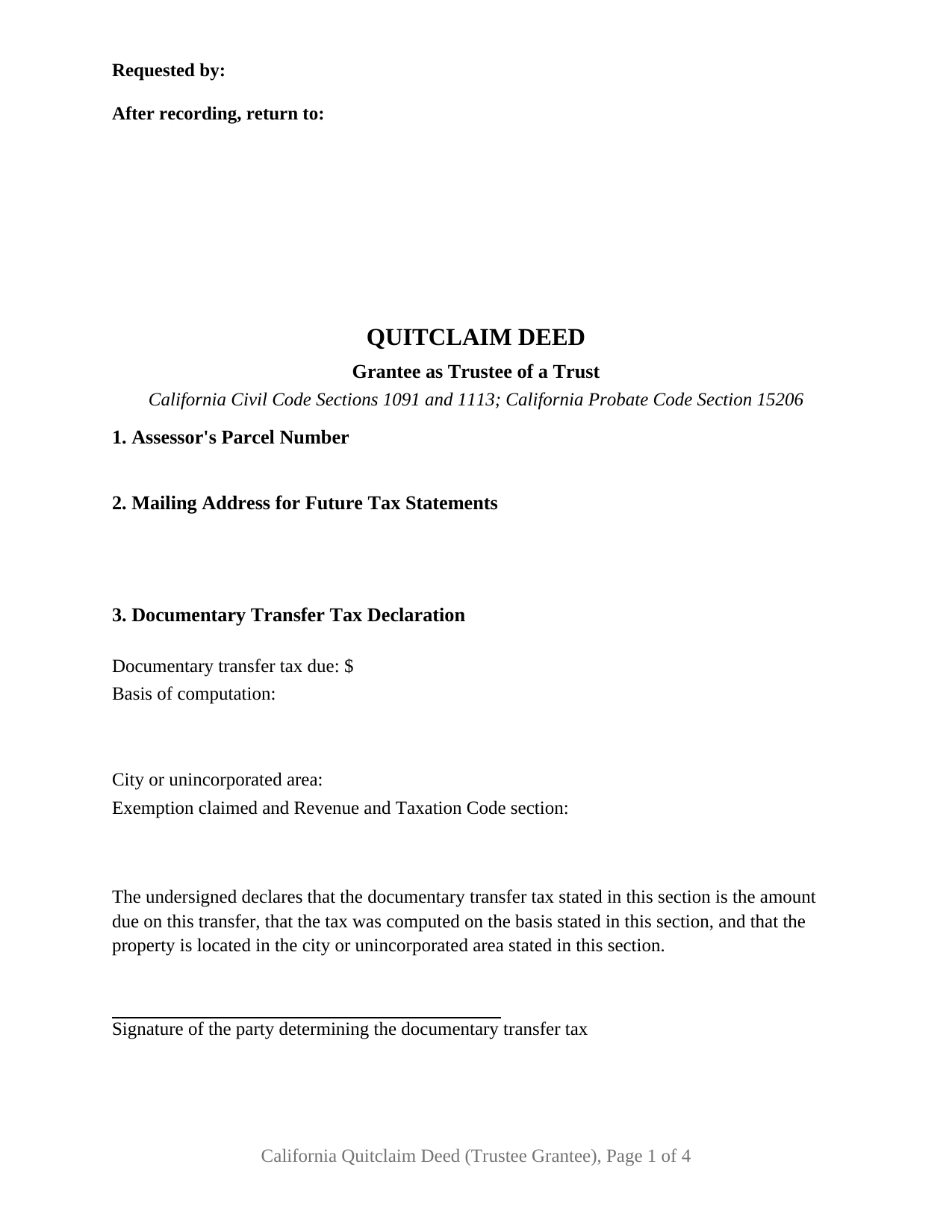
California real property held in trust is not held by the trust. It is held by the trustee, and a deed that moves an interest into a trust says so on its face. This form prepares the trustee grantee configuration of the California quitclaim deed: one grantor releasing whatever interest that grantor holds to a named person acting as trustee, with the trust identified by name and by the date of its instrument.
A Deed That Names a Trustee, Not a Trust
California law treats a trust as a fiduciary relationship rather than a legal entity, so it cannot take title in its own name. The Court of Appeal put it plainly in Boshernitsan v. Bach (2021): only trustees, and not trusts, can hold legal title to property. The trustee holds legal title while the beneficiaries hold equitable title, and Probate Code Section 15200 lists a transfer of property to another person as trustee among the ways a trust comes into being. Section 5 is built around it, carrying the name of the person taking title with the trustee designation, the trust's name, the date of its instrument, and a mailing address. Deeds naming a trust and stopping there turn up in California grantor indexes, and title companies flag them later.
What Passes to the Trustee, and What Is Promised
Nothing is promised. California packs its everyday deed covenants into a single word: Civil Code Section 1113 implies two covenants, and no others, from the word grant, and a quitclaim, often typed as a quit claim deed, leaves that word out. The operative section states the rest expressly. The grantor remises, releases, and forever quitclaims only the interest held when the deed is delivered; title the grantor picks up afterward does not follow the deed; and title vests in the grantee as trustee of the named trust, to be held and administered under the trust instrument and California law. Under Probate Code Section 15206, a written instrument conveying trust property, signed by the settlor, is one of the ways California evidences a trust in relation to real property. The trust instrument itself is a separate document, prepared apart from this deed and not included here.
One Grantor Signs, and the Trustee Does Not
The form recites one grantor, an individual signing personally, and one grantee taking as trustee. A single signature line follows the operative section, and one California acknowledgment certificate follows it, headed by the boxed identity notice Civil Code Section 1189 requires on every certificate taken in the state. A grantee does not execute a quitclaim, so the trustee has no signature line even where the trustee and the grantor are the same person, as when an owner funds a living trust. Patterns presenting this configuration fill California's records: an owner moving a residence to the trustee of a revocable living trust signed years earlier, a cotenant releasing an undivided interest to the trustee of a family trust, and a later transfer to the trustee where an earlier deed named the trust alone. The form is not set up for two grantors, and a grantee taking title in that person's own right presents a different grantee pattern than this deed recites.
Transfer Tax and the Assessor on a Trust Transfer
A transfer into a trust commonly carries no documentary transfer tax, and the deed states why on its face. Revenue and Taxation Code Section 11930 reaches a conveyance of realty, outright or in trust for the benefit of any person, made by inter vivos gift or by reason of a death, and county recorders apply it to a deed transferring the grantor's interest to a revocable trust for the grantor's benefit. Section 3 carries the tax entries the declaration statutes call for, including the exemption line, over the tax determiner's signature. Property tax runs on a separate provision: Revenue and Taxation Code Section 62(d) excludes from change in ownership a transfer into a revocable trust, or into a trust in which the transferor is the present beneficiary, which the assessor administers through the Preliminary Change of Ownership Report accompanying the deed.
Three files make up the package: the fillable deed, a completed example filled in for a Sonoma County transfer to the trustee of a living trust, and a plain language guide covering every numbered section, the notarial certificate, and what a recorder checks at intake. It states what California law provides in general terms, and it is not legal advice about a particular title or trust.
Important: County-Specific Forms
Our quitclaim deed (trustee grantee) forms are specifically formatted for each of the 58 counties in California.
After selecting your county, you'll receive forms that meet all local recording requirements, ensuring your documents will be accepted without delays or rejection fees.