Connecticut Quitclaim Deed (Divorce)
County Specific Legal Forms Validated as recently as September 9, 2026 by our Forms Development Team
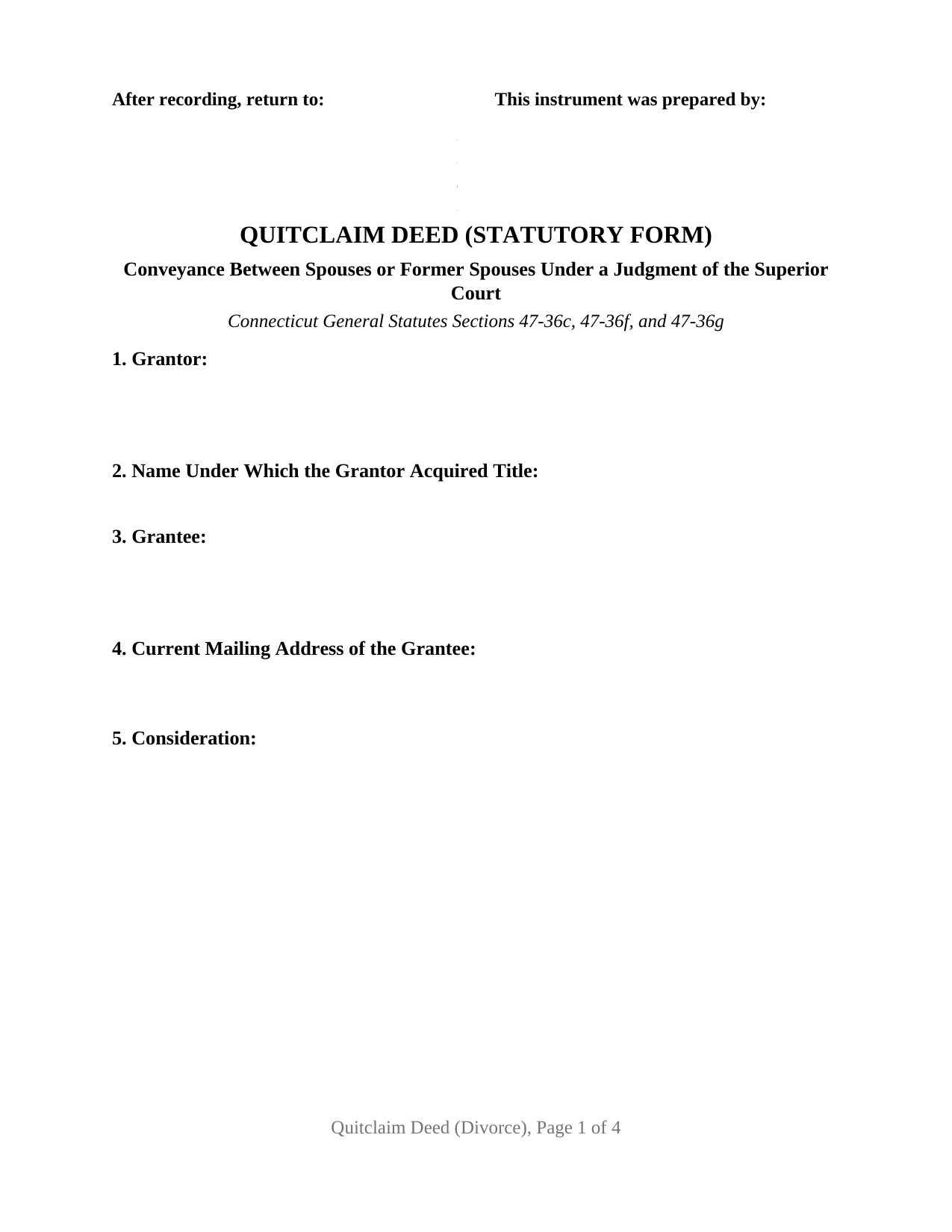
About the Connecticut Quitclaim Deed (Divorce)
How to Use This Form
- Select your county from the list
- Download the county-specific form
- Fill in the required information
- Have the document notarized if required
- Record with your county recorder's office
What Others Like You Are Saying
"Your forms are worth the investment. The guide and example were very helpful and thorough."
"All the paperwork I need......Great service"
"Form was easy to complete, price was reasonable and everything worked out just fine. Would absolutel…"
"These folks are so amazing! They were very kind, patient and the communication was above and beyond.…"
"It was very easy to navigate and find what I needed. Very happy with the app."
4.8/5 from 4,836 reviews. Read all
A Connecticut dissolution judgment reaches the title on its own, and then it stops. Section 47-14g of the General Statutes severs a joint tenancy between the spouses into a tenancy in common on divorce, dissolution, or annulment, unless the decree provides otherwise. Severed is not conveyed. Each party still holds an undivided interest afterward, and this quitclaim deed is the instrument that moves one of those interests to the other.
What the judgment does, and what it leaves for a deed
Connecticut gives a dissolution court its own route to the land records. Section 46b-81(a) lets the Superior Court assign to either spouse any part of the estate of the other and pass title to real property without any act by either spouse. Section 46b-66a(a) lets the court instead order a party to convey, and subsection (c) makes a decree recorded in the town effect that transfer as if it were a deed of the party. A Connecticut divorce can therefore move a house by recorded decree or by signed deed, and this form is the deed.
The severance rule points the same way. It binds third persons only once a certified copy of the decree, or an abstract giving the names, the effective date, and the town and court, reaches the land records. That copy or abstract comes from the court and is recorded separately, so it is not part of this package; the deed carries a blank for its volume and page.
A statutory release with one promise inside it
The conveyance itself is Connecticut boilerplate. Section 47-36c prints the short quitclaim form these words come from, the Statutory Form label in the heading is what Section 7-34a reads at the fee counter, and Section 47-36f settles the effect: a duly executed quitclaim passes whatever the releasor holds and attaches no title covenants. One promise travels with it under Section 47-36g, reaching encumbrances of the Grantor's own making and defending against claims that run through the Grantor. A mortgage of record continues after this deed, and so does the obligation of whoever signed the note.
The judgment, printed on the face of the deed
Section 9 takes the judicial district, the docket number, the date, and the nature of the judgment; Section 10 recites the marriage and the delivery of the deed in performance of it. Naming the judgment also matters to the tax: Section 12-498(a)(9) exempts deeds made pursuant to a decree of the Superior Court under Section 46b-81, the property assignment provision, while subdivision (10) reaches a deed whose consideration is under two thousand dollars. Form OP-236 goes to the town clerk either way, and Section 12-496 supplies the bold face No Conveyance Tax collected stamp for an exempt instrument.
How this form is configured
Twelve numbered sections collect one Grantor and one Grantee, the mailing address Section 47-5(b) asks a deed to carry, the consideration, the town and legal description, the source of title, the encumbrances, the judgment, and the conveyance itself. Section 2 answers a wrinkle particular to this setting: Section 47-13 has an owner whose name changed state the name under which the property was acquired, so a parcel taken in a married name stays findable after a birth name is restored. Execution runs to one signature line, the two subscribing witness lines Section 47-5(a)(4) calls for, and one certificate tracking the Section 1-34 short form. A former spouse deeding out an undivided half of the marital home under a property assignment, and a party conveying a house awarded to the other in a legal separation, present the pattern this deed recites. Two record owners conveying together produce two executions, and an entity, a fiduciary, or an agent under a power of attorney recites a capacity this form does not carry.
Filed in the town, not a county
Connecticut has no county recorder for land records, so the completed divorce deed reaches the town clerk that holds the parcel's record. Section 47-10 withholds force from an unrecorded conveyance as against anyone other than the Grantor and the Grantor's heirs. Under Section 7-24(f) the addressee for the clerk's return belongs at the head of page one.
Three files arrive in the download: the blank deed as a fillable PDF, a completed example worked through all twelve sections on a Southington fact pattern, and a plain language guide covering the statutes, the witness and notarial steps, and the recording and conveyance tax mechanics. The materials are informational and are not legal advice.
Important: County-Specific Forms
Our quitclaim deed (divorce) forms are specifically formatted for each of the 8 counties in Connecticut.
After selecting your county, you'll receive forms that meet all local recording requirements, ensuring your documents will be accepted without delays or rejection fees.