Connecticut Quitclaim Deed (Married Couple as Grantors)
County Specific Legal Forms Validated as recently as October 9, 2026 by our Forms Development Team
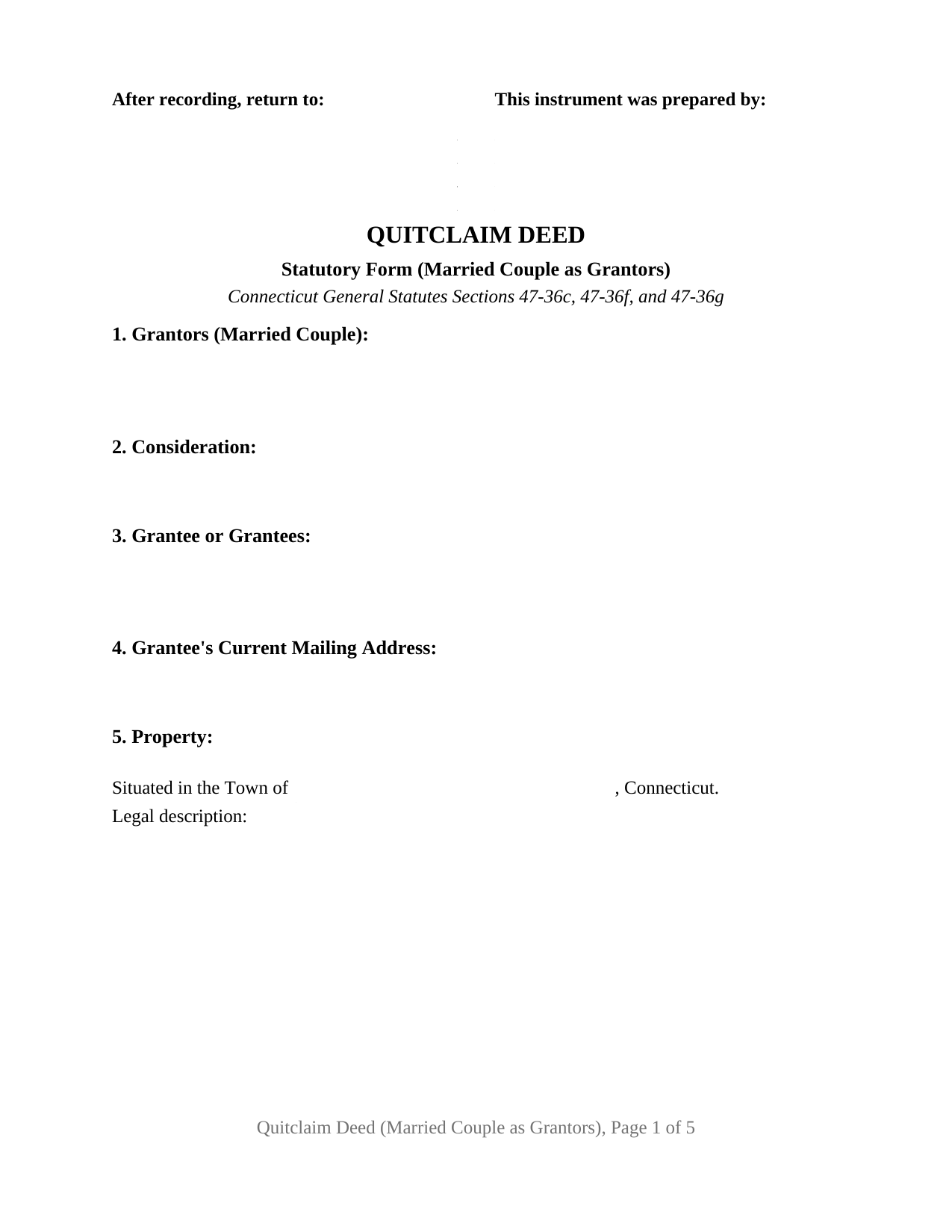
About the Connecticut Quitclaim Deed (Married Couple as Grantors)
How to Use This Form
- Select your county from the list
- Download the county-specific form
- Fill in the required information
- Have the document notarized if required
- Record with your county recorder's office
What Others Like You Are Saying
"I found everything I needed"
"5 stars"
"in one of the reviews, the person said they wished that there was more room allowed for use in the g…"
"Yes I received the forms downloaded them and the example is very helpful as I have not used this for…"
"Easily find and print forms necessary for peace of mind."
4.8/5 from 4,828 reviews. Read all
A married couple can pass jointly held Connecticut real estate through one quitclaim deed built around a single signing ceremony. This form recites two grantors who are married to each other, and it gives that couple one execution: a signature line for each spouse, two witness lines that attest both signatures, and an acknowledgment certificate naming each spouse.
One couple, one ceremony
The form's execution section is arranged for spouses who sign together. Both signature blocks sit on the same page, the two witnesses attest both signatures at the same sitting, and the notary completes a certificate for each spouse, so the whole execution happens in one gathering; in the completed example included with the download, both certificates carry the same date and the same Middlesex County notary. The deed also states the relationship itself: Section 9 recites that the grantors are married to each other and that each joins as a grantor, a recital built into the operative text rather than left to inference from matching surnames.
Spouses passing a shore cottage to an adult child and the child's spouse, and a couple conveying jointly held acreage to a longtime neighbor, present the pattern this deed recites. The form is set up for exactly two grantors who are married to each other; a sole owner, co-owners who are not married to each other, an entity, or a fiduciary presents a different execution pattern than the shared ceremony here.
Both signatures come from the title
Connecticut puts both spouses on this deed for a simple reason: both names are on the title. The state has no community property regime for ordinary lifetime acquisitions, dower and curtesy were abolished for marriages contracted after 1877, and the homestead exemption in Section 52-352b of the General Statutes shields an owner-occupied home from certain judgment enforcement without adding any signature requirement to a deed. So Connecticut law attaches no automatic spousal joinder to a lifetime conveyance; when a married couple holds title jointly, a release of the whole property takes both owners' signatures because each spouse owns an interest of record, and this deed collects both in one instrument.
The statutory release, spoken by two owners together
The conveyance runs through the operative words Section 47-36c of the Connecticut General Statutes assigns to the quitclaim: the grantors, and each of them, for consideration paid, GRANT to the grantee or grantees with QUITCLAIM COVENANTS, and the heading carries the Statutory Form entitlement the statute attaches to its short forms. What passes under Section 47-36f is everything the couple owns in the property, and what the covenant promises under Section 47-36g reaches only encumbrances the grantors themselves made or suffered, so older defects in the chain travel with the land. On the receiving side, the grantee entry accepts one or more takers, and the guide describes each form of co-ownership Connecticut recognizes, from the default tenancy in common through the statutory survivorship joint tenancy the completed example illustrates.
Into the town land records
The finished deed goes to the town clerk where the land lies, since Connecticut keeps its land records in the towns and Section 47-10 makes an unrecorded deed good against no one beyond the grantors and their heirs. The layout puts the return address at the statutory top-of-first-page position, keeps every margin past the three-quarter inch minimum, and includes a field for the grantee's current mailing address, the item Section 47-5(b) asks every deed to carry. A conveyance for two thousand dollars or more generally travels with Connecticut's conveyance tax return and payment, which the clerk collects before a taxable deed records.
The download delivers the blank deed as a fillable PDF, a completed example showing a married couple's conveyance carried through every section from the grantor entry to the second notary certificate, and a plain-language guide covering each numbered section, the witness and acknowledgment mechanics, the co-ownership choices open to grantees, and the recording and conveyance tax steps. The materials are informational and are not legal advice.
Important: County-Specific Forms
Our quitclaim deed (married couple as grantors) forms are specifically formatted for each of the 8 counties in Connecticut.
After selecting your county, you'll receive forms that meet all local recording requirements, ensuring your documents will be accepted without delays or rejection fees.