Connecticut Quitclaim Deed (Interspousal)
County Specific Legal Forms Validated as recently as October 14, 2026 by our Forms Development Team
About the Connecticut Quitclaim Deed (Interspousal)
How to Use This Form
- Select your county from the list
- Download the county-specific form
- Fill in the required information
- Have the document notarized if required
- Record with your county recorder's office
What Others Like You Are Saying
"Exactly what I needed. Thank you"
"Website is very easy to navigate."
"Easy instructions."
"Just what I was looking for"
"Great experience. Easy."
4.8/5 from 4,830 reviews. Read all
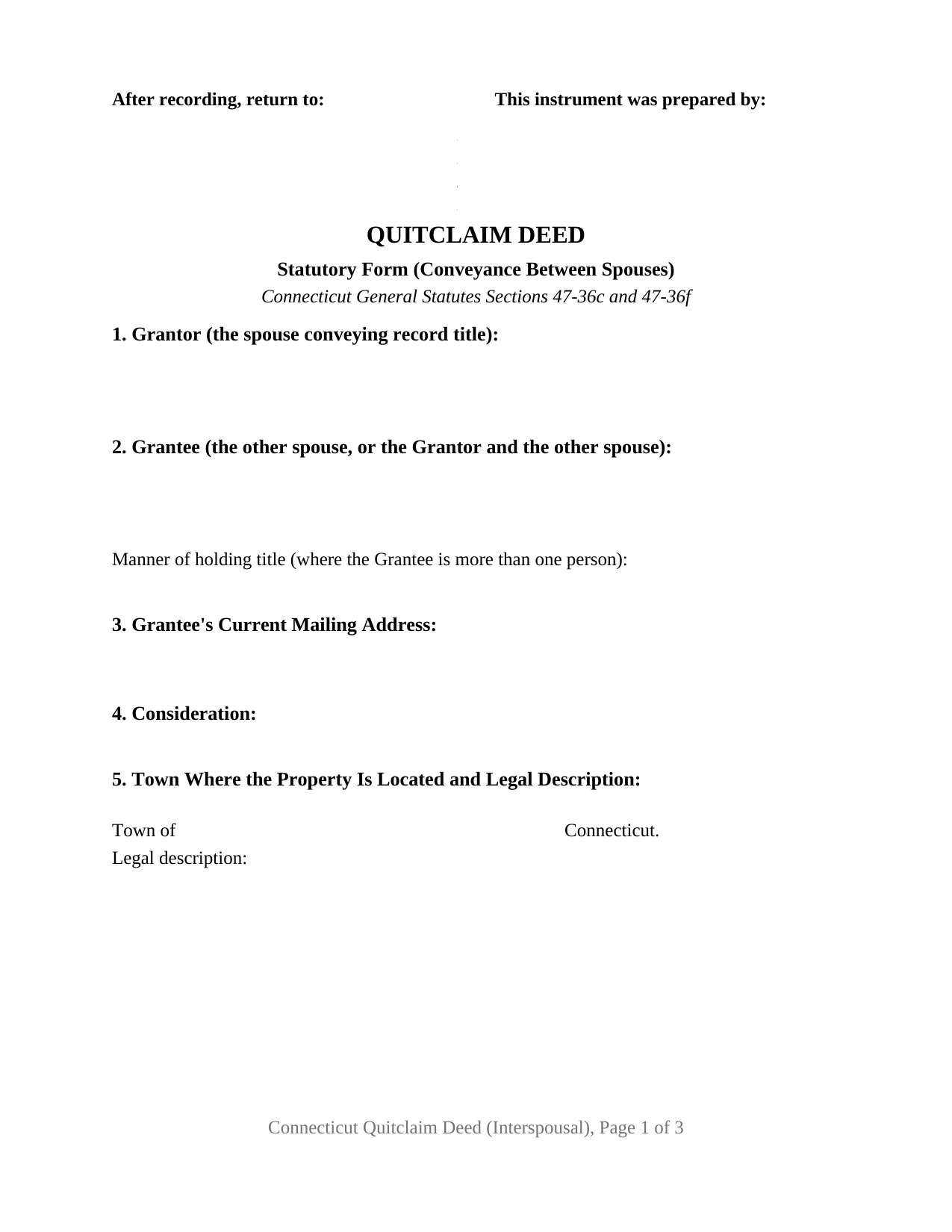
One spouse holds record title, and the deed that moves that title to the other spouse, or into both names at once, is this Connecticut quitclaim deed. It recites a single Grantor, the spouse whose name sits on the recorded deed, and a Grantee who is either the receiving spouse alone or the two spouses together, and it collects one signature, two witness lines, and one acknowledgment certificate. Buyers usually arrive calling it an interspousal transfer deed, a spouse to spouse quit claim, or adding a spouse to the deed.
A grantor who is allowed to be a grantee
The sentence that makes this configuration work sits in Section 47-14a of the Connecticut General Statutes. It creates a joint tenancy in fee simple with right of survivorship on a conveyance of real estate to two or more natural persons, among whom may be the grantor or grantors. That clause does real work: a spouse who owns a Connecticut house alone can name that same spouse and the other spouse as Grantees in Section 2, add the words as joint tenants, and produce statutory survivorship in one recorded instrument, with no intermediate party holding title along the way. The completed example runs exactly that way, in the Town of Monroe.
What the release carries and where it stops
This form performs its conveyance with the operative words of the short quitclaim form at Section 47-36c, and the heading carries the Statutory Form entitlement. Section 47-36f gives a duly executed quitclaim the force of a deed releasing all of the releasor's right, title, and interest. Section 47-36g supplies the narrow promise that rides along: freedom from encumbrances the releasor made or suffered, and a warranty against persons claiming by, from, or under that releasor. A mortgage already on the property continues after this deed records, and the note obligation continues against whoever signed it.
How this form is configured
Section 1 names the spouse who holds record title. Section 2 names the receiving spouse, or the Grantor and that spouse, and carries a second blank for the words that set the manner of holding title where more than one person takes. Section 9 recites that the two are married to each other and recites the Section 47-14a rule about a grantor among the grantees, so the arrangement reads on the face of the deed. Section 11 carries one signature block, because a Connecticut deed is executed by the party who conveys, together with the two subscribing witness blocks Section 47-5(a)(4) calls for and one certificate. A married couple placing a premarital house into both names, and a spouse releasing a half interest so one name stands alone on the title, present the pattern this deed recites. Two people who both appear on the recorded title present a different signing pattern, and an entity or fiduciary Grantor recites authority where this deed recites a marriage.
A conveyance tax answer that differs from a sale
Chapter 223 taxes deeds conveying Connecticut real property, and Section 12-498(a) lists what falls outside the tax. Subdivision (14) exempts deeds between spouses, and subdivision (10) separately exempts a deed whose consideration is under two thousand dollars, which is where a nominal recital lands. The exemption is claimed rather than assumed: Form OP-236 still goes to the town clerk with the deed, and Section 12-496 supplies the No Conveyance Tax collected stamp the clerk places on an exempt instrument. Land classified as farm, forest, open space, or maritime heritage carries a second tax under Section 12-504a, and Section 12-504c(a)(5) excepts deeds between spouses where no consideration is received.
Recorded in the town, not a county
Connecticut land records sit with the town clerks, so the deed goes to the clerk of the town where the property lies, and Section 47-10 leaves an unrecorded conveyance good against no one but the Grantor and the Grantor's heirs. The return addressee prints at the top of the first recorded page under Section 7-24(f), a blank for the Grantee's current mailing address answers Section 47-5(b), and printed-name lines sit under every signature because Section 7-34a prices a signature without one at an extra dollar.
This package holds three items: the deed as a blank fillable PDF, a filled-in Monroe example carried through all eleven sections, and a plain-language guide covering the statutes, the notarial mechanics, the co-ownership choices open to the Grantees, and the recording and tax steps. The materials are informational and are not legal advice.
Important: County-Specific Forms
Our quitclaim deed (interspousal) forms are specifically formatted for each of the 8 counties in Connecticut.
After selecting your county, you'll receive forms that meet all local recording requirements, ensuring your documents will be accepted without delays or rejection fees.