Connecticut Quitclaim Deed (Corporation Grantor)
County Specific Legal Forms Validated as recently as September 10, 2026 by our Forms Development Team
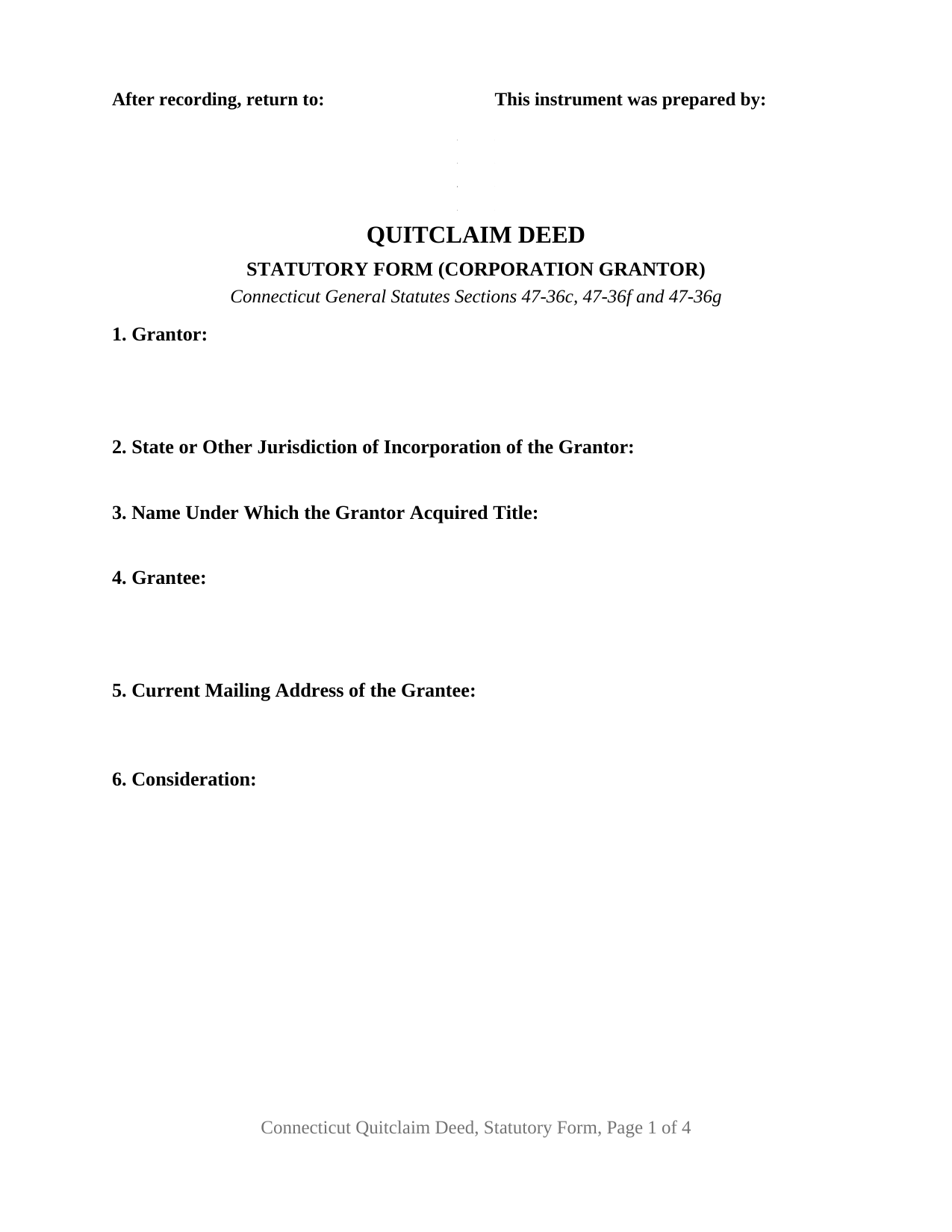
About the Connecticut Quitclaim Deed (Corporation Grantor)
How to Use This Form
- Select your county from the list
- Download the county-specific form
- Fill in the required information
- Have the document notarized if required
- Record with your county recorder's office
What Others Like You Are Saying
"Easy to use and super convenient."
"Easy"
"The Quit Claim Deed for the state of Ohio worked for me, saving me the cost of an attorney doing it.…"
"I LOVE THE EASE OF GETTING THE INFORMATION I REQUESTED. YOUR SERVICE IS MORE THAN WHAT I EXPECTED."
"Usually I have trouble registering things online, even though people tell me it's easy. This time, i…"
4.8/5 from 4,829 reviews. Read all
Two witnesses have to watch a Connecticut deed get signed, and at a corporate signing the two people nearest the pen usually work for the corporation. Connecticut allows exactly that, and it shapes this form: a quitclaim deed for one corporation as Grantor, carrying a single signature line, two witness lines, and a corporate acknowledgment certificate.
The witnesses are allowed to be insiders
Section 47-5 wants two attesting witnesses on every Connecticut conveyance, and appellate authority holds that a grantor or a grantee cannot be one of them. Section 47-6 answers the corporate version of that problem in one sentence: conveyances of real estate made to or by any corporation may be attested by witnesses interested therein, and may be acknowledged before properly authorized persons who are so interested. The treasurer can attest the president's signature, and a notary holding shares is not disqualified by that interest.
A statutory release, and one short promise
Section 47-36c is where the operative words originate, and the phrase Statutory Form stands in this deed's heading, the entitlement Section 7-34a prices at the statutory form rate. Under Section 47-36f a duly executed quitclaim releases every right, title and interest the releasor turns out to hold, with no covenants of title attached. Section 47-36g keeps the accompanying promise short: the releasor stands behind encumbrances of its own making and defends against claims running through it. Older trouble in the chain stays with the land.
Who signs, and on what authority
The execution rule sits in Section 47-5(a)(2)(B): a conveyance by a corporation is subscribed by a duly authorized person, who then acknowledges it. Section 12 records the office that person holds and the corporate action behind the deed. The vote itself stays in the minute book, and Section 47-36aa treats a recorded instrument's silence about entity signatory authority as an insubstantial defect. Section 33-830 calls for no shareholder approval to convey in the usual and regular course of business, while Section 33-831 requires it where the disposition would leave the corporation without a significant continuing business activity.
The name the corporation used when it took title
Section 47-13 speaks to a corporation whose name or status changed after it acquired the property. The conveying instrument states the name under which the property was acquired, and the town clerk indexes the record under both the old name and the current one. Section 3 carries that entry, which keeps a parcel taken in a predecessor name findable after a merger or a name change.
How this form is configured
Thirteen numbered sections take the corporation and its address, the jurisdiction of incorporation, and the earlier name, then the grantee, a mailing address blank answering Section 47-5(b), the price, the town, the legal description, the source of title by volume and page, what the parcel stays subject to, the authority and capacity statement, and the conveyance in the statutory words. Execution runs to one signature line, two subscribing witness lines, and a single certificate tracking the corporate short form at Section 1-62(2), which names the officer and title, the corporation, its place of incorporation, and the words on behalf of it. A manufacturer releasing a rear lot after a shelved plant expansion, and a corporation deeding out real estate as it winds down, present the pattern this deed recites. Two corporations conveying together produce two executions, and an individual owner or a fiduciary grantor recites a capacity this form does not carry.
What the town clerk collects
The land records here belong to the towns, so this deed is filed with the clerk of the town that keeps the parcel's record; Section 47-10 is what gives the conveyance effect beyond the Grantor. Several conveyance tax exemptions are drafted in corporate vocabulary: Section 12-498(a)(7) reaches deeds made pursuant to mergers of corporations, subdivision (8) a deed from a subsidiary to its parent for no consideration beyond cancellation of the subsidiary's stock, and subdivision (10) any deed whose consideration falls under two thousand dollars. Form OP-236 accompanies the deed either way, and until that return is filed and the tax paid, Section 12-497 keeps a taxable deed out of the record.
The download holds the deed as a blank fillable PDF, a Glastonbury example carried through all thirteen sections, and a plain language guide covering the statutes behind each section, the corporate authority provisions, the witness and notarial steps, the ways grantees may take title, and what the clerk collects. The materials are informational and are not legal advice.
Important: County-Specific Forms
Our quitclaim deed (corporation grantor) forms are specifically formatted for each of the 8 counties in Connecticut.
After selecting your county, you'll receive forms that meet all local recording requirements, ensuring your documents will be accepted without delays or rejection fees.