Connecticut Quitclaim Deed (Trustee Grantee)
County Specific Legal Forms Validated as recently as October 20, 2026 by our Forms Development Team
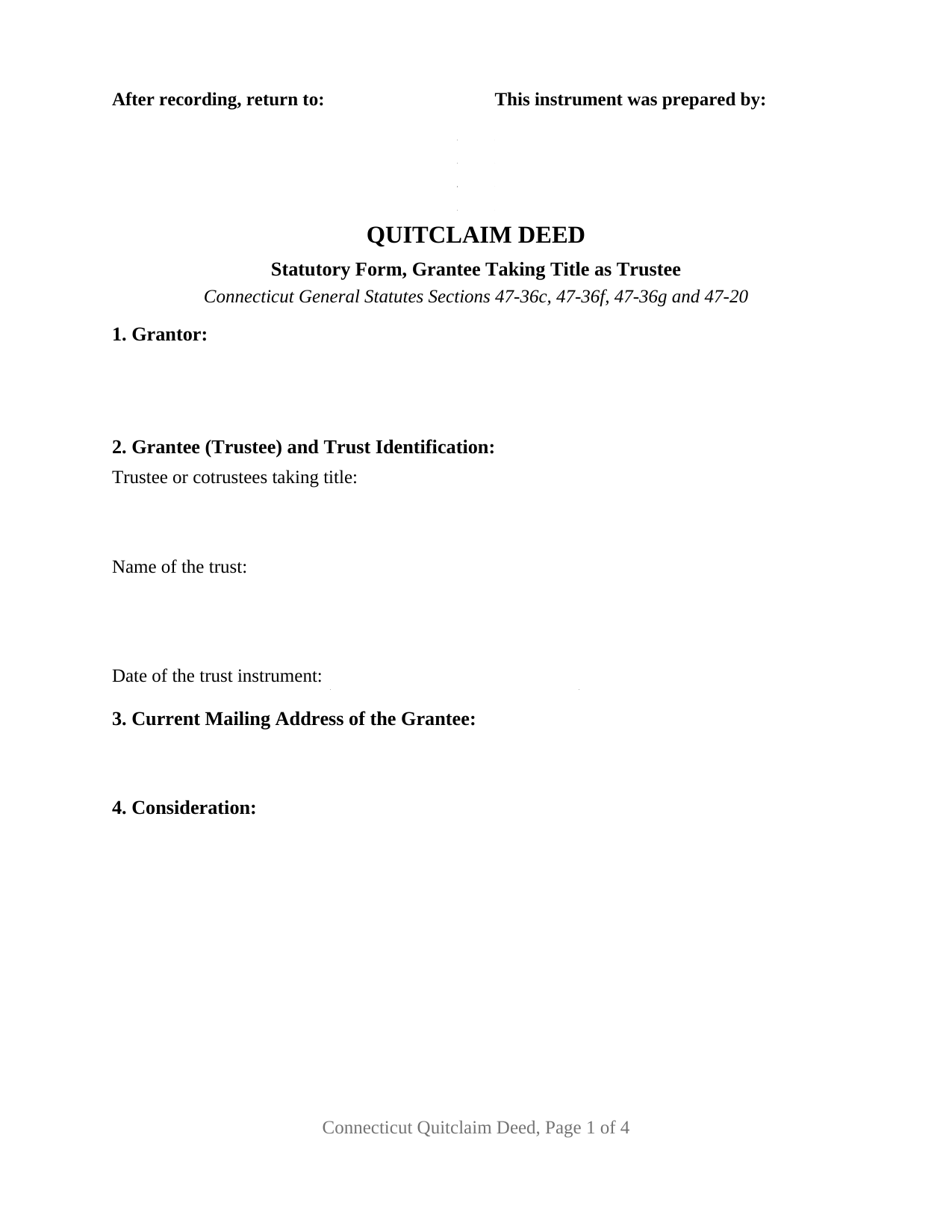
About the Connecticut Quitclaim Deed (Trustee Grantee)
How to Use This Form
- Select your county from the list
- Download the county-specific form
- Fill in the required information
- Have the document notarized if required
- Record with your county recorder's office
What Others Like You Are Saying
"Great last minute forms saved me a critical time when I had no access to my own resources. Five Star…"
"Quick and easy. Would recommend this site to everyone. Deed was sent to the site and recorded at my …"
"Reasonably priced and Extremely easy to use."
"Where have you been my whole life. I will join if I can afford it. Do you have a form for a Private …"
"Fast, effective, and good communication. I have no complaints at all."
4.8/5 from 4,832 reviews. Read all
The receiving side of this Connecticut quitclaim deed is a fiduciary. Section 2 asks for three things in sequence, the trustee's name with the trustee capacity, the name of the trust, and the date of the trust instrument, so the land records show the holder and the trust it is held for. One individual grantor signs; the trustee who takes title signs nothing.
What the word Trustee does after a grantee's name
Connecticut answers that by statute, and the answer surprises people. Under Section 47-20 of the General Statutes, the words as trustee following a grantee's name in a duly executed and recorded instrument, absent other language expressly limiting the grantee's powers, do not affect that grantee's right to sell, mortgage, or otherwise dispose of the real estate, unless a separate duly executed and recorded instrument defines those powers. The same section shields a later buyer or lender from the claim of an undisclosed beneficiary.
That statute is why Section 9 reads as it does. It states that the grantee takes and holds title solely as trustee of the trust named in Section 2, and not individually, and it carries one blank for a separate recorded instrument defining the grantee's powers, with volume and page, where such an instrument exists. Filled in or left at None, that blank is the entry Section 47-20 turns on.
A statutory release with one narrow promise
The conveyance runs on the short quitclaim form at Section 47-36c, and the heading carries the Statutory Form entitlement that Section 7-34a ties to statutory-form fee treatment. Section 47-36f gives a duly executed quitclaim the force of a deed releasing all of the releasor's right, title and interest, except as the deed limits it, without covenants of title. Section 47-36g adds the single promise that travels along, freedom from encumbrances the grantor made or suffered and a warranty against persons claiming by, from or under that grantor. Older matters in the chain, and any recorded mortgage, ride through untouched.
How this form is configured
Eleven numbered sections collect the grantor, the trustee and trust identification, the grantee mailing address Section 47-5(b) asks every deed to state, the town and legal description, the source of title by volume and page, and the encumbrances the property stays subject to. Section 11 performs the conveyance in the statutory words. The execution block carries one grantor signature line, the two subscribing witness blocks Section 47-5(a)(4) calls for, and one acknowledgment certificate tracking the short form at Section 1-34. A parent funding a family trust with a parcel held in one name, and a settlor moving a long-held lot to the trustee named in an existing trust instrument, present the pattern this deed recites. Two record owners conveying together present a different execution than the single signing here, and a trustee conveying property out of a trust reaches the statutory Trustee's Deed wording at Section 47-36s instead.
Indexed under the trust and the trustee
Section 47-36bb matters before drafting. Subsection (a) provides that a transfer of an interest in real property to a trust, rather than to its trustee or trustees, is a valid and enforceable transfer. Subsection (c) directs the town clerk to index an instrument whose grantee is a trust in the name of the trust and in the names of all trustees identified in it. Naming the trust precisely, and every trustee taking title, is what makes the deed findable under either name.
Filing it with the town clerk
Connecticut keeps land records town by town, so this deed is filed with the clerk in the town where the parcel sits. Until it is recorded there, Section 47-10 gives the conveyance no effect against anyone but the grantor and the grantor's heirs. Under the schedule effective July 1, 2025, recording runs seventy dollars for the first page and five dollars per page after it. Conveyance tax that Section 12-497 makes a condition of recording reaches a deed conveying for two thousand dollars or more, while Section 12-498(a)(10) exempts a deed whose consideration is under that figure, the subdivision a nominal transfer into a trust ordinarily reaches. Form OP-236 goes to the clerk either way.
The download holds three items: the deed as a blank fillable PDF, a completed example carried through all eleven sections on a Wilton fact pattern, and a plain-language guide covering the statutes, the notarial mechanics, the co-ownership forms open to grantees, and the recording and tax steps. The materials are informational and are not legal advice.
Important: County-Specific Forms
Our quitclaim deed (trustee grantee) forms are specifically formatted for each of the 8 counties in Connecticut.
After selecting your county, you'll receive forms that meet all local recording requirements, ensuring your documents will be accepted without delays or rejection fees.