Connecticut Quitclaim Deed (LLC Grantor)
County Specific Legal Forms Validated as recently as October 16, 2026 by our Forms Development Team
About the Connecticut Quitclaim Deed (LLC Grantor)
How to Use This Form
- Select your county from the list
- Download the county-specific form
- Fill in the required information
- Have the document notarized if required
- Record with your county recorder's office
What Others Like You Are Saying
"The site was easy to use and find what I needed. The purchase and download were very easy."
"With the guide everything went great"
"Forms do not allow enough space for fields and cutoff. Need to expand the fields to allow for more w…"
"Hard to find, obscure, forms were available. I did not think I was going to be able to find them, le…"
"Great recording service ! Very professional and easy to navigate !!!!"
4.8/5 from 4,828 reviews. Read all
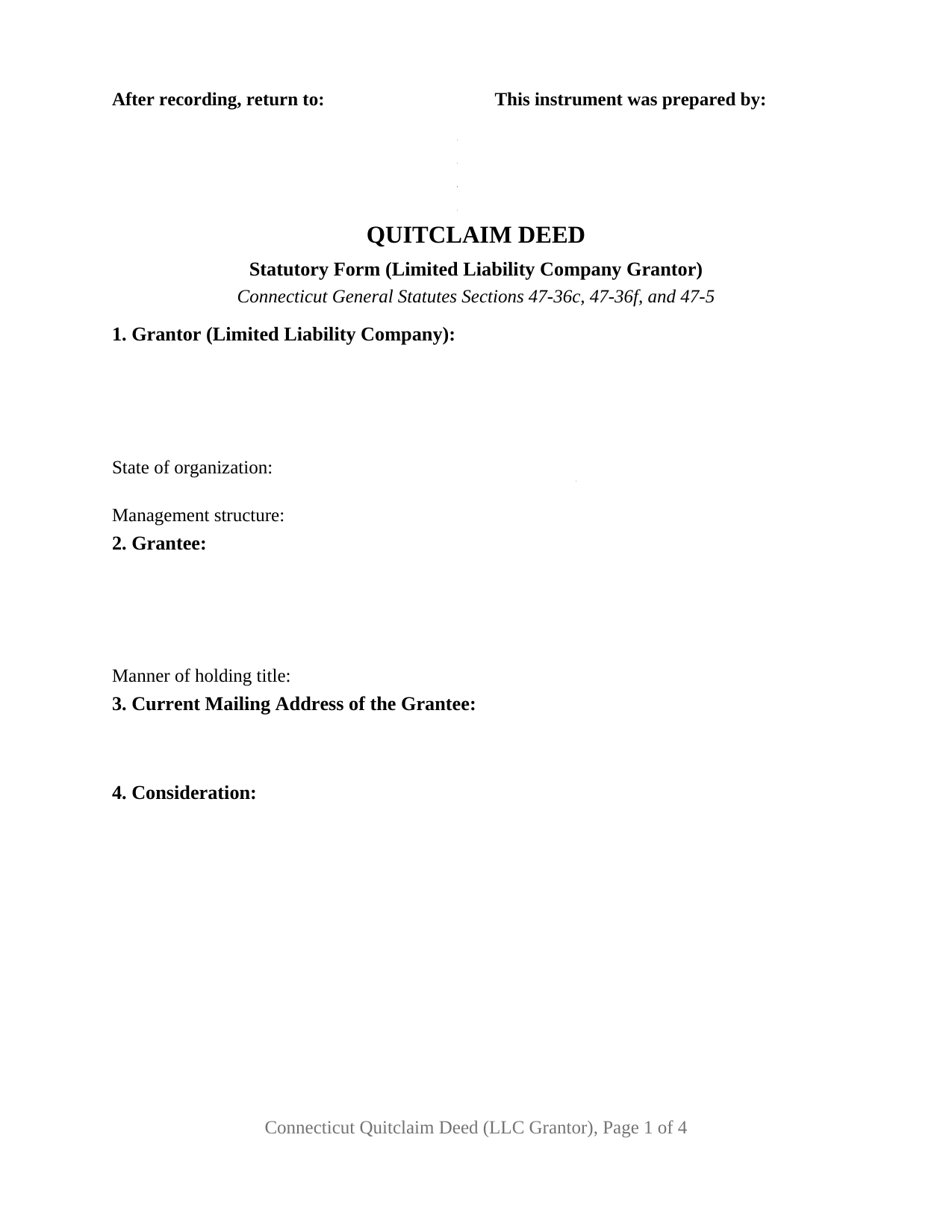
A limited liability company holds the record title here, and exactly one person has to sign for it. This Connecticut quitclaim deed is arranged around that problem: it recites a single company as Grantor, asks for the state of organization and the management structure, and collects one signature, two witness lines, and one certificate naming the signer and the company signed for. Buyers search it as an LLC quit claim deed.
Authority that never reaches the land records
Connecticut keeps a company's signing authority off the record. Under Section 34-324 of the General Statutes a partnership may file a statement of partnership authority naming the partners who may transfer real property held in the partnership name, and a certified copy recorded in the land records is conclusive in favor of a purchaser without knowledge to the contrary. The Connecticut Uniform Limited Liability Company Act prints no counterpart. Authority lives in the operating agreement and in the vote behind the deed, which is why Section 10 takes the signer's capacity and the authorizing action relied on, and why Section 47-36aa treats a recorded instrument's silence about entity authority as an insubstantial defect.
Which person is a duly authorized person
Section 47-5(a)(2)(B) supplies the execution rule: where the grantor is a corporation, limited liability company, or partnership, the conveyance is subscribed by a duly authorized person, and that person acknowledges it. Section 34-255f decides who that is. A company is member-managed unless its operating agreement says otherwise; management then sits with the members, an ordinary-course matter takes a majority in interest, and an act outside the ordinary course of the company's activities and affairs takes two-thirds in interest. In a manager-managed company the decision belongs to the managers.
A narrow covenant, given by a company
The operative words come from the short quitclaim form in Section 47-36c, and the heading prints the Statutory Form label that Section 7-34a prices as a statutory form. What Section 47-36f releases is whatever right, title, and interest the company turns out to hold, carrying no title covenants. Section 47-36g draws the promise tight: the releasor answers for encumbrances it made or suffered and warrants against anyone claiming by, from, or under it, and no further.
How this form is configured
Twelve numbered sections take the company and its address, the state of organization and management structure, the grantee with the current mailing address Section 47-5(b) contemplates, the consideration, the town and legal description, the source of title, the encumbrances and additional provisions, the authority and capacity statement, and the conveyance in the statutory words. The execution block holds one signature line, two subscribing witness lines answering the attestation Section 47-5(a)(4) requires, and one certificate tracking the limited liability company short form at Section 1-62(6), which names the acknowledging member or manager, the company, its management form, and its state of organization. A holding company releasing a surplus rear parcel to the abutting owners, and a company clearing an old access strip out of its name, present the single-company pattern this deed recites. Two companies conveying together present two executions, and an individual owner or a fiduciary recites a capacity this form does not carry.
Two taxes, and only one uses a deed
Chapter 223 taxes the instrument by its consideration, not by who signs it. A release for two thousand dollars or more reaches the clerk with Form OP-236 and the tax Section 12-497 makes a condition of recording; Section 12-498(a)(10) covers consideration under that figure, and the entity exemptions beside it are drafted in corporate vocabulary. Selling the company instead of the land arrives elsewhere: Chapter 228b taxes a transfer of more than half the capital, profits, or beneficial interest of a company at 1.11 per cent of the value of the Connecticut real property behind it, on Form AU-330, with nothing recorded in the town.
Filed with the town, never a county
Recording happens town by town here, so this deed reaches the clerk of the town holding the parcel. An unrecorded conveyance holds nothing against a third party under Section 47-10. The addressee for the clerk's return prints at the top of the first recorded page, where Section 7-24(f) puts it.
Three files arrive: the blank deed as a fillable PDF, a filled-in Coventry example worked through all twelve sections, and a plain-language guide covering the statutes behind each section, the company-authority provisions, the notarial steps, and the co-ownership choices open to the grantees. The materials are informational and are not legal advice.
Important: County-Specific Forms
Our quitclaim deed (llc grantor) forms are specifically formatted for each of the 8 counties in Connecticut.
After selecting your county, you'll receive forms that meet all local recording requirements, ensuring your documents will be accepted without delays or rejection fees.