Connecticut Quitclaim Deed (Married Grantor with Non-Owner Spouse Joinder)
County Specific Legal Forms Validated as recently as October 22, 2026 by our Forms Development Team
About the Connecticut Quitclaim Deed (Married Grantor with Non-Owner Spouse Joinder)
How to Use This Form
- Select your county from the list
- Download the county-specific form
- Fill in the required information
- Have the document notarized if required
- Record with your county recorder's office
What Others Like You Are Saying
"This service is very user-friendly and efficient."
"The requested forms were easy to access. Thank you."
"NO PROBLEMS. I LIKE THE DEED DOCUMENT AND INSTRUCTIONS. MADE IT EASY."
"very helpful"
"I am so thankful for the time saved by using Deeds.com. Not having to run downtown and stand in line…"
4.8/5 from 4,832 reviews. Read all
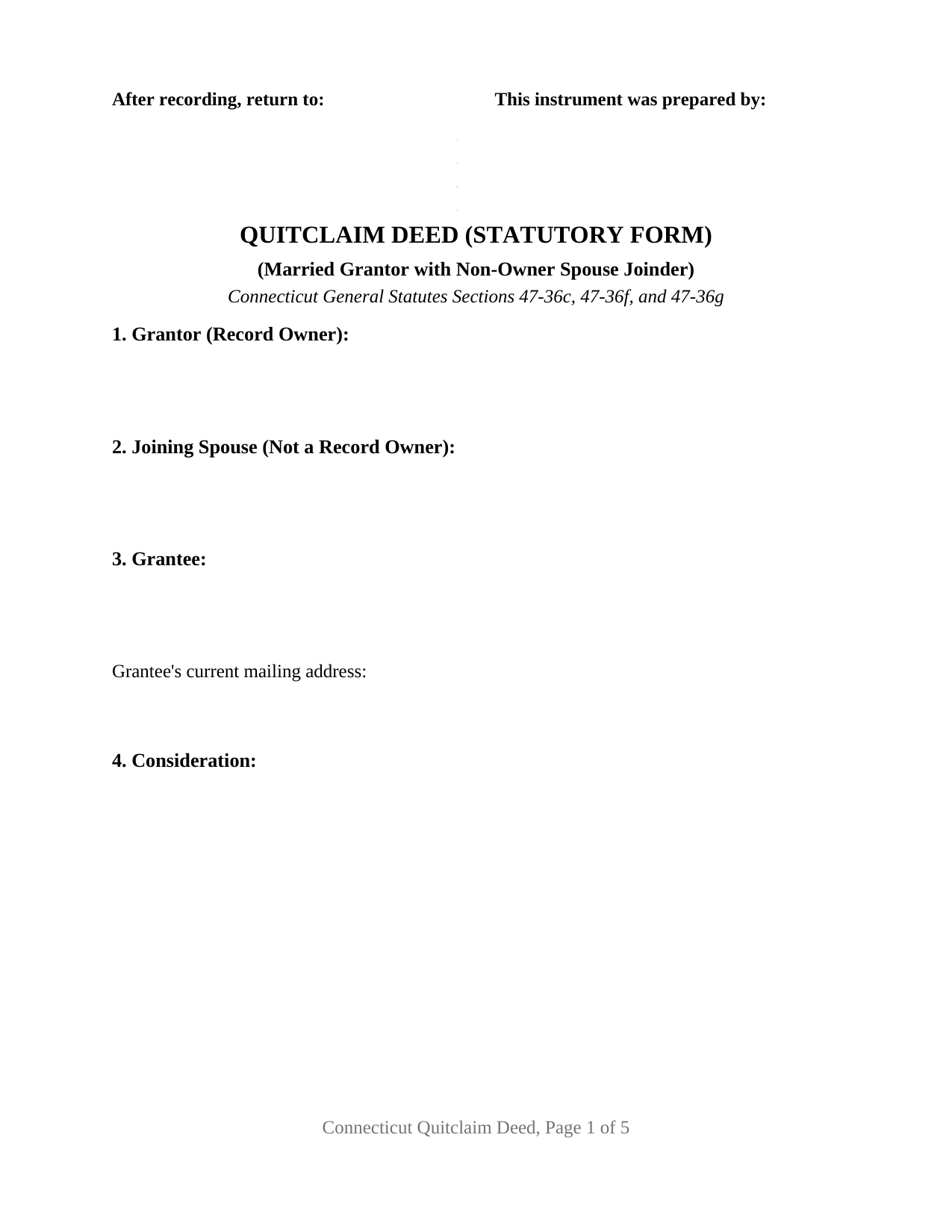
Record title in one married person's name, and a spouse who owns nothing of record but whose signature the closing wants anyway: that is the pattern this Connecticut quitclaim deed is arranged around. The two signers do different legal work, and the deed says so out loud. The record owner conveys the property. The spouse releases whatever claim the spouse may have in it, and nothing else.
One deed, one conveyance, one release
Section 47-36c of the General Statutes supplies the short quitclaim form, and this deed uses its operative words twice over. In the first operative sentence the Grantor, for consideration paid, grants the described property to the Grantee with QUITCLAIM COVENANTS. In the second the Joining Spouse, for consideration paid, grants to the same Grantee, with the same covenants, all right, title, interest, and claim, if any, in that property. Two sentences, two acts, one instrument.
A release by a person who may hold nothing sounds like an empty gesture until Section 47-36f is read: a duly executed quitclaim carries the force and effect of a deed releasing all of the releasor's right, title, and interest, whatever that turns out to be. It disposes of an interest, an arguable interest, or none at all with equal finality. Section 47-36g then caps what the signer promises, reaching encumbrances that signer made or suffered, so a joining spouse takes on nothing about the older chain of title.
Connecticut requires no spousal signature, which is the point
Nothing in Connecticut law makes a non-owner spouse sign a lifetime deed. Dower and curtesy went out for marriages contracted after 1877, the state runs no community property regime for ordinary lifetime acquisitions, Section 47-14a(4) turns tenancy by the entirety wording into an ordinary statutory joint tenancy, and the homestead protection in Section 52-352b is an exemption from judgment enforcement rather than an interest released by signature. Record title and the execution rules of Section 47-5 are what govern.
So the joinder here is not statutory consent. It is a recorded answer to a question a title examiner would otherwise leave open, and it stops there. The surviving spouse's statutory share under Section 45a-436 is measured against property passing under a will, and subsection (f) points to a written contract made before or after marriage as the way that share gets displaced, with the Connecticut Premarital Agreement Act supplying the framework at Sections 46b-36a through 46b-36j. Releasing interests in one parcel is a different document doing a different job, and the guide draws that line carefully.
How this form is configured
Section 1 names the record owner as Grantor. Section 2 names the spouse and labels that party as not a record owner. Section 9 recites the marriage and the single purpose of the joinder in the operative text, so the arrangement is visible on the face of the deed rather than inferred from two similar surnames. Section 11 carries a signature block for each signer, the two subscribing witness blocks Section 47-5(a)(4) calls for, and a certificate for each signer, leaving room for the owner and the spouse to acknowledge on different dates or before different officers. A house acquired by one spouse before the marriage and sold years later, and a rental standing in one name that moves out of it, present the configuration this deed recites. Two people who both hold record title present a different signing pattern, and an entity or fiduciary grantor recites authority in place of the marital recital used here.
What the town clerk sees
The heading carries the Statutory Form entitlement that Section 7-34a ties to statutory-form fee treatment, printed-name blanks sit under every signature because that same section adds a dollar for a signature without one, and a blank for the grantee's current mailing address answers Section 47-5(b). The return addressee sits at the top of the first recorded page under Section 7-24(f). Recording happens in the town where the land lies, since Section 47-10 is what gives a conveyance effect beyond the grantor, and a sale for two thousand dollars or more reaches the clerk with Form OP-236 and the conveyance tax that Section 12-497 makes a condition of recording.
Included in the download: the deed as a fillable PDF, a filled-in example built on a Simsbury fact pattern, and a guide working through all eleven sections, the notarial requirements, the marital-rights statutes behind the joinder, and the recording and tax steps. The materials are informational and are not legal advice.
Important: County-Specific Forms
Our quitclaim deed (married grantor with non-owner spouse joinder) forms are specifically formatted for each of the 8 counties in Connecticut.
After selecting your county, you'll receive forms that meet all local recording requirements, ensuring your documents will be accepted without delays or rejection fees.