Connecticut Quitclaim Deed (Two Grantors)
County Specific Legal Forms Validated as recently as September 28, 2026 by our Forms Development Team
About the Connecticut Quitclaim Deed (Two Grantors)
How to Use This Form
- Select your county from the list
- Download the county-specific form
- Fill in the required information
- Have the document notarized if required
- Record with your county recorder's office
What Others Like You Are Saying
"Great service. Thank you"
"My first submission was super quick and easy. I had trouble with the second submission, as I was not…"
"So very easy to use and we're so glad we could do everything from our home office."
"Very easy to understand instructions. I was able to order, download and print."
"simple to follow and easy to use. Thanks"
4.8/5 from 4,828 reviews. Read all
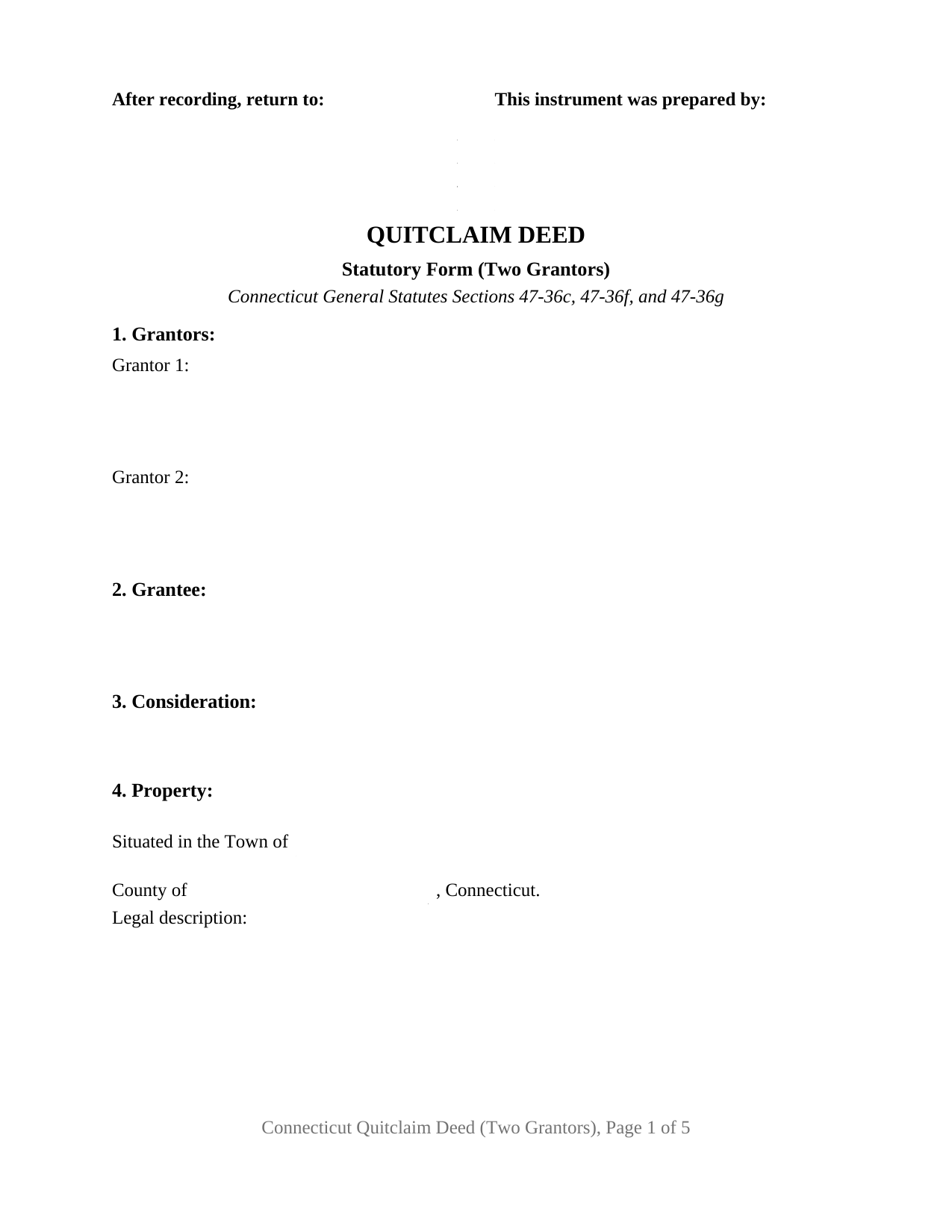
Two record owners can release their interests in the same Connecticut property through a single instrument, and this quitclaim deed is arranged for exactly that pattern. It recites two grantors and gives each one a complete execution of their own: a separately dated signature line, two witness lines for that signature, and an acknowledgment certificate naming that grantor alone.
One deed, two complete executions
Connecticut deed execution runs through Section 47-5 of the General Statutes: a conveyance is written, subscribed by the grantor, acknowledged, and attested by two witnesses. When two owners convey together, the signings do not always happen in the same room, so this form treats each grantor's execution as its own unit. The first grantor can sign before witnesses and a notary in one town while the second signs days later somewhere else entirely, and each certificate records its own date and venue; in the completed example included with the download, one grantor acknowledges in Hartford County and the other in New Haven County, two days apart.
Printed-name lines sit beneath every signature on the document, the grantors', the witnesses', and the notaries' alike, because Section 7-34a adds a one dollar recording fee for any signature without a typed, printed, or stamped name under it. Each acknowledgment certificate tracks the individual short form of Section 1-34, through the commission expiration line Section 1-35 calls for.
Two releasors under the statutory form
The deed performs its conveyance with the operative words of the Section 47-36c statutory quitclaim form, 'for consideration paid, grant to .... with QUITCLAIM COVENANTS,' and it carries the entitlement Statutory Form in its heading, the label Section 7-34a ties to statutory-form recording fee treatment. Under Section 47-36f a duly executed quitclaim deed passes all of the releasors' right, title, and interest except as the deed limits it, and under Section 47-36g the quitclaim covenant reaches only encumbrances made or suffered by the releasor, so each grantor answers for that grantor's own acts and not for older defects in the chain of title.
Two siblings who inherited a house together and are conveying it to one buyer, former co-investors closing out a shared parcel, and a married couple moving jointly held title out of their two names present the two-grantor pattern this deed recites. A quit claim from a single owner, an LLC, a trustee, or an estate fiduciary follows a different execution pattern than the two individual signings here. On the receiving side, the grantee entry accepts one or more recipients, and the guide describes each co-ownership form Connecticut recognizes for them, from the tenancy in common the statutes supply as the default through the survivorship joint tenancy that arises under Section 47-14a when the words 'as joint tenants' follow the names.
Recording town by town, with the tax return alongside
Connecticut land records live with the town clerks, so the deed goes to record in the town where the property lies, and Section 47-10 leaves an unrecorded deed good against only the grantors and their heirs. The return address block sits at the top of the first page, the position Section 7-24(f) assigns it, inside margins that clear the statute's three-quarter inch minimum. A release for consideration of two thousand dollars or more generally travels with Form OP-236 and the state and municipal conveyance tax, which Section 12-497 makes a prerequisite to recording a taxable deed, and a deed that omits the grantee's current mailing address picks up a five dollar surcharge under Section 7-34a.
The download delivers this two-grantor deed as a fillable PDF, a completed example carried through a realistic Connecticut fact pattern from the first grantor's entry to the second notary certificate, and a plain-language guide covering every numbered section, the witness and acknowledgment mechanics, the co-ownership forms available to grantees, and the recording and conveyance tax steps. The materials are informational and are not legal advice.
Important: County-Specific Forms
Our quitclaim deed (two grantors) forms are specifically formatted for each of the 8 counties in Connecticut.
After selecting your county, you'll receive forms that meet all local recording requirements, ensuring your documents will be accepted without delays or rejection fees.