Connecticut Quitclaim Deed (Reserving Life Estate)
County Specific Legal Forms Validated as recently as October 14, 2026 by our Forms Development Team
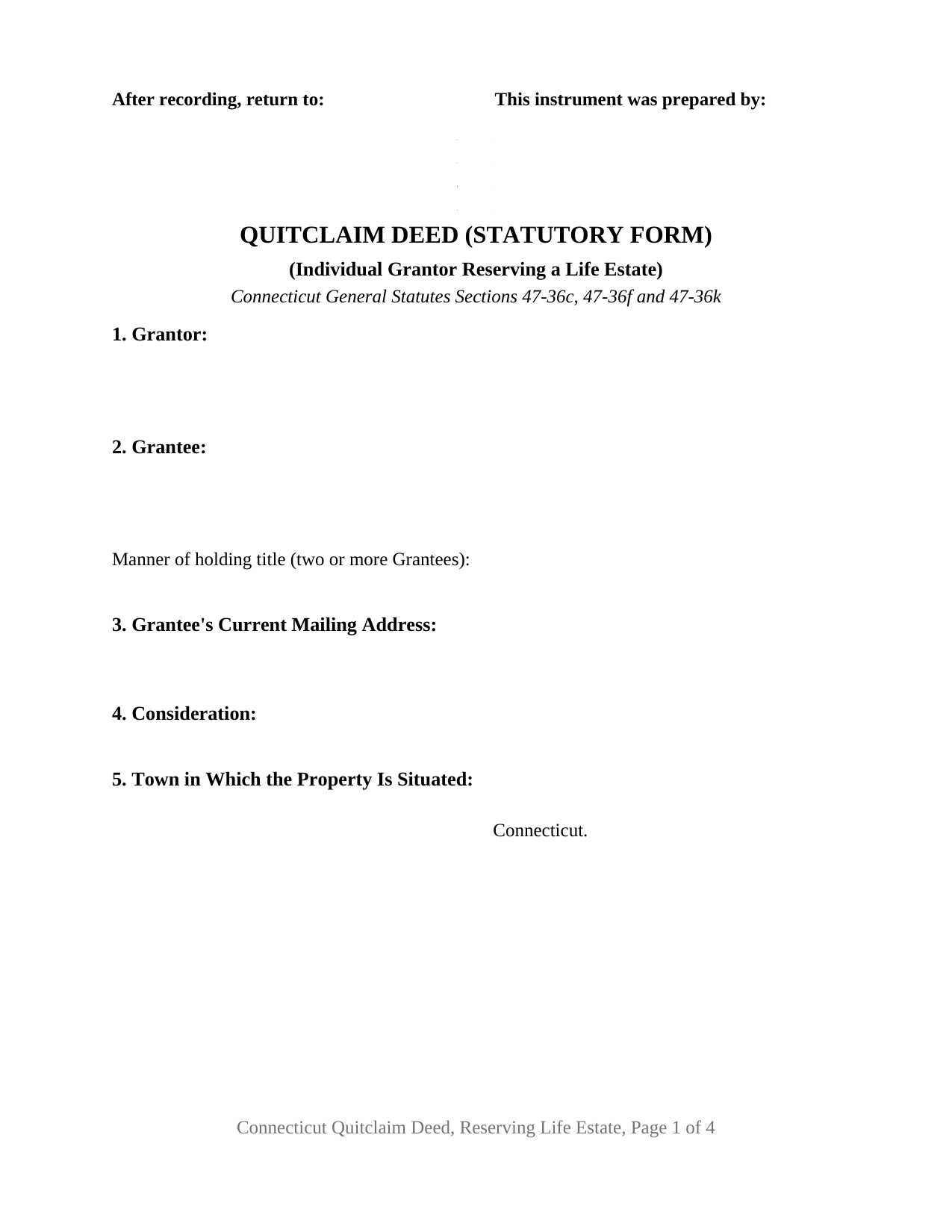
About the Connecticut Quitclaim Deed (Reserving Life Estate)
How to Use This Form
- Select your county from the list
- Download the county-specific form
- Fill in the required information
- Have the document notarized if required
- Record with your county recorder's office
What Others Like You Are Saying
"Excellent service and site. Easy to use. Finding the required forms was easy."
"I truly appreciate the service that you have for the customers. This very convenient and easy to fol…"
"Easy to use."
"Thanks for the quick response. That really helps when you're under a time deadline."
"I found the site to be easy to use and the information very helpful."
4.8/5 from 4,836 reviews. Read all
Hold something back in a Connecticut deed and the words describing it decide how much stays behind. Section 47-36k of the General Statutes provides that a conveyance or reservation of real property reserves an estate in fee simple unless otherwise expressly limited in the deed or reservation, so a reservation that never states its own term reserves everything. This deed is built on that sentence: one individual owner conveys a parcel of Connecticut land and reserves a life estate in printed words carrying a stated term.
The words that keep a reservation from swallowing the grant
Section 47-36b provides that a conveyance under the deed forms chapter passes the grantor's whole interest absolutely, unless otherwise expressly limited in estate, condition, use or trust, and where so limited, conveys the property for the estate declared. Section 47-36f leaves the quitclaim the same room, reaching all the releasor's right, title and interest except as otherwise limited therein.
Section 9 of this form states that limit instead of assuming it: the reservation runs for the term of the grantor's natural life, the estate conveyed is the remainder interest, and the remainder becomes a present possessory estate when the life estate ends, and Section 11 carries it again inside the operative sentence.
What a life use deed moves now and what it keeps
Buyers search this arrangement as a life estate deed or a life use deed. The remainder interest passes to the grantee once the deed is delivered and recorded, while possession and use stay with the grantor for life. Nothing further is signed at the end: the Connecticut Office of Legislative Research, in report 2013-R-0312, states that when the life tenant dies full ownership passes to the remainderman without probate, and that the life tenant bears ownership costs during the life tenancy.
The retained estate carries duties. Section 52-563 makes the holder of a life estate created by the act of the parties liable to the party injured for waste beyond what a life tenant created by operation of law may commit, unless the instrument creating the interest expressly authorized the acts complained of. That exception is why Section 10 accepts additional provisions, where repair, insurance, and tax arrangements between the two sides appear.
A release, and one narrow promise
The conveyance rides on the short form of Section 47-36c, and the heading carries the Statutory Form entitlement. Section 47-36g supplies the only promise traveling with it: the releasor, and anyone claiming under the releasor, will not later claim any right or title to the premises, except as set forth in the deed. Title covenants are absent under Section 47-36f, so a recorded mortgage or easement continues untouched.
How this form is configured
Twelve numbered sections take the grantor, the grantee with a blank for the manner of holding title where two or more take, the grantee mailing address Section 47-5(b) calls for, the consideration, the town, the legal description, the source of title, the encumbrances, the reservation, and the conveyance in the statutory words. Execution runs to one grantor signature line, two subscribing witness lines, and one certificate tracking the individual short form of Section 1-34. An owner deeding a longtime home to two adult children while keeping the right to live there for life, and an owner conveying a two family house to a nephew while holding a life use, present the pattern this deed recites. Two record owners produce two executions, a reservation to someone other than the grantor states a different limitation, and an entity or fiduciary grantor recites an authority this form does not carry.
What the town clerk collects
Connecticut keeps land records in the towns, so the deed reaches the clerk of the town where the parcel sits; under Section 47-10 it holds nothing against a third party until it is recorded there. The conveyance tax is measured by consideration, not by the value of the interest conveyed, so Section 12-498(a)(10), reaching a deed whose consideration is under two thousand dollars, is where a nominal family transfer lands. Form OP-236 reaches the clerk either way, and Section 12-497 holds a taxable deed off the record until that return is filed and the tax is paid.
The download holds three items: the deed as a blank fillable PDF, a completed example worked through all twelve sections on a Guilford fact pattern, and a plain-language guide covering the statutes behind each section, the reservation and waste provisions, and the recording steps. The materials are informational and are not legal advice.
Important: County-Specific Forms
Our quitclaim deed (reserving life estate) forms are specifically formatted for each of the 8 counties in Connecticut.
After selecting your county, you'll receive forms that meet all local recording requirements, ensuring your documents will be accepted without delays or rejection fees.