Connecticut Quitclaim Deed (Trustee Grantor)
County Specific Legal Forms Validated as recently as September 21, 2026 by our Forms Development Team
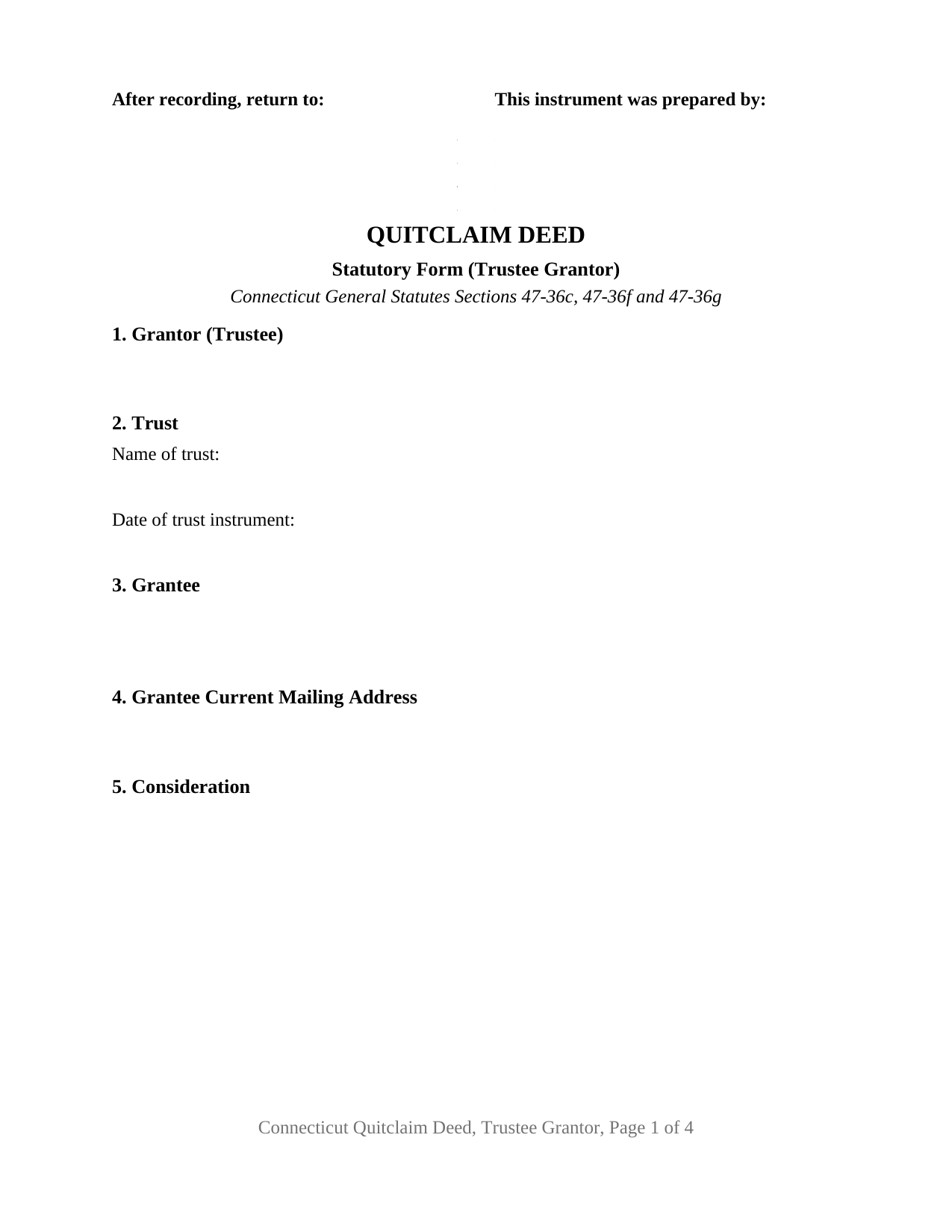
About the Connecticut Quitclaim Deed (Trustee Grantor)
How to Use This Form
- Select your county from the list
- Download the county-specific form
- Fill in the required information
- Have the document notarized if required
- Record with your county recorder's office
What Others Like You Are Saying
"I needed to add my partner to my warranty deed and deeds.com made it easy to understand what form I …"
"So far excellent service - I made a boo boo on the deed - no problem they made the change before the…"
"What a great website. It does Pasco County PROUD !!"
"The form I needed was perfect!"
"Easy to use and clear instructions."
4.8/5 from 4,830 reviews. Read all
Connecticut prints two covenant sets for a trustee conveying land out of a trust, and this deed carries the narrow one. It takes a single trustee as Grantor, signing in a fiduciary capacity and not individually, and the only promise traveling with the conveyance is the quitclaim covenant, which reaches the signer's own acts and stops there. Nothing in it states that the trustee is duly qualified or holds power to sell.
The covenant a trustee does not give here
Chapter 821a prints both instruments together. Section 47-36c sets out a form entitled Trustee's Deed, and Section 47-36s loads it with three covenants: that the trustee is duly qualified to act, that the trustee holds full power and authority to bargain and sell the described premises, and that the trustee and the trustee's successors will warrant and defend against claims of anyone claiming by, from or under the trustee. Public Act 03-75 added it. That instrument is prepared and recorded on its own and is not part of this package.
The quitclaim entry in the same section travels lighter. Section 47-36f gives a duly executed quitclaim the force of a deed releasing all the releasor's right, title and interest, except as the deed limits it, and without covenants of title. Section 47-36g fixes the single promise riding along: freedom from encumbrances the releasor made or suffered, plus a warranty against persons claiming by, from or under that releasor. A fiduciary releasing on those terms hands over what the trust holds and answers for nothing before it.
Capacity on the face, authority by volume and page
Section 10 puts the fiduciary posture on the record. Its printed sentences state that the Grantor signs solely as trustee of the trust named in Section 2 and not individually, and that the conveyance sits within the authority the trust instrument and the law supply. A blank beneath takes the volume and page of any separate recorded document carrying that authority, which answers a peculiarity: under Section 47-20 the word trustee following a grantee's name, absent other limiting language, leaves that grantee free to sell or mortgage as though the word were not there, unless a separate recorded instrument defines the powers. Section 45a-499zzz of the Connecticut Uniform Trust Code supplies what usually fills that blank, a certification of trust giving the trust's date, the settlor, the acting trustee, the powers, and the manner of taking title, without the dispositive terms.
How this form is configured
Eleven numbered sections take the trustee, the trust name and date, the grantee with the current mailing address Section 47-5(b) asks for, the consideration, the town and legal description, the source of title by volume and page, the encumbrances, additional provisions, the capacity statement, and the conveyance in the statutory operative words. The execution block holds one signature line for the trustee, two subscribing witness lines, and one certificate tracking the Section 1-34 form for an acknowledgment taken in a representative capacity, closing on the phrase in the capacity therein stated and for the purposes therein contained. A shore parcel distributed to two adult children, and a family trust releasing a rental it no longer manages, present the single-trustee pattern this deed recites. Cotrustees, a corporate trustee acting through an officer, and a testamentary trustee under a will each present a different execution.
Filing it in the town
Land instruments record town by town here, not by county, so the deed reaches the clerk of the town where the parcel sits. Section 47-10 leaves an unrecorded conveyance good against nobody but the grantor and the grantor's heirs. Section 47-36bb has that clerk index an instrument naming a trust under the trust name and under every trustee identified in it. On tax, no subdivision of Section 12-498(a) exempts a conveyance because a trustee signed it; subdivision (10) reaches a deed whose consideration is under two thousand dollars, where a nominal distribution ordinarily lands, and Section 12-497 holds a taxable quit claim deed off the record until Form OP-236 reaches the clerk and the tax is paid.
Three items arrive in the download. The blank deed comes as a fillable PDF. The completed example works an Old Lyme distribution through every numbered section. The guide walks the statutes behind the form, the trustee-authority provisions of the Connecticut Uniform Trust Code, the witness and notarial requirements, the ways grantees may take title together, and what the town clerk collects. The materials are informational and are not legal advice.
Important: County-Specific Forms
Our quitclaim deed (trustee grantor) forms are specifically formatted for each of the 8 counties in Connecticut.
After selecting your county, you'll receive forms that meet all local recording requirements, ensuring your documents will be accepted without delays or rejection fees.