Connecticut Quitclaim Deed (Individual Grantor by Attorney-in-Fact)
County Specific Legal Forms Validated as recently as August 21, 2026 by our Forms Development Team
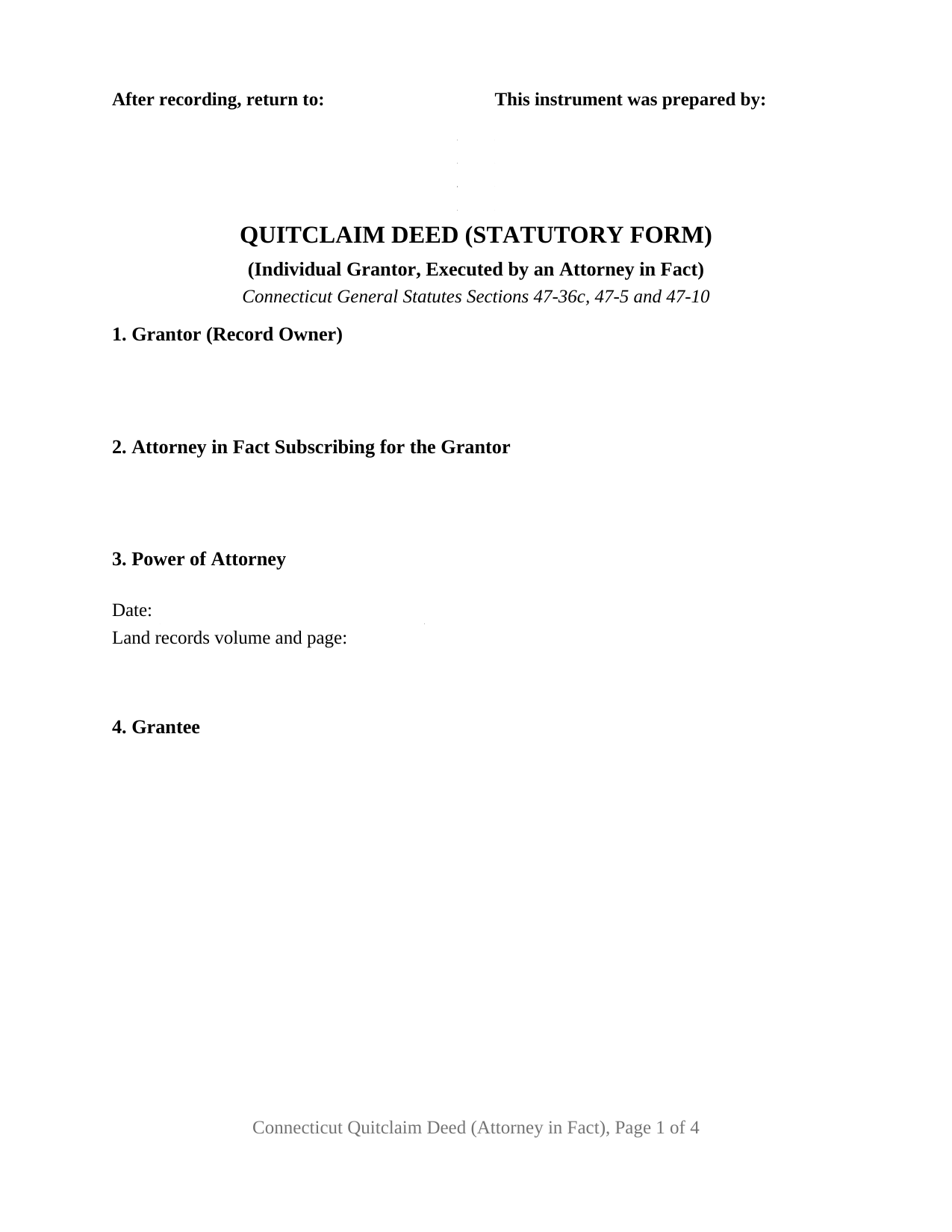
About the Connecticut Quitclaim Deed (Individual Grantor by Attorney-in-Fact)
How to Use This Form
- Select your county from the list
- Download the county-specific form
- Fill in the required information
- Have the document notarized if required
- Record with your county recorder's office
What Others Like You Are Saying
"Fast, reliable, up to date service that I've used several times in the past and will continue to use…"
"Excellent service and customer support. Thank you for your help and time."
"Thanks, the documents were easy to follow and complete."
"I found there were a large number of documents available to download. The file naming on the PDFs co…"
"Very helpful and efficient!"
4.8/5 from 4,830 reviews. Read all
The owner whose name stands on this Connecticut quitclaim deed never signs it. Record title belongs to one individual, and the deed is subscribed in that owner's name by an attorney in fact under a power of attorney, so a single signature line, two witness lines, and one acknowledgment certificate carry the whole execution. Buyers search this configuration as a power of attorney deed or a POA quit claim deed.
The signature line Connecticut prints for an agent
Section 47-5 of the General Statutes prints that signature's shape. Subsection (c) deems execution of a deed pursuant to a power of attorney sufficient if done in substantially a printed form: the name of the owner of record, then By with the signature of the agent and the letters L.S., then the name of the signatory, then the words His or Her Agent. Section 13 is laid out that way, and subsection (d) precludes no other lawful form of execution.
Two instruments, one trip to the town clerk
A deed signed by an agent arrives with company. Section 47-10 provides that when a conveyance is executed by a power of attorney, the power of attorney is recorded with the deed unless it has already been recorded in the records of the town in which the land lies and reference to the power of attorney is made in the deed. Section 3 takes the date of the power of attorney and its volume and page, the deed's reference for that purpose. The power of attorney is a separate instrument, prepared and recorded on its own, and is not included in this package.
Where the agent's authority comes from
Chapter 15c answers that, and one of its lists rewards reading. Section 1-351c, the real property subject of the Connecticut Uniform Power of Attorney Act, authorizes an agent to sell, exchange, convey with or without covenants, quitclaim, release, surrender, encumber, and partition, so the act names this deed's operative act by its own word. One boundary runs the other way: under Section 1-351(b), unless the power of attorney otherwise provides, an agent may not exercise authority to create an interest in the principal's property in the agent or a dependent of the agent.
A narrow covenant, given through an agent
Section 47-36c supplies the operative words, and the heading's Statutory Form entitlement draws statutory form fee treatment under Section 7-34a. Section 47-36f passes whatever the record owner actually holds, with no covenants of title attached, and Section 47-36g confines the promise traveling with it to encumbrances the releasor made or suffered.
How this form is configured
Thirteen numbered sections take the record owner and the attorney in fact, the power of attorney by date and volume and page, the grantee and the mailing address Section 47-5(b) contemplates, the price, the town, the legal description, the chain by which title arrived, what the parcel stays subject to, and the conveyance in the statutory words. Execution runs to one signature line, two subscribing witness lines answering Section 47-5(a)(4), and one certificate tracking the Section 1-62 short form for an individual acting as principal by an attorney in fact. An owner who moved to assisted living while an adult child holds the power of attorney and closes the sale of the family home, and an owner living overseas who leaves the signing to an agent, present the pattern this deed recites. A record owner signing personally, coagents whose authority is not exercisable independently, an entity, and a fiduciary each present a capacity this form does not carry.
Recorded in the town, never a county
Connecticut records land instruments town by town, so this deed goes to the clerk for the town where the parcel sits; until it is recorded there, Section 47-10 gives it no force against anyone but the grantor and the grantor's heirs. Fees run seventy dollars for the first recorded page and five dollars per page after it, under the schedule effective July 1, 2025. A conveyance priced at two thousand dollars or more travels with Form OP-236, and Section 12-497 keeps a taxable deed off the record until the return is filed and the tax paid.
Three items arrive in the download: the deed as a blank fillable PDF, a completed example worked through all thirteen sections on a Cheshire fact pattern, and a plain-language guide covering the statutes, the authority provisions, and the notarial steps. The materials are informational and are not legal advice.
Important: County-Specific Forms
Our quitclaim deed (individual grantor by attorney-in-fact) forms are specifically formatted for each of the 8 counties in Connecticut.
After selecting your county, you'll receive forms that meet all local recording requirements, ensuring your documents will be accepted without delays or rejection fees.