Louisiana Extract of Trust
Parish Specific Legal Forms Validated as recently as October 2, 2026 by our Forms Development Team
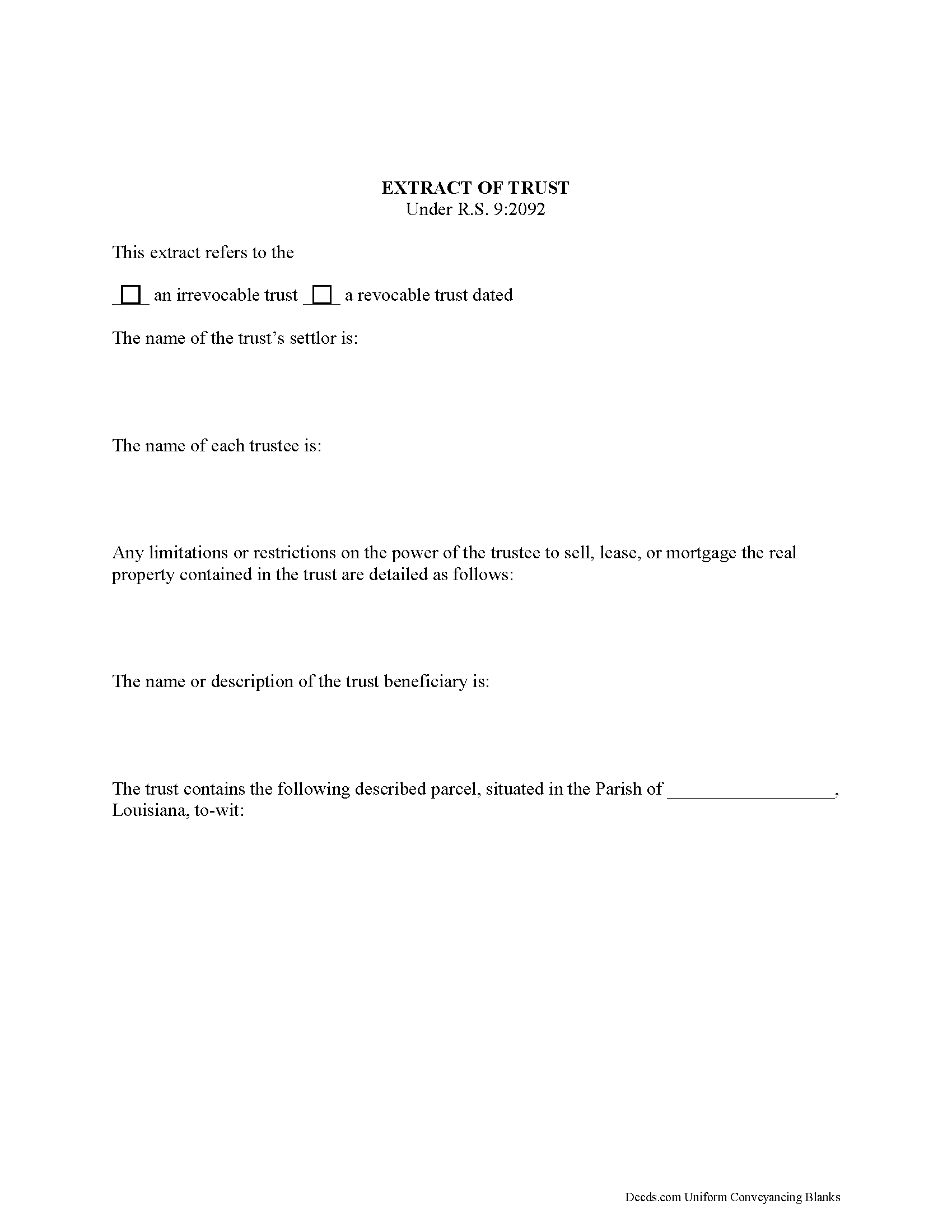
About the Louisiana Extract of Trust
How to Use This Form
- Select your parish from the list
- Download the parish-specific form
- Fill in the required information
- Have the document notarized if required
- Record with your parish recorder's office
What Others Like You Are Saying
"Form is easy to complete but has a crowded look upon printing. I would put more returns between para…"
"I LOVE that very concise directions and a sample completed deed were included. They were incredibly …"
"It's all good!!!!"
"It looks like it can be a huge time saver. I did a deed and appeared very professional."
"Deed.com was so easy to use to file my Quit Claim deed. They instructed me on how to send them my do…"
4.8/5 from 4,825 reviews. Read all
Extract of Trust: A Lagniappe that Will Set You up Right
A lagniappe is a little something extra. It might be the unexpected addition to make a recipe a little more exciting -- like a bit of chicory in an average cup of coffee. For a Louisiana trust containing titled property, an extract of trust is the lagniappe that brings the important facts into focus.
Under R.S. 9:2092(A) of the Louisiana Trust Code, "If at any time the trust property of either an inter vivos trust or a testamentary trust includes immovable [real property] or other property the title to which must be recorded in order to affect third parties, a trustee shall file . . . an extract of trust . . . for record in each parish in which the property is located."
The extract of trust, as the name suggests, is an abstract of the information about the trust. It is executed by either the trust's settlor or the trustee. The settlor is the person who created the trust (9:1761), and the trustee is any "person to whom title to the trust property is transferred to be administered by him as a fiduciary" and who is designated by the trust instrument (9:1781).
The document requires the name and date of the trust and a statement as to whether the trust is revocable or irrevocable. It contains the name of each settlor and trustee, as well as the name of each beneficiary or a description of the beneficiary. A beneficiary is "a person for whose benefit the trust is created and may be a natural person, corporation, partnership, or other legal entity having the capacity to receive property," and is designated in the trust instrument (R.S. 9:1801, 9:1802).
An extract also requires a legal description of the real property contained by the trust, as well as the limitations or restrictions on the trustee's power to sell, lease, or mortgage real property. Pursuant to R.S. 9:2092(B)(2), "any limitation or restriction in the trust instrument on the power of the trustee to sell, lease, or mortgage immovable property shall not be effective against third persons unless it is noted or recited in the extract of trust."
Consult a lawyer, as Louisiana trust law can quickly become complicated, and each situation is unique. (Louisiana EOT Package includes form, guidelines, and completed example)
Important: Parish-Specific Forms
Our extract of trust forms are specifically formatted for each of the 64 parishes in Louisiana.
After selecting your parish, you'll receive forms that meet all local recording requirements, ensuring your documents will be accepted without delays or rejection fees.