West Virginia Quitclaim Deed
County Specific Legal Forms Validated as recently as September 3, 2026 by our Forms Development Team
About the West Virginia Quitclaim Deed
How to Use This Form
- Select your county from the list on the left
- Download the county-specific form
- Fill in the required information
- Have the document notarized if required
- Record with your county recorder's office
What Others Like You Are Saying
"Very good so far -- downloading all the forms. So many forms -- I had no idea ...."
"10 STARS! Deeds.com never fails! Thank you so much!"
"To call an affidavit of minor correction a Correction Deed in your descriptions is incorrect. They a…"
"Thank you for all your assistance and patience in doing the deed. I can honestly say that DEEDs.com …"
"Thank you! I received my forms promptly and they are easy to follow along for filling out. The examp…"
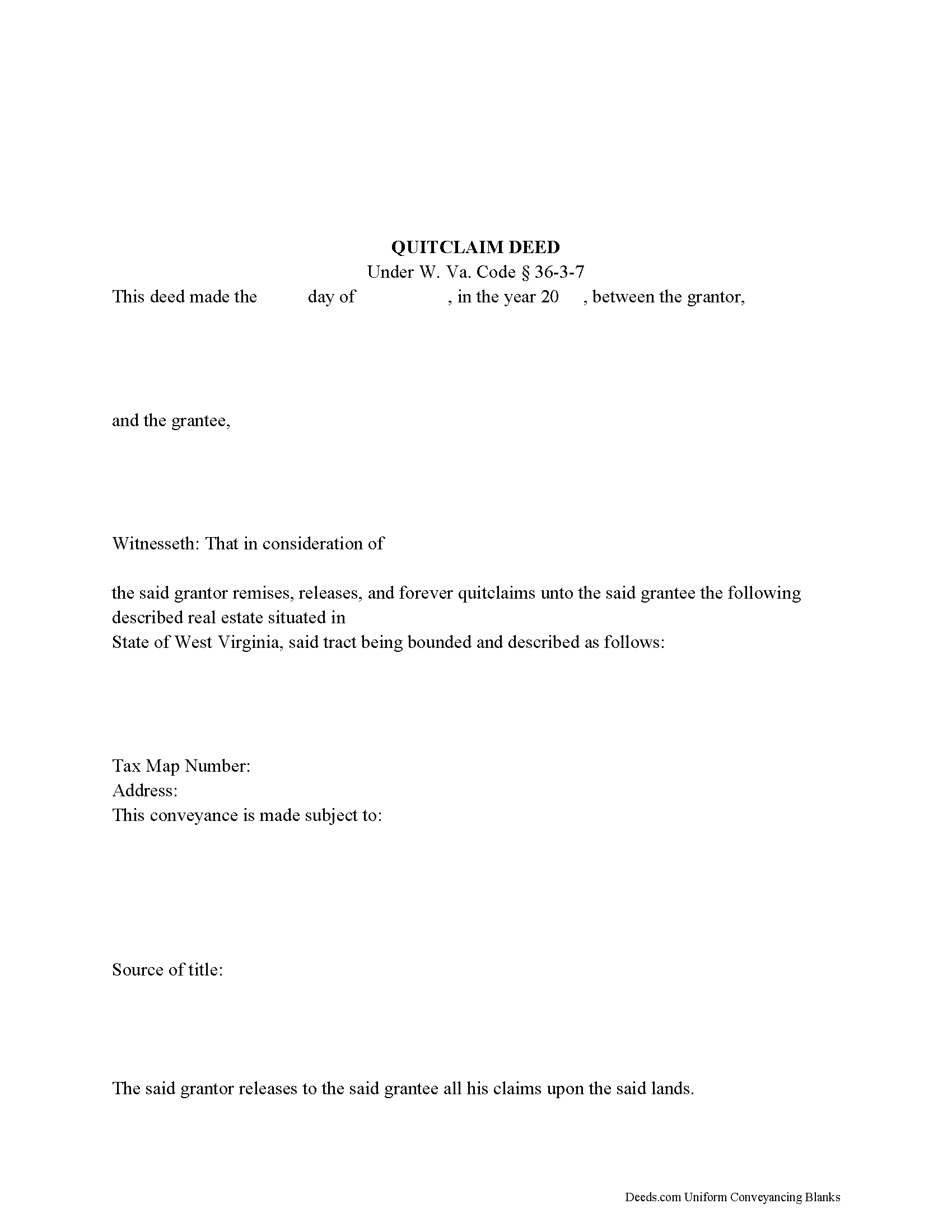
West Virginia keeps no catalog of deed types. W. Va. Code Section 36-3-4 abolished the old distinctions among deeds of grant, of bargain and sale, and of lease and release, and directs that a properly executed and delivered instrument take effect according to the intent it manifests, statutory form or not. A quit claim deed here is a drafting result rather than a category the code hands out: release words in, covenant words out. This West Virginia quitclaim deed is that drafting, set up for one or two individual owners.
The words that do the work
Section 36-3-7 is the engine. Where a deed says that the grantor releases to the grantee all claims upon the lands, or uses words of like import, the code reads it as though the grantor had remised, released, and forever quitclaimed every right, title, and interest, at law and in equity, in the land described. Section 9 of the form prints that sentence and adds nothing. Two neighbors settle the usual worries: Section 36-3-1 makes a seal unnecessary, and Section 36-3-6 keeps a deed good though consideration is neither paid nor recited.
What a release leaves standing
Absent language is the point. Not one covenant word from Chapter 36, Article 4 appears on the page, so the grantor promises nothing about ownership, nothing about encumbrances, and nothing about defending the title later. A recorded deed of trust, a judgment lien, a mineral reservation, and an easement pass through untouched. Recording changes priority rather than substance: under Section 40-1-9 a deed is void as to creditors and later purchasers for value without notice until duly recorded where the land lies.
The signature the record can demand from the other side
West Virginia added an unusual recording condition in July 2025. Section 39-1-2(b)(2) closes the record to a quitclaim deed made without consideration, and to any deed passing property worth $100 or less that carries no excise tax, unless the grantee signs the instrument and acknowledges it, or two witnesses prove it as to the grantee before the clerk. Named exceptions cover a transfer on death deed and close family transfers under $2,000 or without consideration. The consequence is a void deed passing no interest, so the form treats the rule as architecture: Section 11 carries grantee signature lines with certificates of their own, completed where the subsection reaches the transfer and blank where it does not.
One or two names on either side
The form recites natural persons signing in their own capacity, in any of four counts: one grantor to one grantee, one to two, two to one, or two to two. The party blocks are free-form and print no status, capacity, or vesting words, so the grantors' own description of themselves and the grantees' chosen designation go in as written, and the guide rather than the instrument teaches what those blanks may carry. Section 10 draws two grantor blocks, headed GRANTOR and SECOND GRANTOR (if applicable), each with a certificate of its own, the second left blank when a single owner conveys. What the blocks are not set up to recite is an entity signing through an officer or manager, a fiduciary signing in a representative capacity, an agent signing under a recorded power of attorney, or three or more owners on either side. Co-ownership matters here: Section 36-1-19 makes a deceased joint tenant's share pass as a tenant in common's would, leaving survivorship to arise only where the grantee designation manifests it under Section 36-1-20.
Two tax papers, one on the deed and one beside it
Section 12 prints the declaration of consideration or value that Section 11-22-6 places at the end of a taxable instrument, with lines for consideration paid, true and actual value, and the ground of any exemption. The clerk reads it before computing stamps at the state rate of $1.10 for each $500 of value, plus the county excise and the $20 Affordable Housing Fund fee on transfers for consideration. The State Tax Department rule at 110 CSR 22, Section 2.6.1.13, puts a quit claim deed without consideration outside the definition of a taxable document; the sales listing form the same statute requires comes from the clerk and is completed separately.
The download delivers this West Virginia quit claim deed as a fillable PDF, a completed example worked through a Jefferson County release, and a guide covering the twelve sections, the four certificates, and the recording package. The materials are informational and are not legal advice.
How to Use This Form
- Select your county from the list above
- Download the county-specific form
- Fill in the required information
- Have the document notarized if required
- Record with your county recorder's office
What Others Like You Are Saying
"Very good so far -- downloading all the forms. So many forms -- I had no idea ...."
"10 STARS! Deeds.com never fails! Thank you so much!"
"To call an affidavit of minor correction a Correction Deed in your descriptions is incorrect. They a…"
"Thank you for all your assistance and patience in doing the deed. I can honestly say that DEEDs.com …"
"Thank you! I received my forms promptly and they are easy to follow along for filling out. The examp…"
Important: County-Specific Forms
Our quitclaim deed forms are specifically formatted for each county in West Virginia.
After selecting your county, you'll receive forms that meet all local recording requirements, ensuring your documents will be accepted without delays or rejection fees.