Navajo County Affidavit of Succession to Interest in Community Property with Right of Survivorship Form
Last validated June 1, 2026 by our Forms Development Team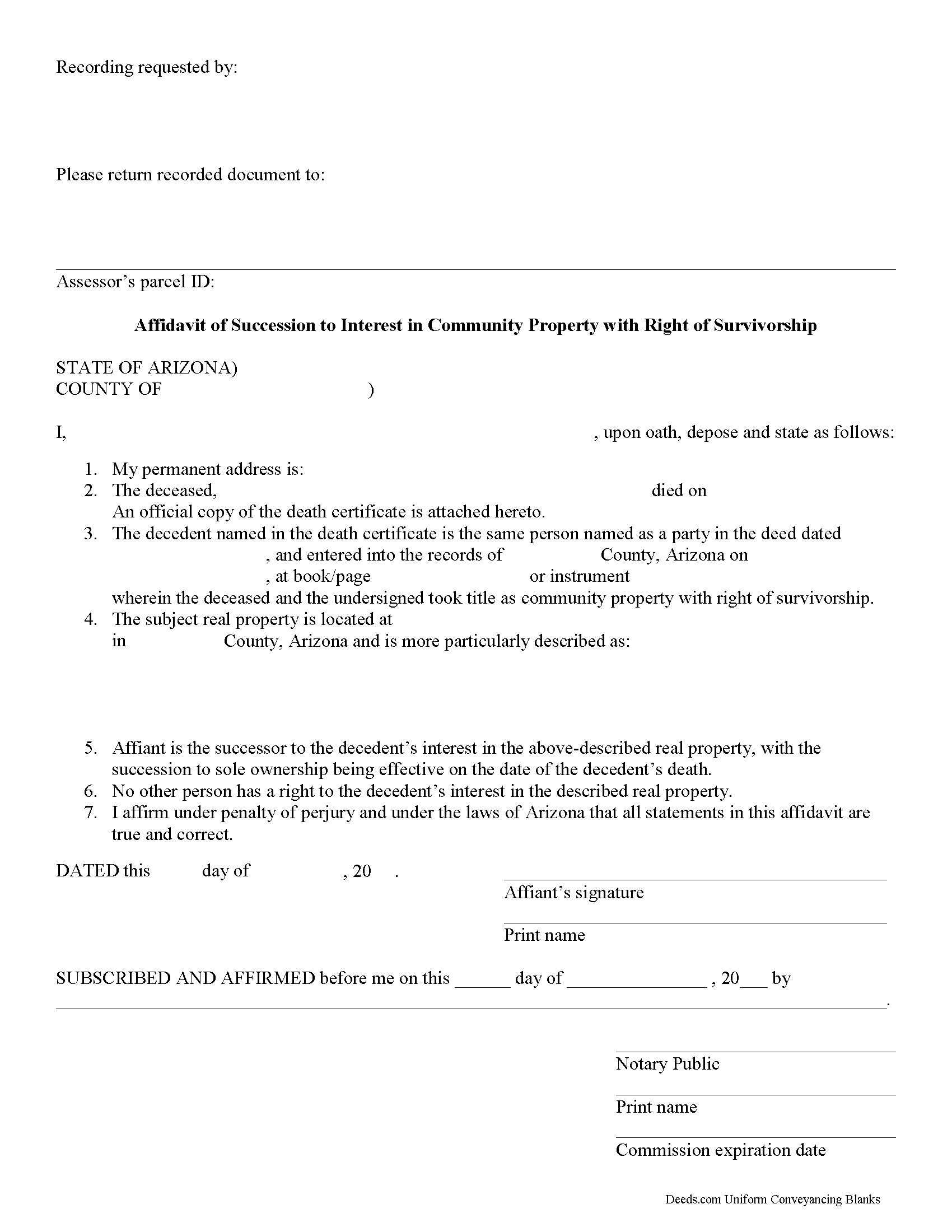
Navajo County Affidavit of Succession to Interest in Community Property with Right of Survivorship Form
Fill in the blank form formatted to comply with all recording and content requirements.
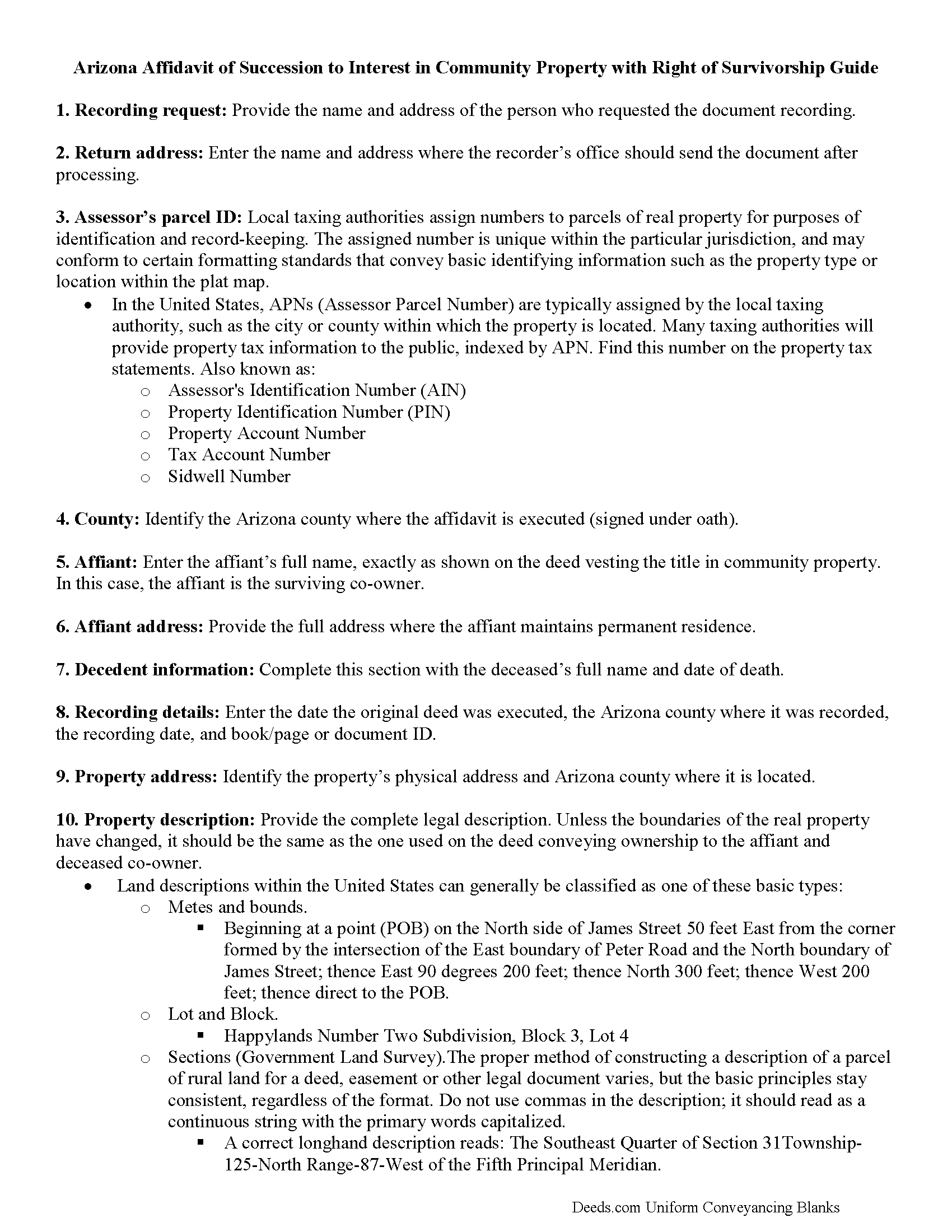
Navajo County Affidavit of Succession to Interest in Community Property with Right of Survivorship Guide
Line by line guide explaining every blank on the form.
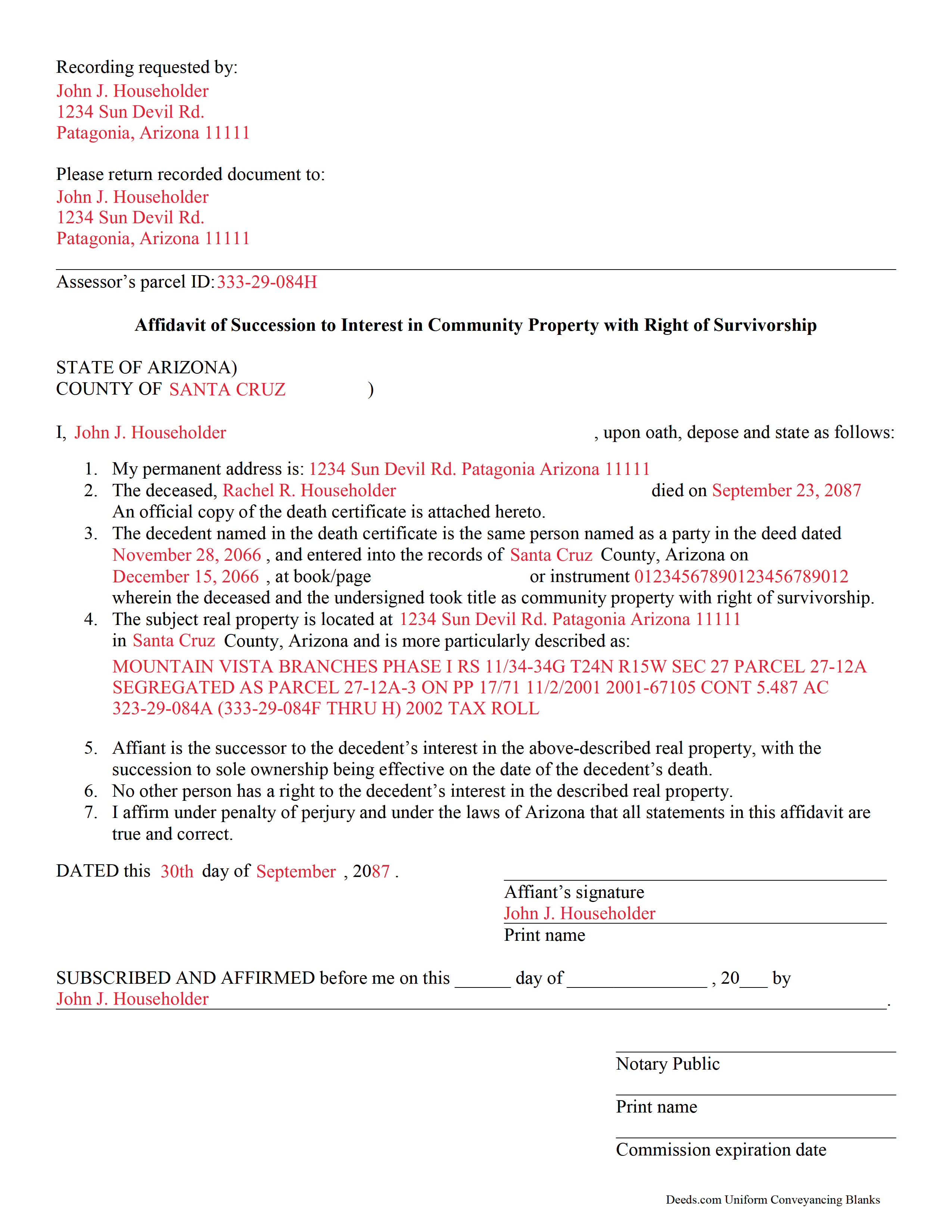
Navajo County Completed Example of the Affidavit of Succession to Interest in Community Property with Right of Survivorship Document
Example of a properly completed form for reference.
All 3 documents above included • One-time purchase • No recurring fees
Immediate Download • Secure Checkout
Additional Arizona and Navajo County documents included at no extra charge:
Where to Record Your Documents
Recorder's Office
Holbrook, Arizona 86025
Hours: Monday thru Friday 8:00 am until 4:30 pm
Phone: 928-524-4194
Recording Tips for Navajo County:
- Bring your driver's license or state-issued photo ID
- Check that your notary's commission hasn't expired
- Bring extra funds - fees can vary by document type and page count
- Both spouses typically need to sign if property is jointly owned
- Recording early in the week helps ensure same-week processing
Cities and Jurisdictions in Navajo County
Properties in any of these areas use Navajo County forms:
- Blue Gap
- Cibecue
- Clay Springs
- Fort Apache
- Heber
- Holbrook
- Hotevilla
- Indian Wells
- Joseph City
- Kayenta
- Keams Canyon
- Kykotsmovi Village
- Lakeside
- Overgaard
- Pinedale
- Pinetop
- Pinon
- Polacca
- Second Mesa
- Shonto
- Show Low
- Snowflake
- Sun Valley
- Taylor
- White Mountain Lake
- Whiteriver
- Winslow
- Woodruff
Hours, fees, requirements, and more for Navajo County
How do I get my forms?
Forms are available for immediate download after payment. The Navajo County forms will be in your account ready to download to your computer. An account is created for you during checkout if you don't have one. Forms are NOT emailed.
Are these forms guaranteed to be recordable in Navajo County?
Yes. Our form blanks are guaranteed to meet or exceed the applicable formatting requirements used for recording in Navajo County, including margin requirements, font requirements, and other layout standards. This guarantee applies to formatting, not to the legal sufficiency of information entered by the user or the suitability of a form for a particular transaction.
Can I reuse these forms?
Yes. You can reuse the forms for your personal use. For example, if you have multiple properties in Navajo County you only need to order once.
What do I need to use these forms?
The forms are PDFs that you fill out on your computer. You'll need Adobe Reader (free software that most computers already have). You do NOT enter your property information online - you download the blank forms and complete them privately on your own computer.
Are there any recurring fees?
No. This is a one-time purchase. Nothing to cancel, no memberships, no recurring fees.
How much does it cost to record in Navajo County?
Recording fees in Navajo County vary. Contact the recorder's office at 928-524-4194 for current fees.
Questions answered? Let's get started!
The Arizona Affidavit of Succession to Interest in Community Property with Right of Survivorship is the recorded instrument used to confirm that a surviving spouse now holds sole title to real property the couple previously owned as community property with right of survivorship under ARS 33-431. Arizona's statute transfers the deceased spouse's interest automatically at death — no probate, no court order, no retitling — but the county recorder's index continues to show both spouses on title until something new is recorded. This affidavit, filed with a certified copy of the death certificate, puts the death into the chain of title and gives future title examiners, lenders, and buyers the record they need to confirm the survivor's ownership of the whole. It is also the vehicle that most effectively documents the stepped-up basis for the entire property — one of the primary tax reasons Arizona couples choose this specific vesting over plain joint tenancy.
When the Arizona Affidavit of Succession Is Used
This affidavit is used exclusively for Arizona real property held by a married couple as community property with right of survivorship, after one spouse has died. The vesting must match: a deed into the couple as "community property with right of survivorship" or using that specific statutory phrase under ARS 33-431. Properties titled in one of Arizona's other marital vesting options require different instruments — joint tenancy with right of survivorship uses an affidavit of surviving joint tenant, plain community property without the survivorship feature requires probate of the decedent's half, and sole-and-separate property of the deceased spouse passes through the probate estate regardless of the survivor's marital status at death. Getting the affidavit form matched to the recorded vesting is the first step before anything else in this process makes sense.
Why This Vesting Is Used in Arizona
Community property with right of survivorship is the preferred marital vesting for most Arizona homeowners because it delivers two benefits that no other form combines. First, the right of survivorship passes full title to the surviving spouse automatically at the first death, without probate — the same probate-avoidance benefit as joint tenancy. Second, because the property retains its community property character, the surviving spouse receives a full stepped-up basis on the entire property at the first death, not just on the deceased spouse's half interest. This is materially different from joint tenancy, where the survivor gets a stepped-up basis on only the decedent's half and retains the original cost basis on the surviving spouse's half. For an appreciated Arizona home, the difference in capital gains tax on a later sale can be substantial, and it is the reason Arizona's community property with right of survivorship form exists as a distinct vesting option.
Recording this affidavit — rather than letting the record sit or handling the transfer through a less formal document — also helps support the stepped-up basis position when the property is later sold. The recorded affidavit and death certificate together establish the date of death and the shift to sole ownership, which are the facts the surviving spouse's CPA will need to document the basis step-up on a future 1040 Schedule D.
What the Affidavit Establishes
The affidavit is a sworn statement locking in the facts required to confirm the survivor's title. The content typically includes the identity of the deceased spouse, the date and place of death, the identity of the surviving spouse making the affidavit, confirmation that the two were married at the time of death, a reference to the deed that vested the property in the couple as community property with right of survivorship (by recording date and recording number), the legal description of the property matching that deed, and a statement that the affiant is the surviving spouse entitled to take the whole by operation of law under ARS 33-431. The affidavit is signed by the surviving spouse under penalty of perjury and acknowledged before a notary public. A certified copy of the deceased spouse's death certificate — issued by the vital records office with its official seal — accompanies the affidavit when it is presented for recording.
Matching the Affidavit to the Recorded Vesting
The single most important drafting step is confirming that the prior recorded deed actually vested the property in the couple as community property with right of survivorship. Arizona recognizes four marital vesting options, and the words on the deed control. A deed to "[Husband] and [Wife], husband and wife" without more creates community property — no survivorship. A deed to "[Husband] and [Wife], as joint tenants with right of survivorship" creates joint tenancy with right of survivorship, which is a different form with a different tax treatment. A deed to "[Husband] and [Wife], as community property with right of survivorship" or using the full statutory recital creates the vesting this affidavit addresses. The survivor who records this affidavit against property held in a different vesting is documenting something that did not actually happen, and a careful title examiner will reject the chain on a future sale. Before recording the affidavit, pull the most recent deed into the couple and confirm the exact vesting language it uses.
What the Survivor Takes Subject To
The surviving spouse takes the whole property subject to every encumbrance that was in place at the deceased spouse's death. Mortgages, deeds of trust, tax liens, judgment liens, easements, CC&Rs, and mechanic's liens all continue. A mortgage on the property typically remains in place and the surviving spouse takes subject to it; federal law under the Garn-St Germain Act generally prevents a lender from accelerating an owner-occupied residential mortgage on the basis of a transfer to a surviving spouse, so a due-on-sale clause will not usually be triggered. Judgment liens against the deceased spouse that attached to the couple's community property interest during the marriage continue to affect the property; judgment liens against the surviving spouse continue to affect the survivor's interest, which now encompasses the whole.
AHCCCS Estate Recovery
The Arizona Health Care Cost Containment System has the right to pursue estate recovery against the estate of a deceased Medicaid recipient for benefits paid during life. The intersection of estate recovery and community property with right of survivorship is complex: property passing to a surviving spouse is often protected from recovery during the survivor's lifetime under federal Medicaid rules, but Arizona has developed its own framework under ARS 36-2935 and related regulations, and a claim can still attach or be deferred depending on specific circumstances. A surviving spouse who knows the deceased received Medicaid or long-term care benefits should consult counsel before treating the property as fully unencumbered or before selling, even after the affidavit has been recorded. The affidavit itself does not resolve estate recovery questions — it records the title transfer, but it does not extinguish potential claims.
Who Signs and Execution
The surviving spouse signs the affidavit. There are no other required signers — by definition, only one party was the deceased spouse's survivor, and that person is the affiant. The affidavit is signed under penalty of perjury and acknowledged before a notary public or other officer authorized to take acknowledgments under ARS 33-401 and ARS 33-501. Arizona does not require subscribing witnesses. When the surviving spouse is physically or mentally unable to sign, the affidavit typically cannot be signed by another family member or by a child of the couple — the appropriate path in that situation is a conservatorship proceeding or, where a valid durable power of attorney exists, signature by the attorney-in-fact, subject to the specific powers granted in that document.
Affidavit of Property Value Exemption
Arizona generally requires an Affidavit of Property Value to accompany instruments affecting interests in real property (ARS 11-1133), but a transfer at death to a surviving spouse under community property with right of survivorship is exempt under ARS 11-1134 because no taxable conveyance is occurring — the deceased spouse's interest extinguishes and the survivor's interest expands to the whole by operation of law. The exemption must be claimed on the face of the affidavit with a statement that the transfer is exempt and a citation to the specific exemption subsection, placed below the legal description. Affidavits that omit the recital are routinely rejected at the recorder's window, even though the transaction is plainly exempt.
Formatting and Recording
ARS 11-480 sets the formatting requirements for every recordable instrument: legible type of at least ten points, white paper no larger than 8.5 by 14 inches, a caption identifying the document (for example, "Affidavit of Succession to Community Property with Right of Survivorship"), a top margin of at least two inches on the first page reserved for the recorder's stamp, and minimum half-inch margins elsewhere. Record the affidavit in the county where the property is located — or in each county where the property sits, when it spans more than one county. Confirm current recording fees and accepted forms of payment with the recorder's office in advance.
What's Included in the Download Package
The Arizona Affidavit of Succession to Community Property with Right of Survivorship package includes the affidavit form drafted to reference the original community property with right of survivorship deed, identify the deceased and surviving spouses, and claim the ARS 11-1134 exemption on the face of the instrument, detailed guidelines covering the Arizona-specific drafting and recording requirements and the documents to record alongside the affidavit, and a completed example showing how the form should look for a typical surviving-spouse succession. All files are available for instant download after purchase.
Important: Your property must be located in Navajo County to use these forms. Documents should be recorded at the office below.
This Affidavit of Succession to Interest in Community Property with Right of Survivorship meets all recording requirements specific to Navajo County.
Our Promise
The documents you receive here are guaranteed to meet or exceed the applicable Navajo County recording format requirements. If there is a rejection caused by our formatting, we will correct the issue or refund your payment. This guarantee applies to document formatting only and does not extend to information entered by the user, the selection of the form, or the legal effect of the completed document.
Save Time and Money
Get your Navajo County Affidavit of Succession to Interest in Community Property with Right of Survivorship form done right the first time with Deeds.com Uniform Conveyancing Blanks. At Deeds.com, we understand that your time and money are valuable resources, and we don't want you to face a penalty fee or rejection imposed by a county recorder for submitting nonstandard documents. We constantly review and update our forms to meet rapidly changing state and county recording requirements for roughly 3,500 counties and local jurisdictions.
4.8 out of 5 - ( 4734 Reviews )
Dennis H.
June 26th, 2019
Thank you for this program. It will help in the future. Dennis Holt
Thank you!
Solomon L.
October 10th, 2024
Great communication, this was my first e-recording.
Your feedback is greatly appreciated. Thank you for taking the time to share your experience!
Yolanda S.
April 12th, 2021
very professional
Thank you!
Chris K.
April 18th, 2023
Wasn't able to get the deed from you. Had to wade through the county offices myself.
Sorry we were not able to help you find what you needed.
Samy K.
March 2nd, 2022
I searched on line for the blank forms I needed, everyone that said it's free was a part m they wanted to sign me up for a monthly membership, deeds.com had the forms that I can download and fill in, I paid $24 and got more than I needed, very easy company to deal with, I highly recommend them.
Thank you for your feedback. We really appreciate it. Have a great day!
Richard L.
February 13th, 2021
Thanks for the complete and reasonably priced set of docs. I was specifically looking for and glad to find a current version of a TOD deed following the California extension.
Thank you for your feedback. We really appreciate it. Have a great day!
Travis S.
May 6th, 2023
I couldn't even look for a deed because the website said that deed/title searching wasn't available. Very disappointed about it.
I'm sorry to hear that you had a disappointing experience with the website's deed/title searching feature. It can be frustrating when a feature you were hoping to use isn't available.
We do hope that you found what you were looking for elsewhere.
Rodney S.
October 7th, 2021
Good service; thank you.
Thank you!
Joyce B.
April 29th, 2021
Thanks, the documents were easy to follow and complete.
Thank you for your feedback. We really appreciate it. Have a great day!
Benjamin A.
November 27th, 2019
This method seems simple for me to complete. Wish me luck.
Thank you for your feedback. We really appreciate it. Have a great day!
Peggy G.
May 19th, 2019
This is an easy document to complete and file. Thank you for having the completed sample for review.
We appreciate your business and value your feedback. Thank you. Have a wonderful day!
Robert M.
October 4th, 2020
Quick and friendly answers. So Easy!
We appreciate your business and value your feedback. Thank you. Have a wonderful day!
Betty S.
May 2nd, 2022
Thank you for the excellent and complete layout of all forms needed to complete the Affidavit of Death and Heirship, including the notarial officer and an example of how these forms should be completed. This method definitely saves time and money and an answer to my family's Prayers.
Thank you for your feedback. We really appreciate it. Have a great day!
Tamra L.
April 24th, 2026
excellent instructions and clear forms. Thank you for your service!
Glad everything was clear and easy to follow. We appreciate you taking the time to share this.
Norma O.
March 10th, 2020
good
Thank you!