Arizona Affidavit of Succession to Interest in Community Property with Right of Survivorship
County Specific Legal Forms Validated as recently as June 1, 2026 by our Forms Development Team
About the Arizona Affidavit of Succession to Interest in Community Property with Right of Survivorship
How to Use This Form
- Select your county from the list on the left
- Download the county-specific form
- Fill in the required information
- Have the document notarized if required
- Record with your county recorder's office
What Others Like You Are Saying
"Quick service .Easy download.I ordered Quit Claim and should have ordered warranty deed. I will make…"
"Very simple. By creating the deed and filing it myself, I am saving a legal fee of $300!"
"Some of the forms I ordered didn't have enough space for all of the information, but were useful as …"
"I am quite pleased with this website. I was able to complete my task with relative ease thanks to al…"
"The service provided by the staff at Deeds.com is consistently excellent with prompt replies and smo…"
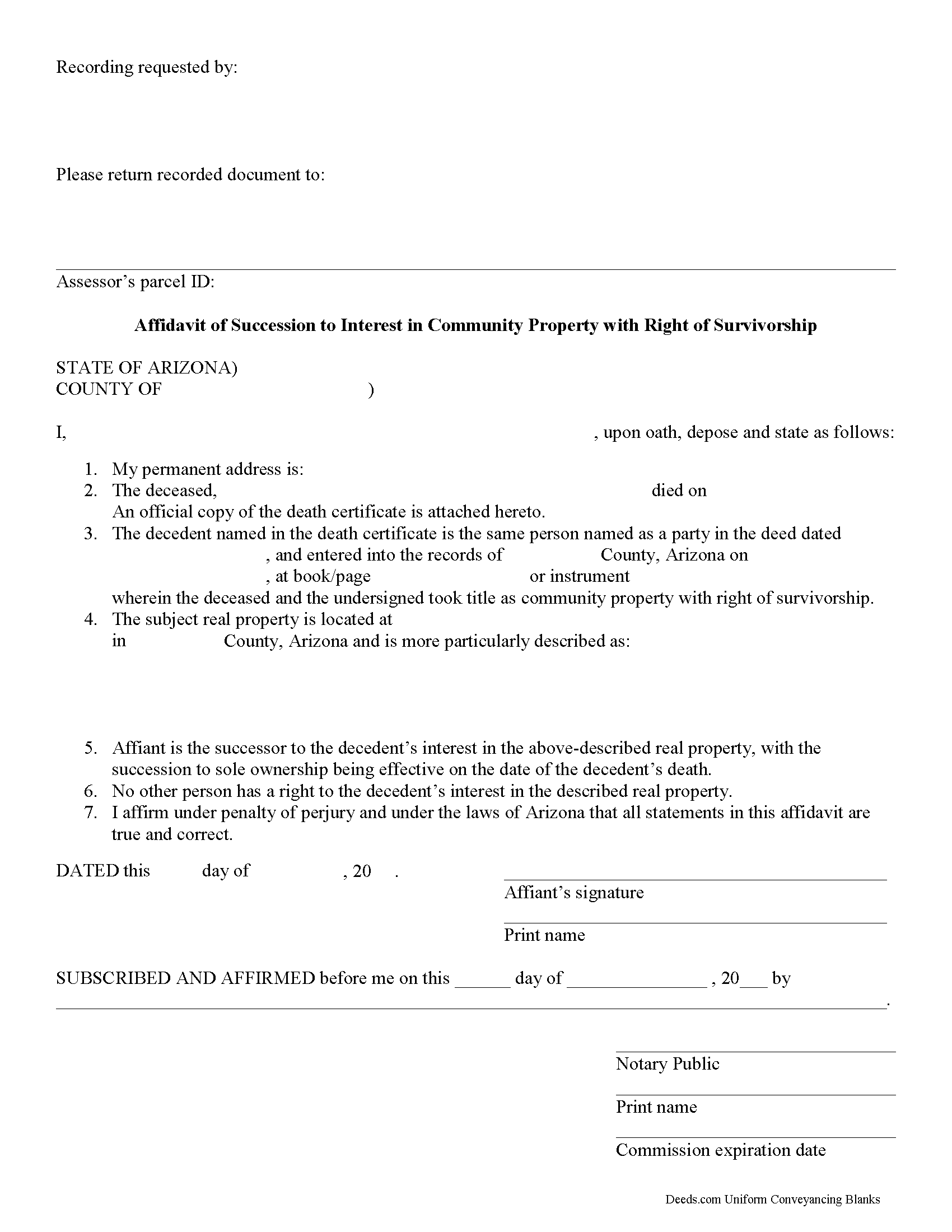
The Arizona Affidavit of Succession to Interest in Community Property with Right of Survivorship is the recorded instrument used to confirm that a surviving spouse now holds sole title to real property the couple previously owned as community property with right of survivorship under ARS 33-431. Arizona's statute transfers the deceased spouse's interest automatically at death — no probate, no court order, no retitling — but the county recorder's index continues to show both spouses on title until something new is recorded. This affidavit, filed with a certified copy of the death certificate, puts the death into the chain of title and gives future title examiners, lenders, and buyers the record they need to confirm the survivor's ownership of the whole. It is also the vehicle that most effectively documents the stepped-up basis for the entire property — one of the primary tax reasons Arizona couples choose this specific vesting over plain joint tenancy.
When the Arizona Affidavit of Succession Is Used
This affidavit is used exclusively for Arizona real property held by a married couple as community property with right of survivorship, after one spouse has died. The vesting must match: a deed into the couple as "community property with right of survivorship" or using that specific statutory phrase under ARS 33-431. Properties titled in one of Arizona's other marital vesting options require different instruments — joint tenancy with right of survivorship uses an affidavit of surviving joint tenant, plain community property without the survivorship feature requires probate of the decedent's half, and sole-and-separate property of the deceased spouse passes through the probate estate regardless of the survivor's marital status at death. Getting the affidavit form matched to the recorded vesting is the first step before anything else in this process makes sense.
Why This Vesting Is Used in Arizona
Community property with right of survivorship is the preferred marital vesting for most Arizona homeowners because it delivers two benefits that no other form combines. First, the right of survivorship passes full title to the surviving spouse automatically at the first death, without probate — the same probate-avoidance benefit as joint tenancy. Second, because the property retains its community property character, the surviving spouse receives a full stepped-up basis on the entire property at the first death, not just on the deceased spouse's half interest. This is materially different from joint tenancy, where the survivor gets a stepped-up basis on only the decedent's half and retains the original cost basis on the surviving spouse's half. For an appreciated Arizona home, the difference in capital gains tax on a later sale can be substantial, and it is the reason Arizona's community property with right of survivorship form exists as a distinct vesting option.
Recording this affidavit — rather than letting the record sit or handling the transfer through a less formal document — also helps support the stepped-up basis position when the property is later sold. The recorded affidavit and death certificate together establish the date of death and the shift to sole ownership, which are the facts the surviving spouse's CPA will need to document the basis step-up on a future 1040 Schedule D.
What the Affidavit Establishes
The affidavit is a sworn statement locking in the facts required to confirm the survivor's title. The content typically includes the identity of the deceased spouse, the date and place of death, the identity of the surviving spouse making the affidavit, confirmation that the two were married at the time of death, a reference to the deed that vested the property in the couple as community property with right of survivorship (by recording date and recording number), the legal description of the property matching that deed, and a statement that the affiant is the surviving spouse entitled to take the whole by operation of law under ARS 33-431. The affidavit is signed by the surviving spouse under penalty of perjury and acknowledged before a notary public. A certified copy of the deceased spouse's death certificate — issued by the vital records office with its official seal — accompanies the affidavit when it is presented for recording.
Matching the Affidavit to the Recorded Vesting
The single most important drafting step is confirming that the prior recorded deed actually vested the property in the couple as community property with right of survivorship. Arizona recognizes four marital vesting options, and the words on the deed control. A deed to "[Husband] and [Wife], husband and wife" without more creates community property — no survivorship. A deed to "[Husband] and [Wife], as joint tenants with right of survivorship" creates joint tenancy with right of survivorship, which is a different form with a different tax treatment. A deed to "[Husband] and [Wife], as community property with right of survivorship" or using the full statutory recital creates the vesting this affidavit addresses. The survivor who records this affidavit against property held in a different vesting is documenting something that did not actually happen, and a careful title examiner will reject the chain on a future sale. Before recording the affidavit, pull the most recent deed into the couple and confirm the exact vesting language it uses.
What the Survivor Takes Subject To
The surviving spouse takes the whole property subject to every encumbrance that was in place at the deceased spouse's death. Mortgages, deeds of trust, tax liens, judgment liens, easements, CC&Rs, and mechanic's liens all continue. A mortgage on the property typically remains in place and the surviving spouse takes subject to it; federal law under the Garn-St Germain Act generally prevents a lender from accelerating an owner-occupied residential mortgage on the basis of a transfer to a surviving spouse, so a due-on-sale clause will not usually be triggered. Judgment liens against the deceased spouse that attached to the couple's community property interest during the marriage continue to affect the property; judgment liens against the surviving spouse continue to affect the survivor's interest, which now encompasses the whole.
AHCCCS Estate Recovery
The Arizona Health Care Cost Containment System has the right to pursue estate recovery against the estate of a deceased Medicaid recipient for benefits paid during life. The intersection of estate recovery and community property with right of survivorship is complex: property passing to a surviving spouse is often protected from recovery during the survivor's lifetime under federal Medicaid rules, but Arizona has developed its own framework under ARS 36-2935 and related regulations, and a claim can still attach or be deferred depending on specific circumstances. A surviving spouse who knows the deceased received Medicaid or long-term care benefits should consult counsel before treating the property as fully unencumbered or before selling, even after the affidavit has been recorded. The affidavit itself does not resolve estate recovery questions — it records the title transfer, but it does not extinguish potential claims.
Who Signs and Execution
The surviving spouse signs the affidavit. There are no other required signers — by definition, only one party was the deceased spouse's survivor, and that person is the affiant. The affidavit is signed under penalty of perjury and acknowledged before a notary public or other officer authorized to take acknowledgments under ARS 33-401 and ARS 33-501. Arizona does not require subscribing witnesses. When the surviving spouse is physically or mentally unable to sign, the affidavit typically cannot be signed by another family member or by a child of the couple — the appropriate path in that situation is a conservatorship proceeding or, where a valid durable power of attorney exists, signature by the attorney-in-fact, subject to the specific powers granted in that document.
Affidavit of Property Value Exemption
Arizona generally requires an Affidavit of Property Value to accompany instruments affecting interests in real property (ARS 11-1133), but a transfer at death to a surviving spouse under community property with right of survivorship is exempt under ARS 11-1134 because no taxable conveyance is occurring — the deceased spouse's interest extinguishes and the survivor's interest expands to the whole by operation of law. The exemption must be claimed on the face of the affidavit with a statement that the transfer is exempt and a citation to the specific exemption subsection, placed below the legal description. Affidavits that omit the recital are routinely rejected at the recorder's window, even though the transaction is plainly exempt.
Formatting and Recording
ARS 11-480 sets the formatting requirements for every recordable instrument: legible type of at least ten points, white paper no larger than 8.5 by 14 inches, a caption identifying the document (for example, "Affidavit of Succession to Community Property with Right of Survivorship"), a top margin of at least two inches on the first page reserved for the recorder's stamp, and minimum half-inch margins elsewhere. Record the affidavit in the county where the property is located — or in each county where the property sits, when it spans more than one county. Confirm current recording fees and accepted forms of payment with the recorder's office in advance.
What's Included in the Download Package
The Arizona Affidavit of Succession to Community Property with Right of Survivorship package includes the affidavit form drafted to reference the original community property with right of survivorship deed, identify the deceased and surviving spouses, and claim the ARS 11-1134 exemption on the face of the instrument, detailed guidelines covering the Arizona-specific drafting and recording requirements and the documents to record alongside the affidavit, and a completed example showing how the form should look for a typical surviving-spouse succession. All files are available for instant download after purchase.
How to Use This Form
- Select your county from the list above
- Download the county-specific form
- Fill in the required information
- Have the document notarized if required
- Record with your county recorder's office
What Others Like You Are Saying
"Quick service .Easy download.I ordered Quit Claim and should have ordered warranty deed. I will make…"
"Very simple. By creating the deed and filing it myself, I am saving a legal fee of $300!"
"Some of the forms I ordered didn't have enough space for all of the information, but were useful as …"
"I am quite pleased with this website. I was able to complete my task with relative ease thanks to al…"
"The service provided by the staff at Deeds.com is consistently excellent with prompt replies and smo…"
Common Uses for Affidavit of Succession to Interest in Community Property with Right of Survivorship
- Establish a chain of title after a property owner passes away
- Provide documentation required by a title company to clear title
- Remove a deceased joint tenant from a property title
- Document survivorship rights for jointly held property
- Establish the identity of the surviving property owner
- Support the transfer of property to surviving heirs
- Document the death of a property owner for public record
Compare other Arizona deed forms and documents
Important: County-Specific Forms
Our affidavit of succession to interest in community property with right of survivorship forms are specifically formatted for each county in Arizona.
After selecting your county, you'll receive forms that meet all local recording requirements, ensuring your documents will be accepted without delays or rejection fees.