Florida Quitclaim Deed (Individual Grantor by Attorney-in-Fact)
County Specific Legal Forms Validated as recently as October 9, 2026 by our Forms Development Team
About the Florida Quitclaim Deed (Individual Grantor by Attorney-in-Fact)
How to Use This Form
- Select your county from the list
- Download the county-specific form
- Fill in the required information
- Have the document notarized if required
- Record with your county recorder's office
What Others Like You Are Saying
"Great service; document was exactly what I wanted. I highly recommend your company."
"Thanks for such great service!"
"Thank you for the comprehensive forms - very much appreciated!"
"Easy to use and download. Will use in the future, if ever needed."
"I really appreciate your forms according to South Dakota laws and statues. Your forms allow me to ef…"
4.8/5 from 4,825 reviews. Read all
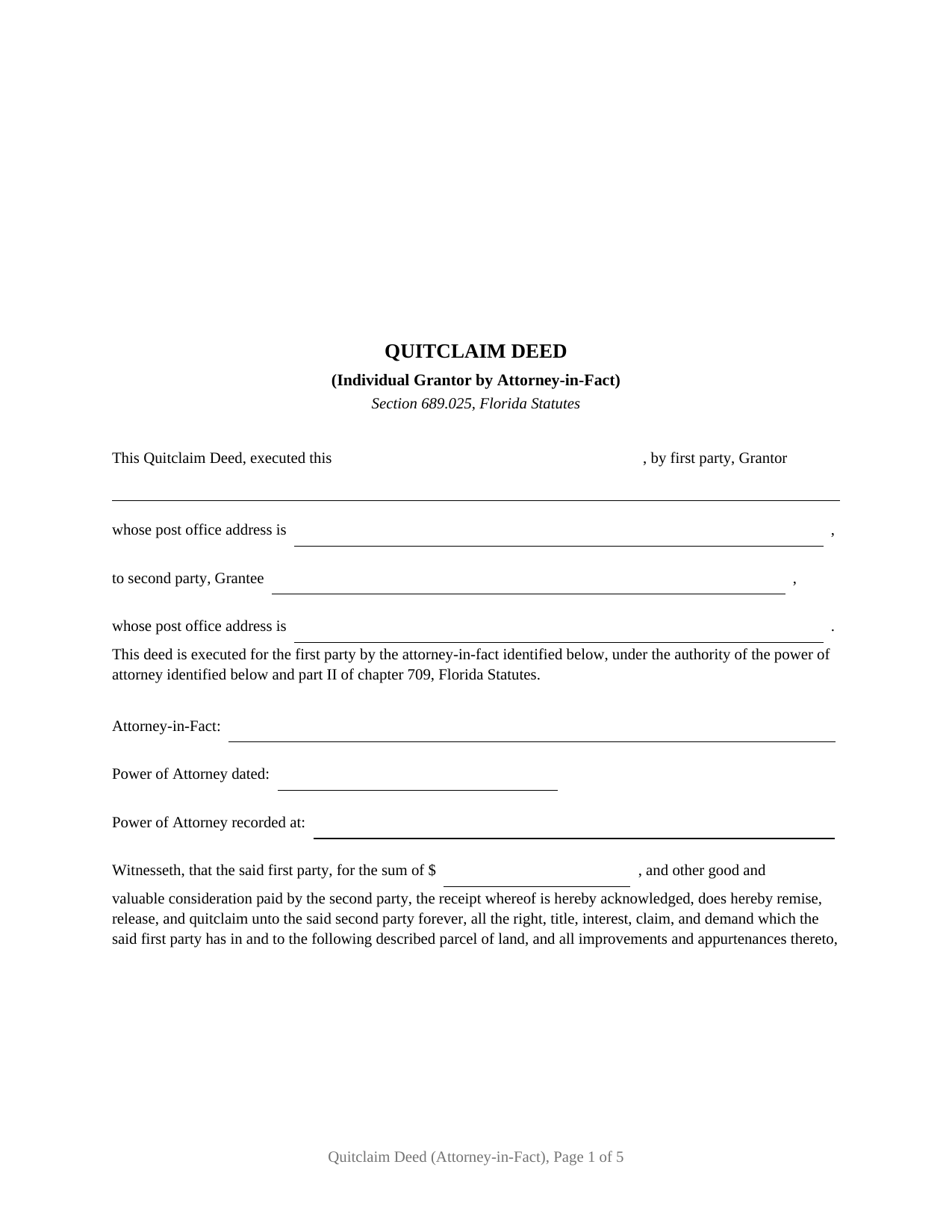
When a Florida property owner cannot appear to sign a deed, the signature can come from an attorney-in-fact acting under a power of attorney. This form prepares that conveyance: a Florida quitclaim deed in the statutory form of section 689.025, Florida Statutes, executed for one individual grantor by the agent named in a recorded power of attorney, with the witness blocks, joinder paragraph, and notary certificates the arrangement calls for.
A statutory quitclaim form since 2023
Florida gave the quitclaim deed a prescribed form in 2023. Section 689.025 requires substantially the statutory language, a legible legal description, and a blank for the parcel identification number, and its operative words, remise, release, and quitclaim, convey whatever right, title, interest, claim, and demand the grantor holds, with no warranty of title. This form carries that statutory text verbatim, adds an express no-warranty statement, and recites the attorney-in-fact and the power of attorney by date and recording reference so the source of the signature appears on the face of the record.
One signature in another person's name
The deed recites one first party, the individual grantor who is the principal under the power of attorney, one second party as grantee, and one attorney-in-fact, named with a post office address in a recital that cites part II of chapter 709. A single grantor signature block follows, headed for the grantor and signed by the attorney-in-fact, with two subscribing witness blocks beneath it and the statutory attorney-in-fact acknowledgment of section 695.25(5), which names the agent as the person acknowledging and the principal in its on behalf of clause. The grantor's name line carries whatever status words the record uses. Records presenting this configuration include a principal living in another state whose agent under a durable power of attorney conveys a Florida parcel to a child, and an owner in a care facility whose agent transfers the principal's interest to a relative. The form is not set up as a deed by two grantors, by an entity or trustee, or by a principal signing personally.
What the agent's signature rests on
The Florida Power of Attorney Act sets a strict foundation. A power of attorney is signed by the principal before two witnesses and a notary, and the agent may exercise only authority the document specifically grants; a catchall clause purporting to permit all acts grants nothing under section 709.2201. A transfer for little or no consideration is a gift, and gift authority stands apart: section 709.2202 requires the principal's separate signature or initials next to that power, and an agent outside the principal's ancestors, spouse, and descendants cannot use it in the agent's own favor unless the power says so. Because section 695.01 protects an instrument executed under a power of attorney only when the power is recorded, the deed and an unrecorded power of attorney ordinarily reach the clerk together.
Homestead joinder survives the power of attorney
Article X, Section 4(c) of the Florida Constitution requires a married owner's spouse to join in any alienation of homestead, and section 689.111, which allows homestead conveyance through an attorney-in-fact, expressly preserves that joinder; section 709.2201 restates it for the agent. The form answers with a labeled joining spouse block, complete with its own two witnesses and its own notary certificate, used when the property is the homestead of a married grantor and left blank when it is not. The deed limits that signature to the homestead joinder.
Witnesses, certificates, and the recording counter
Every signature on the deed takes two subscribing witnesses, and since January 1, 2024, each witness's printed name and post office address must appear on the instrument. The notary sections reproduce the statutory short form certificates of section 695.25, including the attorney-in-fact certificate that names the agent and the principal and records whether the appearance was by physical presence or online notarization, with a reserved area beneath each certificate for the notary's rubber stamp seal. The deed is recorded with the clerk of the circuit court in the county where the land lies, with documentary stamp tax of 70 cents per 100 dollars of consideration in most counties; a mortgage balance counts as consideration even on a family gift, and the guide walks through the nominal-consideration cases.
The download includes the blank deed as a fillable PDF with a removable instructions page, a completed example built on a Sarasota County fact pattern, and a guide covering every blank, the signing ceremony, and recording. The materials are informational and are not legal advice.
Important: County-Specific Forms
Our quitclaim deed (individual grantor by attorney-in-fact) forms are specifically formatted for each of the 67 counties in Florida.
After selecting your county, you'll receive forms that meet all local recording requirements, ensuring your documents will be accepted without delays or rejection fees.