Florida Quitclaim Deed (Married Grantor with Non-Owner Spouse Joinder)
County Specific Legal Forms Validated as recently as October 9, 2026 by our Forms Development Team
About the Florida Quitclaim Deed (Married Grantor with Non-Owner Spouse Joinder)
How to Use This Form
- Select your county from the list
- Download the county-specific form
- Fill in the required information
- Have the document notarized if required
- Record with your county recorder's office
What Others Like You Are Saying
"Very good, and easy and fast to use."
"Very fast and efficient. Easy to fill out but was upset the latest tax exemptions ruled in 2014 did …"
"Great experience"
"It's worth the cost to download the fill in the blank forms. So quick and easy. The lady I spoke to …"
"The forms are extremely helpful. They could use some updating. Promissory note "...in the form …"
4.8/5 from 4,825 reviews. Read all
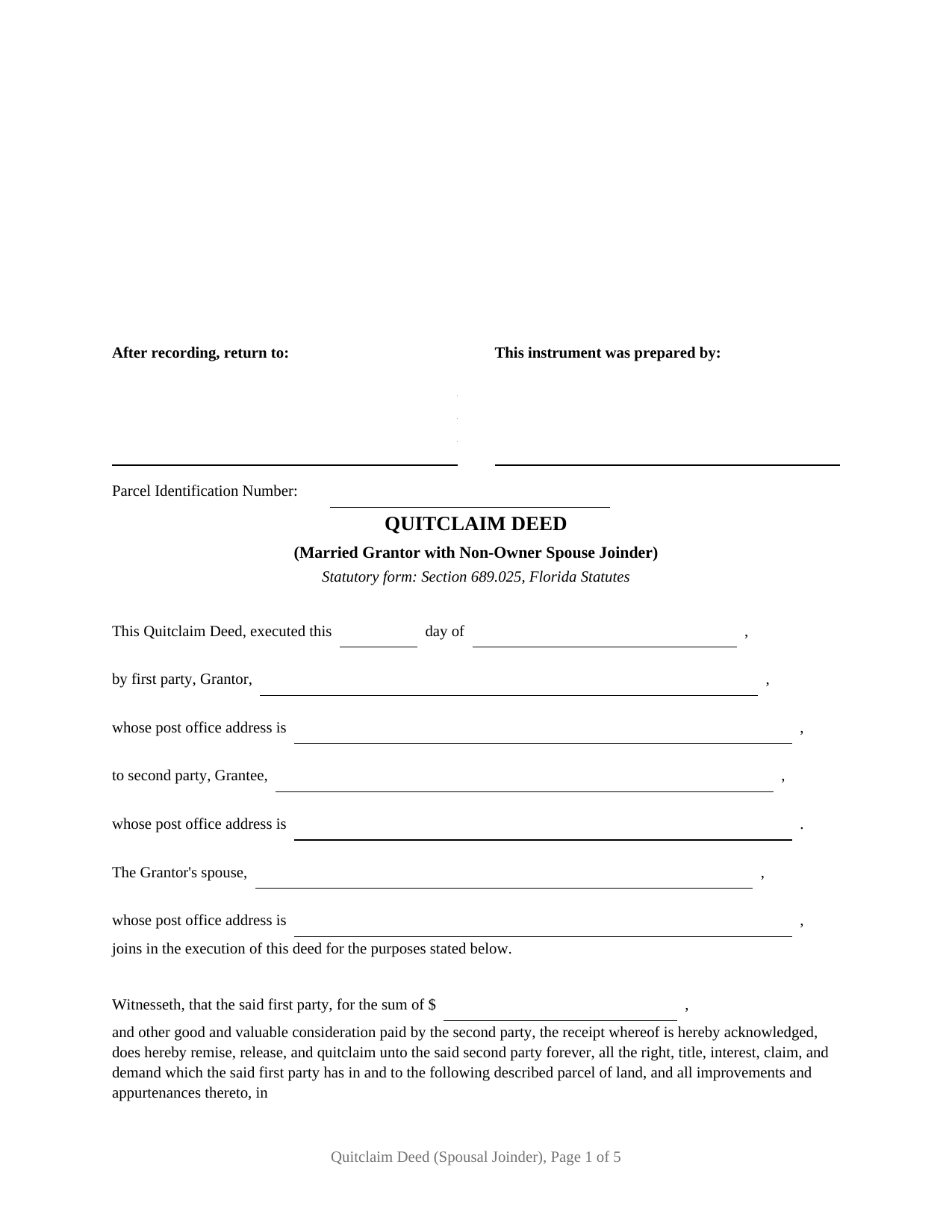
Florida title records are full of properties held in one spouse's name alone, and the Florida Constitution still gives the other spouse a decisive signature. Article X, Section 4(c) provides that the owner of homestead real estate, if married, may alienate the homestead by mortgage, sale, or gift only when joined by the owner's spouse. This quitclaim deed is drafted for exactly that title picture: one married grantor holding record title alone, conveying by quitclaim, with the non-owner spouse joining in the deed.
A constitutional signature, not a co-owner's
The joining spouse conveys no record title, because the spouse holds none. The joinder answers a different question: whether the deed of a married owner's homestead carries the signature the constitution assigns to the spouse. The form recites the joinder purpose, and the joining spouse also remises, releases, and quitclaims any homestead right or other marital interest to the grantee, so the recorded deed shows both the constitutional joinder and a release. One boundary is stated on the face of the deed: the joinder is not the separate waiver of homestead devise rights described in Section 732.7025, Florida Statutes, which exists only through its own prescribed statutory language.
One owner, one joining spouse, two signing ceremonies
The deed recites a fixed configuration. The first party is one grantor, identified in the Joinder of Spouse section as married; the second party is the grantee; and a third person is named as the Grantor's spouse, with the deed stating that this person is not a record owner of the property and joins to satisfy Article X, Section 4(c). Those statements print as deed text. The execution side matches: a signature block for the grantor and a labeled block for the joining spouse, two subscribing witness blocks behind each, and a separate acknowledgment certificate for each signer, so the two may sign on different days or before different notaries. A house bought before the marriage and still titled in the buying spouse's name, or a parcel one spouse inherited, which the couple has since occupied as their homestead and now conveys to a purchaser or a family member, presents the pattern this deed recites. The form is not set up as a conveyance by two spouses who both hold title, as a deed from one spouse to the other, or as a deed signed by an entity, a trustee, or an agent under a power of attorney.
The statutory quitclaim form Florida adopted in 2023
Section 689.025, Florida Statutes, created by chapter 2023-238, Laws of Florida, prescribes a quitclaim deed form: a deed substantially in the statutory form, with the operative words remise, release, and quitclaim, a legible legal description, and a blank for the parcel identification number. This form follows the statutory text, so the deed conveys all the right, title, interest, claim, and demand the grantor has in the parcel, together with improvements and appurtenances, and carries no warranty of title. Under Section 695.01(2), Florida Statutes, grantees by quitclaim deed are deemed bona fide purchasers without notice within the recording act.
Two witnesses for every signature, and the clerk's data
Florida deeds are signed in the presence of two subscribing witnesses under Section 689.01, Florida Statutes, and since January 1, 2024, the recording statute also requires each witness's printed name beneath the witness signature and each witness's post office address on the instrument. Each acknowledgment follows the short form of Section 695.25(1), with the physical presence or online notarization boxes the notary marks, and ends with a reserved area for the rubber stamp seal Section 117.05 places below or beside the notary's signature. The preparer's name and address, the grantee's post office address, the parcel identification number blank, and the blank three inch by three inch recording space at the top right of the first page are built into the layout. The clerk of the circuit court records the deed in the county where the land lies and collects documentary stamp tax at recording; a mortgage on the property counts as consideration even where no money changes hands, while an unencumbered parcel conveyed for nominal consideration carries the minimum tax.
The download includes the fillable blank deed with a removable instructions page, a completed example showing a realistic Orange County transfer from start to finish, and a plain language guide covering every entry, the joinder mechanics, the stamp tax, and recording. The materials describe Florida law in general terms and are not legal advice.
Important: County-Specific Forms
Our quitclaim deed (married grantor with non-owner spouse joinder) forms are specifically formatted for each of the 67 counties in Florida.
After selecting your county, you'll receive forms that meet all local recording requirements, ensuring your documents will be accepted without delays or rejection fees.