Florida Quitclaim Deed (Divorce)
County Specific Legal Forms Validated as recently as October 9, 2026 by our Forms Development Team
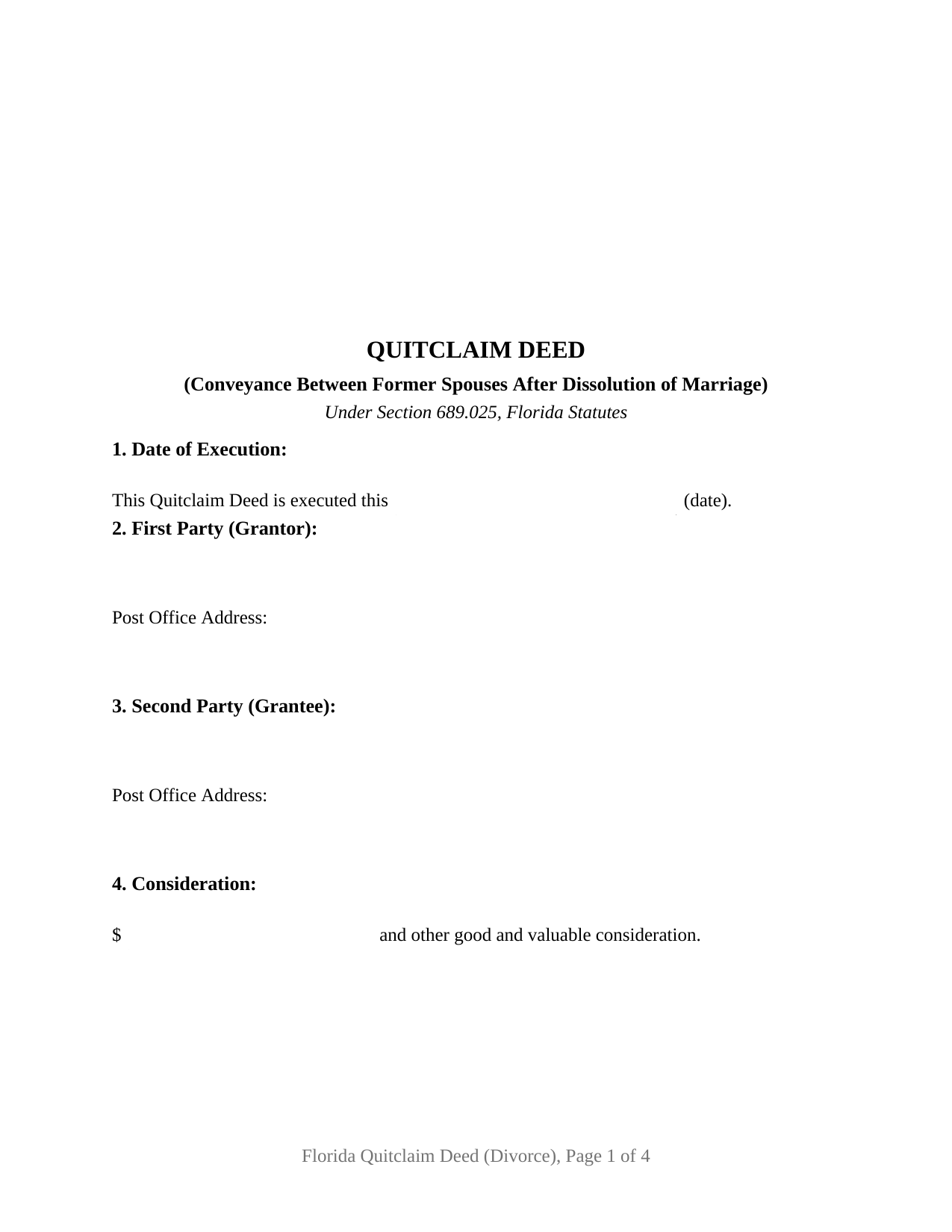
About the Florida Quitclaim Deed (Divorce)
How to Use This Form
- Select your county from the list
- Download the county-specific form
- Fill in the required information
- Have the document notarized if required
- Record with your county recorder's office
What Others Like You Are Saying
"Simple and easy going process"
"Very easy to use and had my forms paid for and downloaded very quickly."
"Everything worked Fine. I wish there was an John Doe type of an example for the Tax form."
"Love this site. It has been truly helpful and easy to navigate."
"Great"
4.8/5 from 4,836 reviews. Read all
A final judgment of dissolution of marriage ends the marriage, and section 689.15, Florida Statutes, rewrites the title in the same instant: what the couple held as tenants by the entirety becomes an undivided half interest in each of them, held as tenants in common. This quitclaim deed finishes that story in the county Official Records, with the departing former spouse releasing to the other whatever interest still stands in the departing party's name.
What the judgment leaves in the record
Florida divorce judgments can move real property on their own. Section 61.075(4) gives a judgment distributing assets the effect of a duly executed instrument of conveyance once the judgment, or a certified copy, is recorded where the land lies. Even so, a deed usually follows, and for practical reasons: a deed states the platted legal description in conveyancing form, is indexed as a conveyance between two named parties, and spares a title examiner the work of reading a family law judgment. The two coexist in one chain, and this form prepares the deed.
One signature, and no joinder line
The architecture follows the fact pattern. The form recites one first party and one second party, describes them as former spouses, and identifies the judgment that dissolved the marriage by court, case number, and date, so the record shows on its face why a deed of this kind is being filed. It carries one grantor signature block, two subscribing witness blocks with printed name and post office address lines, and a single acknowledgment certificate for the single signature the deed collects. What it omits is a joining spouse block. Article X, section 4(c) of the Florida Constitution reaches the homestead of an owner who is married, and once the judgment has dissolved the marriage between these two parties, that joinder no longer belongs on a deed between them. Records presenting this configuration include a departing former spouse releasing the house the other keeps under the judgment, and a release of an interest in an investment property awarded to one party. A deed signed while the marriage still exists, whether before a petition or while one is pending, is a conveyance between spouses rather than former spouses, and the homestead joinder rule still reaches it; that is a configuration this deed does not recite. It does not recite an entity, a trustee, or an agent signing under a power of attorney.
The tax line at the recording counter
Documentary stamp tax is where a divorce deed differs most from an ordinary transfer. Chapter 201 measures consideration to include a mortgage riding on the property whether or not the grantee assumes it, which turns many no-money family transfers taxable at 70 cents per 100 dollars, or Miami-Dade's own rate and surtax. Section 201.02(7)(a) lifts that burden for this configuration: the tax does not reach a deed between spouses or former spouses pursuant to an action for dissolution of their marriage where the property is or was their marital home. The Florida Department of Revenue applies the same rule to divorce deeds, notes that a refund may be sought within a year of the dissolution where tax was paid, and states that tax follows the consideration, mortgage included, when the property was not the marital home. The deed carries a dedicated documentary stamp tax section for the amount tendered or the exemption claimed with its citation.
Statutory words, statutory blanks
Underneath the divorce configuration sits Florida's prescribed quitclaim form, section 689.025, enacted in 2023. Its operative words, remise, release, and quitclaim, pass the right, title, interest, claim, and demand the signer holds, with improvements and appurtenances, and promise nothing about any of it. The statute also calls for the parcel identification number blank, which the form places with the legal description. Recording data comes from section 695.26: printed names under signatures, a post office address for each witness since January 1, 2024, the grantee's address, and the preparer named as a natural person, all with the clerk's 3 inch square kept clear at the top right of page one.
The download holds the blank deed as a fillable PDF with a removable instructions page, a completed example built on a Hillsborough County dissolution, and a plain language guide covering every numbered entry, the signing formalities, the stamp tax, and recording with the clerk of the circuit court. The materials are informational and are not legal advice; a Florida attorney can apply these statutes to a particular judgment and title.
Important: County-Specific Forms
Our quitclaim deed (divorce) forms are specifically formatted for each of the 67 counties in Florida.
After selecting your county, you'll receive forms that meet all local recording requirements, ensuring your documents will be accepted without delays or rejection fees.