Florida Quitclaim Deed (Trustee Grantee)
County Specific Legal Forms Validated as recently as October 9, 2026 by our Forms Development Team
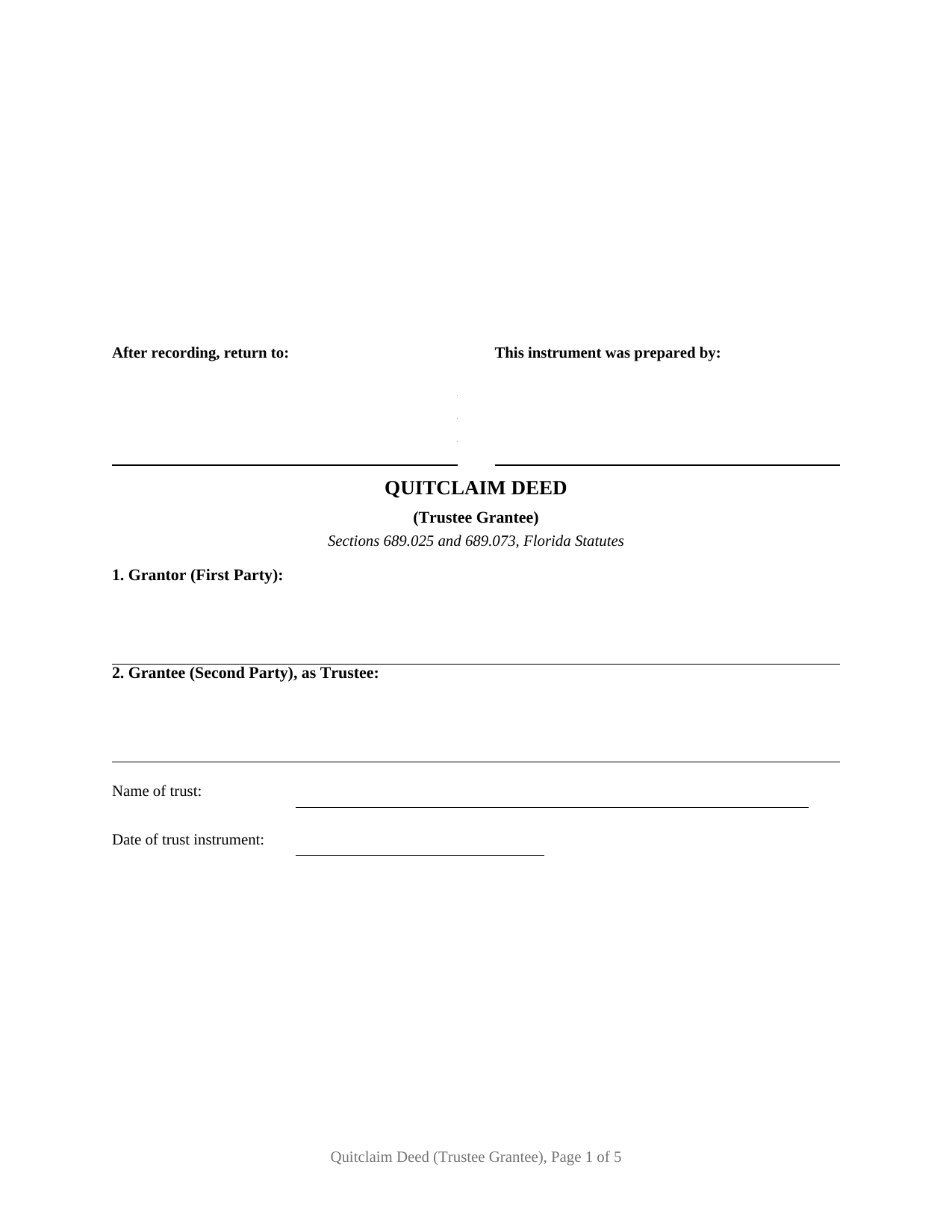
About the Florida Quitclaim Deed (Trustee Grantee)
How to Use This Form
- Select your county from the list
- Download the county-specific form
- Fill in the required information
- Have the document notarized if required
- Record with your county recorder's office
What Others Like You Are Saying
"Really appreciate you he quick response and solution to my problem!! Thank you!!"
"considering the current epidemic your fees save me time and parking fees. with help from DC recorder…"
"Excellent, easy to operate, saved $$$ by doing this TOD deed myself. WILL BUY AGAIN!!"
"Easy to understand, quick access, inexpensive, and I took it to my registrar's office and he said th…"
"No review provided."
4.8/5 from 4,828 reviews. Read all
Florida treats the word trustee on a deed with suspicion. Under section 689.07 of the Florida Statutes, a deed made out to a grantee as trustee that names no beneficiaries, states no trust purposes, and identifies no trust by title or date is declared to grant the grantee a fee simple estate personally, with full power to sell and encumber the property. A conveyance meant to fund a trust can end up titling the land in one person's name. This Florida Quitclaim Deed (Trustee Grantee) is drafted around that statute: it names and dates the trust and carries the trustee-powers language Florida law gives effect.
The statutory quitclaim, aimed at a trustee
The deed follows the quitclaim form Florida enacted in 2023 as section 689.025. The grantor remises, releases, and quitclaims all right, title, interest, claim, and demand in the described parcel, with no covenant or warranty of title; the trustee takes exactly the interest the grantor holds. Most often the deed funds the owner's own revocable living trust; section 689.075 confirms that a trust is valid even though the settlor keeps the power to revoke or amend it.
Powers the record can rely on
Section 689.073 gives recorded trustee-powers language real consequences. A recorded deed that designates the grantee as trustee and confers the power to protect, to conserve, to sell, to lease, to encumber, or otherwise to manage and dispose of the property vests that authority in the trustee of record, and a later buyer, lender, or title agent dealing with the trustee is not obligated to inquire into the trust agreement, the trustee's authority, or the beneficiaries. The deed carries that wording verbatim, for the named trustee and any successor trustee.
One grantor, one trustee, and a block for the spouse
The form recites one first party, an individual conveying in his or her own right, and one second party taking title as trustee of the trust named and dated in Section 2, not individually. One grantor signature block, two witness blocks, and one acknowledgment certificate serve the grantor; a labeled joining spouse block, with its own witnesses and certificate, follows for the homestead of a married grantor and stays blank otherwise. A homeowner deeding her residence to herself as trustee of her revocable living trust, a parent conveying a rental parcel to the trustee of an irrevocable trust for descendants, and a co-owner moving an undivided interest into a family trust present the pattern this deed recites. The form is not set up as a deed by two grantors, by spouses holding entireties title, by a trustee as grantor, by an entity, or by an agent under a power of attorney, and it names one trustee, not co-trustees.
Witnesses, joinder, and the county record
The grantor signs before two subscribing witnesses under section 689.01, and since January 1, 2024, each witness's printed name and post-office address must appear on the instrument. Each notary certificate follows the short form of section 695.25(1), with the physical presence or online notarization boxes the officer marks and a reserved area for the rubber stamp seal section 117.05 places beside the notary's signature. Article X, section 4(c) of the Florida Constitution requires a spouse's joinder in a lifetime alienation of homestead, and the joining-spouse block gives that signature a place on the deed when homestead moves into the trust.
Documentary stamps on a deed into a trust
Documentary stamp tax is collected at recording. Rule 12B-4.013(25) of the Florida Administrative Code taxes a deed to a trustee only to the extent it transfers beneficial ownership and there is consideration, and Rule 12B-4.013(25)(i) states that a deed to a trustee from a grantor who holds the power to revoke the trust is not a transfer of ownership subject to the tax. A deed that moves beneficial ownership to other beneficiaries is measured under section 201.02 on the consideration for the interest transferred, mortgage balance included; the guide covers the rules, the minimum tax on a nominal recital, and the Miami-Dade rates.
The download includes the blank deed as a fillable PDF with a removable instructions page, a completed example showing an Orange County transfer into a revocable living trust, and a plain-language guide covering every section, witnessing and notarization, and recording with the clerk of the circuit court. The materials are informational and are not legal advice; a Florida attorney can apply these statutes to a particular title or trust.
Important: County-Specific Forms
Our quitclaim deed (trustee grantee) forms are specifically formatted for each of the 67 counties in Florida.
After selecting your county, you'll receive forms that meet all local recording requirements, ensuring your documents will be accepted without delays or rejection fees.