Florida Quitclaim Deed (Individual)
County Specific Legal Forms Validated as recently as October 9, 2026 by our Forms Development Team
About the Florida Quitclaim Deed (Individual)
How to Use This Form
- Select your county from the list
- Download the county-specific form
- Fill in the required information
- Have the document notarized if required
- Record with your county recorder's office
What Others Like You Are Saying
"I just love this site!"
"Thank you So far everything worked great. Got my downloads so I'm off and running. I hope the rest o…"
"It was a wonderful experience. Thank you for your help."
"Since the recorder's office is closed, due to Covid, this worked well to submit my Quit Claim Deed. …"
"Great site makes this procedure easy to do,thanks"
4.8/5 from 4,825 reviews. Read all
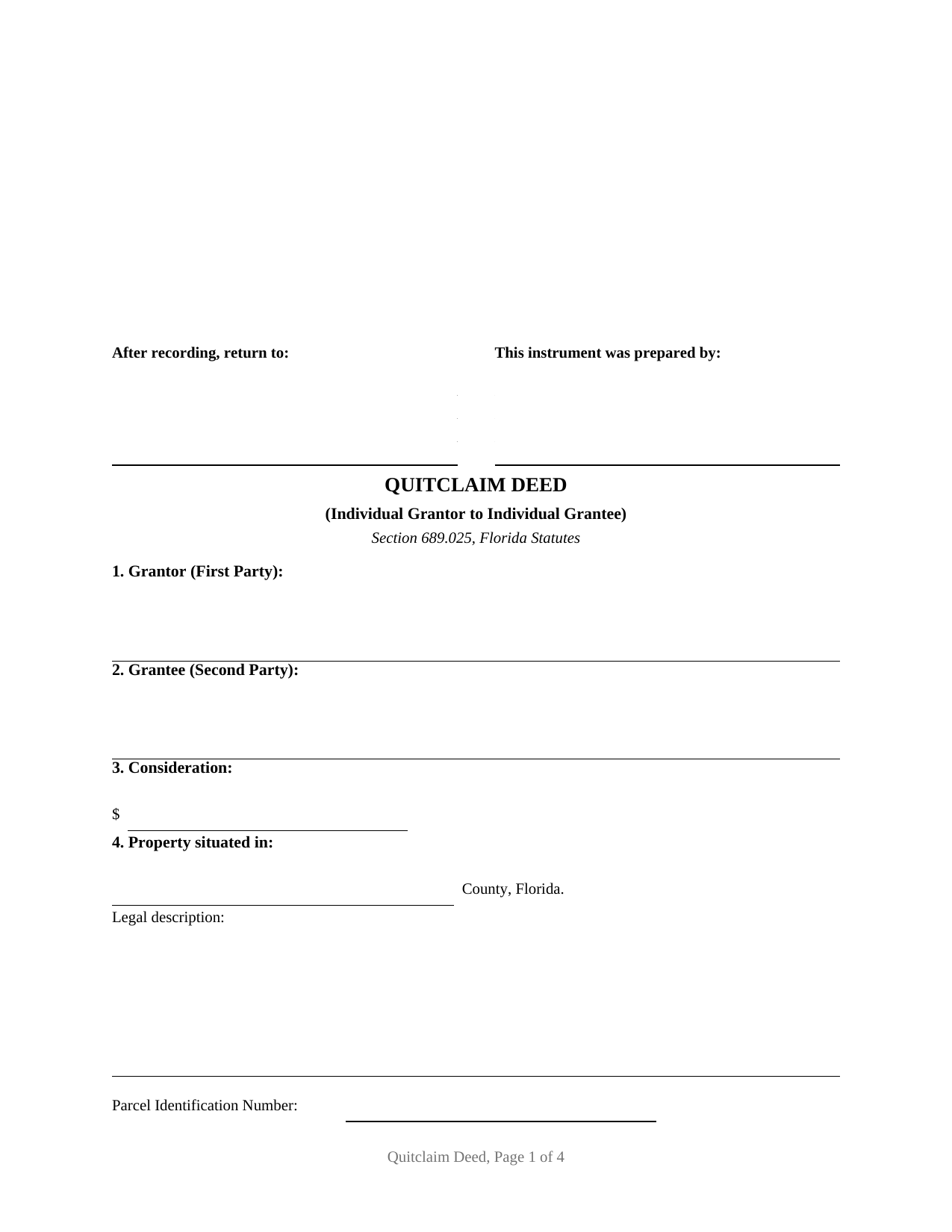
One name on the grantor line, one on the grantee line. This Florida quitclaim deed prepares the simplest configuration the state's statutory form takes: a single individual conveying to a single individual, under Section 689.025, Florida Statutes. The deed carries the prescribed operative wording, the parcel identification number blank the statute calls for, and an express no-warranty statement, all arranged around one signature ceremony, with a conditional joining spouse block standing behind it for the homestead case.
One grantor, one grantee
The form recites one first party and one second party, each an individual, and its own text states that the first party executes the deed as an individual in his or her own right. The grantor's name and post office address sit in Section 1, the grantee's in Section 2, and a single acknowledgment certificate serves the grantor's signature; a second certificate exists only for the joining spouse block. That one-to-one architecture matches the record patterns where a lone individual moves an interest to another: a co-owner releasing a fractional share to the person who keeps the property, one relative passing an inherited interest to another, or an individual releasing a doubtful claim so a title examiner reads a clean chain. The form is not set up as an entity, trustee, or attorney-in-fact conveyance, and it recites a single grantee rather than co-owners taking survivorship or entireties title; the guide describes how a sole grantee holds what the deed delivers.
An interest passed as-is
The operative words of Section 689.025, remise, release, and quitclaim, move whatever right, title, interest, claim, and demand the first party holds at delivery, and the deed says expressly that it conveys without covenant or warranty of title. Nothing in it promises that the grantor owns anything, and encumbrances of record follow the property into the grantee's hands. Florida's recording act still treats the receiving side generously: Section 695.01(2) deems the grantee under a quitclaim deed a bona fide purchaser without notice for recording act purposes, and recording fixes priority by the register number the clerk assigns.
Two witnesses, one certificate, current rules
Execution follows Section 689.01: the grantor signs before two subscribing witnesses. Since January 1, 2024, the recording statute has also demanded each witness's printed name beneath the witness signature and each witness's post office address on the face of the deed, and the form dedicates labeled lines to all of it. The acknowledgment tracks the current Florida certificate: venue lines, the physical presence or online notarization election of Section 117.05, the date, the signer's name, the identification method, and the notary's name, seal, serial number, and commission expiration. A preparer block naming a natural person and the blank clerk spaces of Section 695.26 complete the recording data, with the first page holding the reserved band where the clerk's stamp lands.
The spouse question a single signature raises
A deed built for one signer still meets Florida's constitution when the property is the signer's homestead. Article X, Section 4(c) lets a married owner alienate homestead real estate only with the spouse joined in the instrument, so the form ends with a labeled joining spouse block, carrying its own two witnesses and its own acknowledgment certificate. The deed's text gives that block effect only when someone signs it: an unmarried grantor, or a grantor conveying property that is not homestead, leaves it blank, and the printed deed says the unsigned block has no effect. Documentary stamp tax rides along at recording under Section 201.02, computed on consideration that includes any mortgage on the land, a point that reaches even one-dollar family transfers of encumbered property; the guide walks the computation, the Miami-Dade rate difference, and the minimum tax on nominal-consideration deeds.
The download delivers the blank statutory deed as a fillable PDF with a removable instructions page, a completed example showing an Orange County transfer filled in from the preparer block through the second certificate, and a plain language guide covering every numbered section, the witnessing and notarization ceremony, and recording with the clerk of the circuit court. The materials describe Florida law in general terms; they are informational and are not legal advice.
Important: County-Specific Forms
Our quitclaim deed (individual) forms are specifically formatted for each of the 67 counties in Florida.
After selecting your county, you'll receive forms that meet all local recording requirements, ensuring your documents will be accepted without delays or rejection fees.