Florida Quitclaim Deed (Corrective)
County Specific Legal Forms Validated as recently as October 9, 2026 by our Forms Development Team
About the Florida Quitclaim Deed (Corrective)
How to Use This Form
- Select your county from the list
- Download the county-specific form
- Fill in the required information
- Have the document notarized if required
- Record with your county recorder's office
What Others Like You Are Saying
"Love the accessibility to all counties. Save money and time using Deeds for all our recording needs!"
"love the site very helpful and easy."
"I am so thankful for the time saved by using Deeds.com. Not having to run downtown and stand in line…"
"Super easy, excellente"
"Very easy to find forms and good examples for filling out forms!"
4.8/5 from 4,828 reviews. Read all
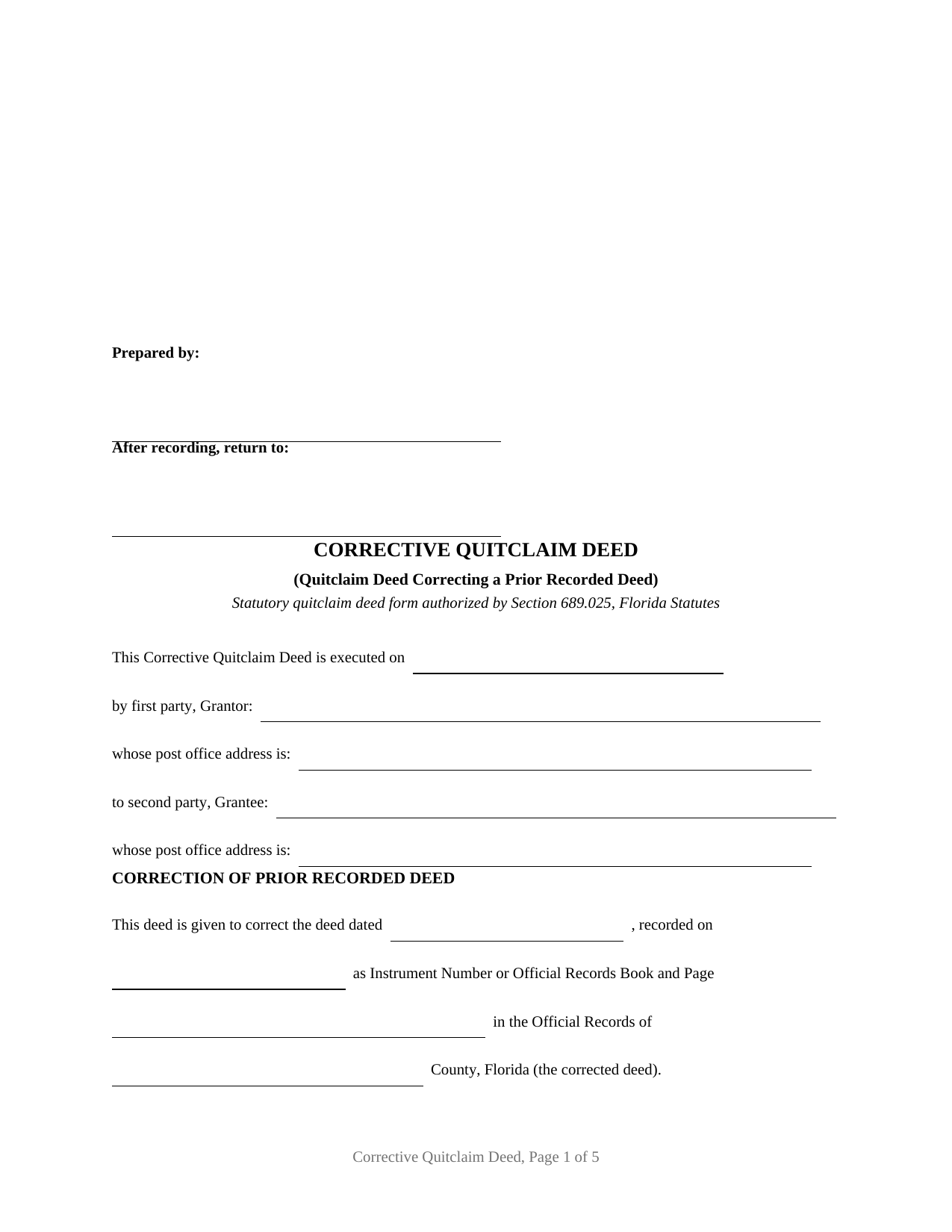
A recorded deed with a wrong lot number, a misspelled name, or missing witness information does not fix itself; the error sits in the county Official Records until a new instrument corrects it. In Florida, when the flawed deed is a quitclaim deed, the correction arrives the same way the original did. The Florida Corrective Quitclaim Deed re-executes the conveyance in substantially the statutory form of section 689.025, Florida Statutes, identifies the recorded deed and the error being corrected, and places the corrected description and terms on record.
Why a quitclaim error takes a new deed
Florida has a statutory shortcut for certain deed mistakes, but it is a narrow one. The curative procedure of section 689.041 applies to a scrivener's error in a legal description, defines an erroneous deed as any deed other than a quitclaim deed, and reaches only a single qualifying error, such as one wrong lot or block identification. An error in a recorded quitclaim deed sits outside that procedure, so the correction path is re-execution: the original grantor signs a new quitclaim deed to the same grantee. This form's correction recital identifies the corrected deed by date, recording reference, and county, states the error, and provides that the corrective deed controls to the extent of any conflict, before conveying with the statutory operative words: remise, release, and quitclaim.
What the correction recites, and who signs it
The form recites one grantor and one grantee, the same two natural persons the corrected deed named, and a correction paragraph that identifies the corrected deed by date, recording date, instrument number or book and page, and county, and states the error in the filler's own words. One grantor signature block, two subscribing witness blocks, and one acknowledgment certificate serve the grantor; a labeled joining spouse block, with its own two witness blocks and its own certificate, follows for the case where the property is the homestead of a married grantor, and stays blank otherwise. Records presenting this configuration include a lot or block number transposed in a platted description, a grantee's surname misspelled, and a deed recorded without witness addresses. The form is not set up as a deed that adds, drops, or substitutes a grantee, which is a new conveyance rather than a correction, nor as an entity, trustee, attorney-in-fact, or two-grantor instrument.
Built on the 2023 statutory form
Since chapter 2023-238, Laws of Florida, a Florida quitclaim deed must follow substantially the form set out in section 689.025, including a blank for the property appraiser's parcel identification number. The same legislation tightened the recording statute: for deeds recorded on or after January 1, 2024, section 695.26 requires each witness name printed beneath the witness signature and each witness post office address on the instrument. The form tracks all of it, with the two subscribing witness blocks section 689.01 requires for each signature, the joinder block under article X, section 4(c) of the Florida Constitution, and acknowledgment certificates in the short form of section 695.25, carrying the physical presence or online notarization boxes the officer marks and a reserved area for the rubber stamp seal section 117.05 places below the notary's signature.
Documentary stamps on a correction
Deeds transferring an interest in Florida real property carry documentary stamp tax at 70 cents per $100 of consideration, with Miami-Dade County applying its own rate structure. Since January 25, 2026, Rule 12B-4.014(3) of the Florida Administrative Code has provided that a deed correcting a technical deficiency in a previous deed in the nature of a scrivener's error, where the correcting deed conveys no interest in real property, is not subject to the tax, replacing the rule's earlier minimum-tax text. County transfer forms collect the point at the counter: the Orange County property transfer form lists corrective deeds correcting a legal description, names, or a scrivener's error among the stated reasons for paying no documentary stamp tax or only the 70 cent minimum. A deed that changes who owns the property is a new conveyance with tax computed on its own consideration, mortgage balance included.
The download prepares the correction from start to finish: a fillable statutory form deed with the correction recital, a completed example correcting a lot number error in Orange County, and a plain language guide that walks entry by entry, from the recording references of the corrected deed through witnessing, notarization, and recording with the clerk of the circuit court. The materials are informational, not legal advice.
Important: County-Specific Forms
Our quitclaim deed (corrective) forms are specifically formatted for each of the 67 counties in Florida.
After selecting your county, you'll receive forms that meet all local recording requirements, ensuring your documents will be accepted without delays or rejection fees.