Florida Quitclaim Deed (Interspousal)
County Specific Legal Forms Validated as recently as October 9, 2026 by our Forms Development Team
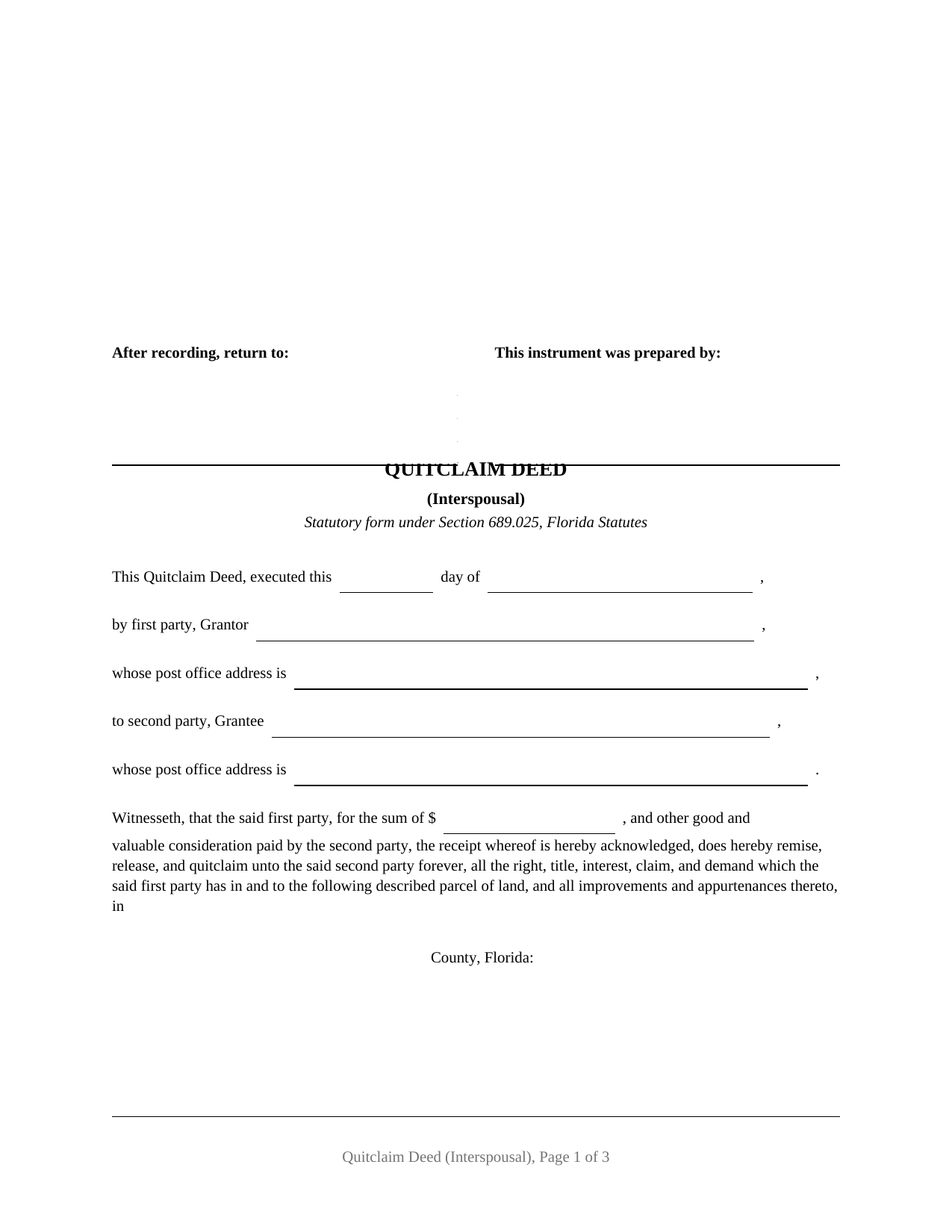
About the Florida Quitclaim Deed (Interspousal)
How to Use This Form
- Select your county from the list
- Download the county-specific form
- Fill in the required information
- Have the document notarized if required
- Record with your county recorder's office
What Others Like You Are Saying
"Very easy to choose template and download. The price seems fair. Not sure the section on the deed fo…"
"Very happy, thank you!"
"Got it next business day in the morning. Saved me phone call and perhaps a trip to courthouse. Very …"
"Excellent transaction."
"The experience has been excellent. The site gave me exactly what I was looking for. The documentatio…"
4.8/5 from 4,825 reviews. Read all
Florida lets one spouse deed real estate directly to the other. Section 689.11 of the Florida Statutes validates a conveyance of real estate, including homestead, made by one spouse to the other, passes legal title to the grantee spouse, and states that the grantee need not execute the conveyance. No intermediary, no straw-man transfer, and only one signature line: the grantor's. This form pairs that rule with Florida's statutory quitclaim deed language, producing an interspousal deed built for the county recording counter.
The statutory quitclaim form, word for word
Since 2023, Florida has prescribed the text of a quitclaim deed. Chapter 2023-238, Laws of Florida, created Section 689.025, which prescribes the deed's text, a legible legal description, and a blank space for the parcel identification number. This form follows the statutory language exactly: the deed remises, releases, and quitclaims to the second party all the right, title, interest, claim, and demand which the first party has in and to the described parcel, together with its improvements and appurtenances. Those words convey whatever interest the grantor holds at delivery, and nothing more; a quitclaim deed carries no covenant or warranty of title, and the deed says so in its own text.
Built around a married grantor and grantee
The deed recites that the grantor and grantee are married to each other and invokes Section 689.11, so the recorded instrument shows on its face why the grantee's signature is absent, even where the property is constitutional homestead. The architecture follows that recital: one grantor signature block, two subscribing witness blocks, and a single acknowledgment certificate, with no joinder line and no second grantor block anywhere on the deed. Transfers of this shape appear in the record when title held in one spouse's name is moved into the other spouse's name, when a spouse releases an undivided interest so the record stands in a single name, and when a marital or premarital agreement calls for a conveyance between the spouses. The form names one grantee alone, so it moves an interest into that spouse's sole name; a deed placing title in both spouses, or one stating the purpose to create a tenancy by the entirety, is a different structure that Section 689.11 also describes and that this deed does not recite. It likewise does not recite former spouses after a dissolution, an entity or trustee as grantor, or an agent signing under a power of attorney.
Documentary stamps: where the mortgage matters
Florida taxes deeds at 70 cents per 100 dollars of consideration (Miami-Dade County has its own rate structure), and consideration includes a mortgage on the property even when nobody assumes it. That rule reaches deeds between spouses, so a transfer of mortgaged property can be taxable on the share of the loan that travels with the interest conveyed. Section 201.02(7)(b), Florida Statutes, carves out the transfer most interspousal deeds involve: homestead property moving between spouses with nothing but the existing mortgage or lien as consideration is exempt, whether the deed runs from one spouse to the other, from one spouse to both, or from both to one. The guide walks through the computation, the minimum tax on an unencumbered transfer, and the exemption.
Two witnesses, a notary, and the clerk's blank square
A Florida deed is signed before two subscribing witnesses and acknowledged before a notary, and since January 1, 2024, each witness's printed name and post office address belong on the instrument. The form carries dedicated witness blocks, a notary certificate in the words of the Section 695.25 short form with the physical presence or online notarization boxes Florida certificates now state and a reserved area for the notary's rubber stamp seal, a preparer block, and the 3 inch by 3 inch space the clerk claims at the top right of the first page. After recording, title stands in the grantee spouse's name alone, and the grantor becomes the spouse whose joinder the Florida Constitution calls for on any later sale, gift, or mortgage of the homestead.
The package includes the blank deed as a fillable PDF with a removable instructions page, a completed example showing a realistic Orange County transfer between spouses, and a plain-language guide that treats every blank, the homestead angle, and the recording costs; the materials are informational and are not legal advice.
Important: County-Specific Forms
Our quitclaim deed (interspousal) forms are specifically formatted for each of the 67 counties in Florida.
After selecting your county, you'll receive forms that meet all local recording requirements, ensuring your documents will be accepted without delays or rejection fees.