Florida Quitclaim Deed (Married Couple as Grantors)
County Specific Legal Forms Validated as recently as October 9, 2026 by our Forms Development Team
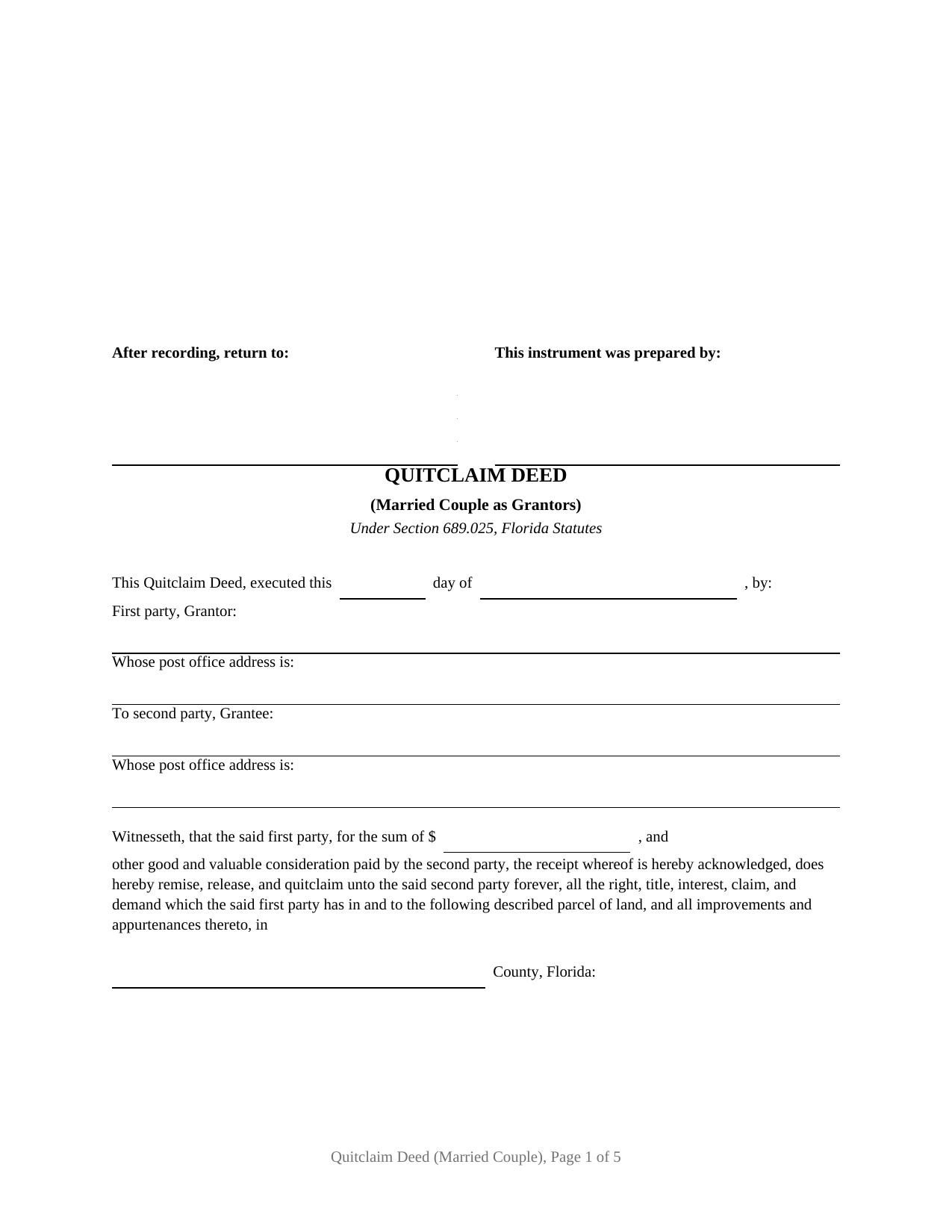
About the Florida Quitclaim Deed (Married Couple as Grantors)
How to Use This Form
- Select your county from the list
- Download the county-specific form
- Fill in the required information
- Have the document notarized if required
- Record with your county recorder's office
What Others Like You Are Saying
"I was pleased with the process. Easy and secure. Great customer service. I will use again for sure"
"Once I found this site the rest was easy. I read through the guide but the example really helped the…"
"was not ready to pay for much needed forms but very important"
"Deeds.com made it easy to obtain and download the deed form I needed - I will keep this account acti…"
"Complete Package don't spend good money for a title co. to do this"
4.8/5 from 4,825 reviews. Read all
Two signatures, two pairs of witnesses, two acknowledgment certificates, one conveyance. This Florida quitclaim deed is configured for a married couple conveying together: both spouses sign as the first party, and the deed recites on its face that the two grantors are married to each other and that both join in its execution. It follows the statutory quitclaim form of Section 689.025, Florida Statutes, operative words included, and it carries the blank for the county parcel identification number that section calls for.
What two spousal signatures accomplish
Florida presumes that real property titled in both spouses' names is held as a tenancy by the entirety, a form of ownership the spouses convey together rather than in halves. And where the property is the couple's constitutional homestead, Article X, Section 4(c) of the Florida Constitution permits a married owner to alienate it by sale, gift, or mortgage only with the spouse joined in the instrument. A quitclaim executed by both spouses conveys the entireties title as a whole and carries the homestead joinder on its face, and this form recites the marriage so the record shows both signatures doing that work.
The married-couple configuration
The form recites exactly two grantors, married to each other, each signing in his or her own right. The first-party entry takes both names with the couple's status words, the way a vesting deed to spouses reads them; the second-party entry takes the grantee's name and post office address. Each spouse has a separate signature block, two subscribing witness blocks of his or her own, and a separate acknowledgment certificate, so the two may sign on different days or before different notaries. Parents deeding a jointly titled house to an adult child, spouses conveying entireties property to a purchaser who has bargained for a quitclaim, and a couple releasing their shared record interest in a family parcel present the pattern this deed recites. The form is not set up as a conveyance from one spouse to the other, as a deed by one titled spouse with the other spouse joining only for homestead purposes, as a deed between former spouses, or as a conveyance by an entity, a trustee, or an agent under a power of attorney.
Remise, release, and quitclaim
The statutory form's operative words, "does hereby remise, release, and quitclaim," pass the grantors' right, title, interest, claim, and demand in the described land, together with improvements and appurtenances, and nothing more. Florida courts describe the quitclaim as conveying only the interest the grantor actually has, which may be an entire fee, a fractional share, or nothing at all. No covenant of title travels with it: the grantee takes subject to mortgages, taxes, easements, and restrictions, whether or not the deed mentions them. That bare-bones character is why the form appears so often in transfers between relatives and in title cleanups, where the work is moving an interest rather than guaranteeing one. An unusual Florida wrinkle sits in the recording act itself: Section 695.01(2) deems grantees by quitclaim deed bona fide purchasers without notice, so a recorded Florida quitclaim carries recording-act protection that some states withhold from the form.
Witnesses, the notary, and the clerk's window
Florida deeds are signed in the presence of two subscribing witnesses, and for instruments executed since January 1, 2024, each witness's printed name and post-office address belong on the instrument as recording requirements. The form provides labeled witness blocks as to each grantor, a separate statutory acknowledgment certificate for each spouse in the Section 695.25 short form with the physical-presence or online-notarization boxes current law calls for and a reserved area for the notary's seal, a preparer block naming a natural person, and a first page that keeps the statutory 3-inch square at the top right blank for the Clerk of the Circuit Court. Documentary stamp tax is collected at recording: 70 cents per $100 of consideration in every county but Miami-Dade, with a minimum of 70 cents on a no-consideration transfer of unencumbered property, and with any outstanding mortgage counted as consideration even in a gift between relatives.
Inside the download
The package includes the blank deed as a fillable PDF with a removable instructions page, a plain-language guide keyed to every entry on the form, and a completed example showing a married couple's transfer from start to finish, witness and notary blocks included. The materials describe the statutes and the form; they are informational and are not legal advice.
Important: County-Specific Forms
Our quitclaim deed (married couple as grantors) forms are specifically formatted for each of the 67 counties in Florida.
After selecting your county, you'll receive forms that meet all local recording requirements, ensuring your documents will be accepted without delays or rejection fees.