Florida Quitclaim Deed (Two Grantors to Themselves as Trustees)
County Specific Legal Forms Validated as recently as October 10, 2026 by our Forms Development Team
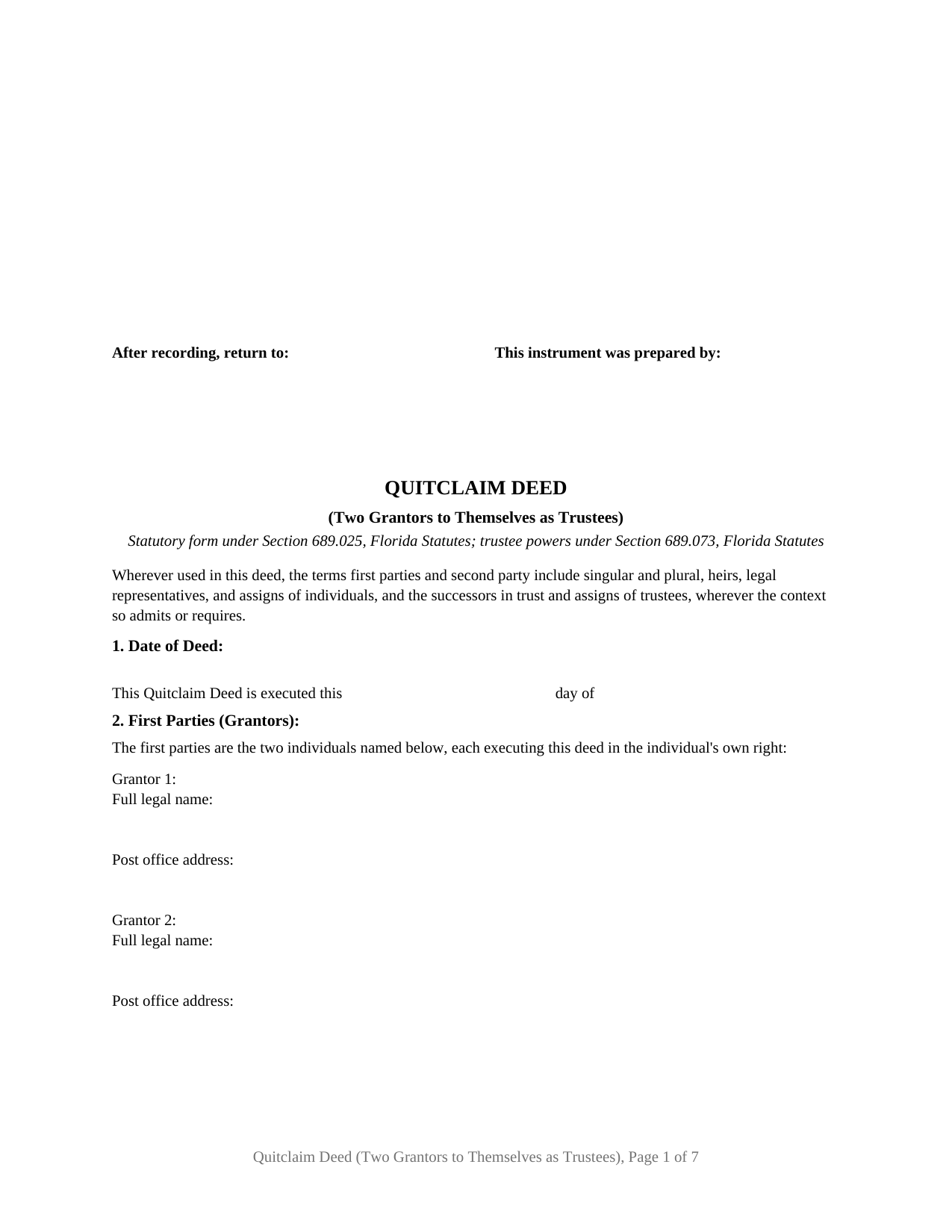
About the Florida Quitclaim Deed (Two Grantors to Themselves as Trustees)
How to Use This Form
- Select your county from the list
- Download the county-specific form
- Fill in the required information
- Have the document notarized if required
- Record with your county recorder's office
What Others Like You Are Saying
"Could not have been easier. Instructions were clear. Guidelines and example were clearly written. Er…"
"It was simple and fast thanks so much."
"This process was so easy."
"Very fast and easy! Thanks!!"
"This is a great service. I submitted the information and the next day my deed had been recorded. Onl…"
4.8/5 from 4,828 reviews. Read all
Nobody new appears on this deed. The two individuals who sign it as grantors are the very people who take title, renamed on the grantee line as trustees of one identified trust. This Florida quitclaim deed prepares that conveyance: the recorded step that moves co-owned real property into trustee title under the grantors' own trust, most often the joint revocable living trust they settled together.
Same two people, a different capacity
Florida law is comfortable with settlors standing on both sides of a trust arrangement. Section 689.075, Florida Statutes, states that an otherwise valid inter vivos trust is not invalid, and is not an attempted testamentary disposition, because the settlor or another person holds the power to revoke, amend, or modify it, or to control the trustees in administering it. The statute's separate sole-trustee paragraph addresses a single trustee, not two settlors serving as cotrustees. After recording, the clerk's index shows the two holding as trustees. The trust instrument governs the beneficial interests and generally need not be recorded with the deed. Because section 689.07 vests a personal fee simple in a grantee labeled trustee when the deed identifies no trust, this deed names the trust and the date of its trust instrument on its face.
Recorded powers a later buyer can rely on
The deed also carries the recorded powers language of section 689.073, Florida Statutes, granting the two trustees, and any successor trustee, full power and authority to protect, to conserve, to sell, to lease, to encumber, or otherwise to manage and dispose of the described real property. Under that section the recorded grant is what third parties may act on: a later buyer or lender reads the authority in the county records, with no duty to look behind the deed into the trust agreement.
Two signatures, four witness blocks, one trust
The configuration is fixed on the face of the form. Two grantor signature lines print, each followed by its own pair of subscribing witness blocks with printed name and post office address entries, and an acknowledgment certificate follows for each grantor, so the two may appear on different dates or before different notaries. Each certificate closes with a reserved area for the notary's official seal; each grantor states a full legal name and post office address, and the two trustees have separate address entries. The second party section states as fixed text that the grantees are the same two individuals named as grantors, taking as trustees of the named trust. Married settlors funding the trust they share, and two relatives placing a co-owned parcel under one family trust, present the two-owner pattern this deed recites; where the grantors are spouses and the parcel is their constitutional homestead, both are already signing, so the joinder that article X, section 4(c) of the Florida Constitution attaches to a married owner's homestead conveyance appears in the signatures themselves. What the form is not set up as: a sole owner's funding deed, a conveyance to a trustee who is not a grantor, a split between two trusts, an entity or attorney-in-fact conveyance, or three or more owners.
The statutory form and the tax rule underneath
Beneath the trust configuration is the quitclaim form prescribed by section 689.025, Florida Statutes: the operative remise, release, and quitclaim clause and the parcel identification number blank, with no covenant of title in the instrument. Recording follows chapter 695, from the two-witness data rules in force since January 2024 to the clerk's reserved square on page one. On the tax line, current Florida Administrative Code Rule 12B-4.013(25), effective January 25, 2026, analyzes a conveyance to or from a trustee by beneficial ownership and consideration rather than by the fiduciary label a deed carries, and Rule 12B-4.013(25)(i) states that a deed to a trustee from a grantor holding the power to revoke the trust, and a deed back on revocation, are not transfers of ownership subject to the tax. What a given deed owes is not settled by a nominal consideration figure or by a mortgage on the land; the trust's terms, beneficial ownership before and after, and the consideration chapter 201 measures decide it.
The download pairs the fillable blank deed and its removable instructions page with a completed example that funds a Duval County couple's revocable living trust, and a plain language guide covering every section, the witnessing and certificate mechanics, the documentary stamp tax analysis for trust conveyances, and recording. The materials are informational only; they are not legal advice.
Important: County-Specific Forms
Our quitclaim deed (two grantors to themselves as trustees) forms are specifically formatted for each of the 67 counties in Florida.
After selecting your county, you'll receive forms that meet all local recording requirements, ensuring your documents will be accepted without delays or rejection fees.