Ohio Fiduciary Deed (Administrator)
County Specific Legal Forms Validated as recently as October 23, 2026 by our Forms Development Team
About the Ohio Fiduciary Deed (Administrator)
How to Use This Form
- Select your county from the list
- Download the county-specific form
- Fill in the required information
- Have the document notarized if required
- Record with your county recorder's office
What Others Like You Are Saying
"Service is good. The website isn't very user friendly and could use some updating. Overall I'm happy…"
"I recommend you add a box "Add another document or package." The way it is now confused me…"
"Whomever "KCH" is, that person was of great help. It took me several tries due my inexperi…"
"The personal attention and the ease of use is beyond any other service I have used. Thank you for ma…"
"The documents' format contained information needed to complete the necessary paperwork for filing wi…"
4.8/5 from 4,830 reviews. Read all
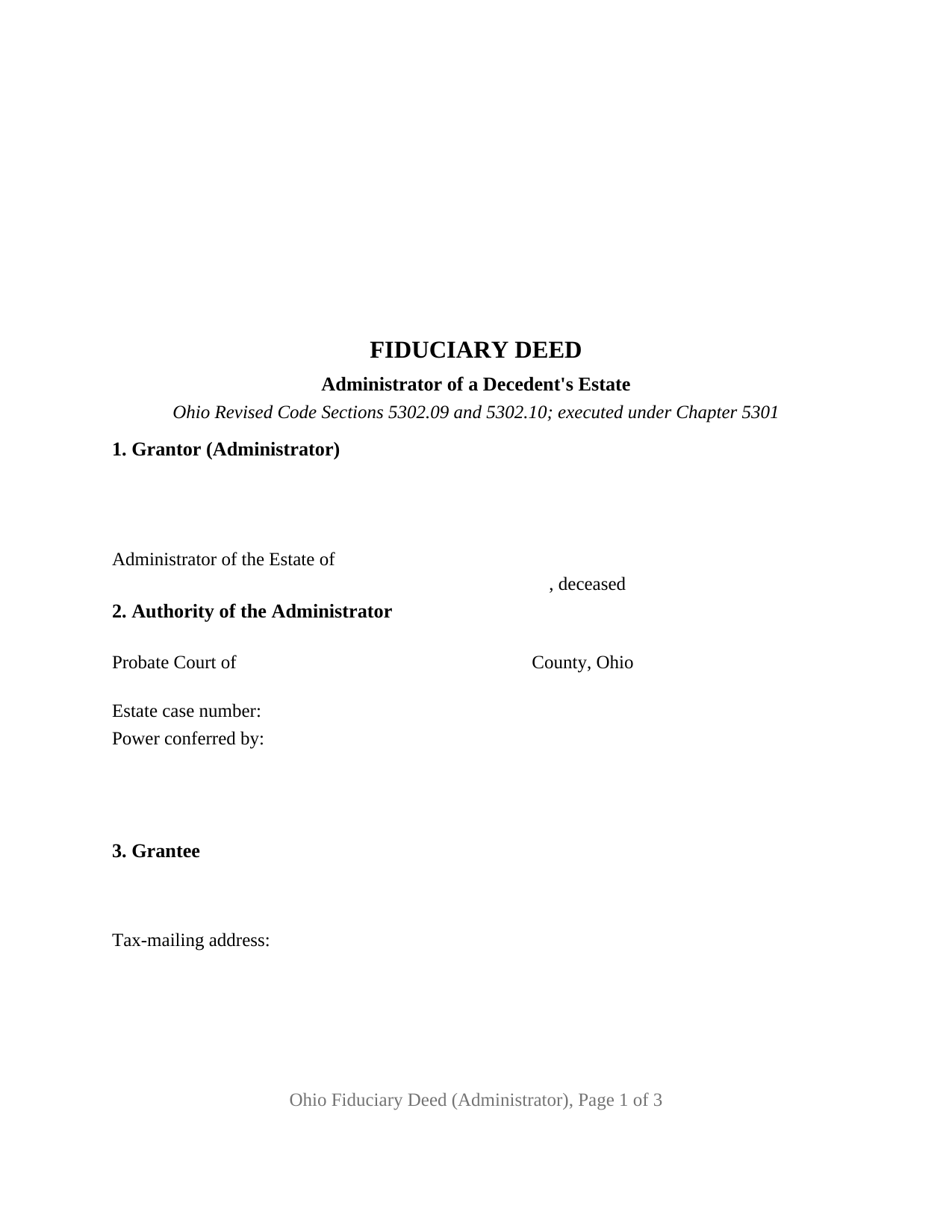
An Ohio fiduciary deed signed by the administrator of a decedent's estate conveys estate real property to a purchaser under authority the deed itself identifies: a probate court's order of sale and entry confirming the sale under Chapter 2127 of the Ohio Revised Code, or a power of sale the surviving spouse and all of the heirs consented to in writing under Section 2127.011. This form prepares that deed, sometimes called an administrator's deed or a probate estate deed, for one administrator conveying under the statutory form in Section 5302.09, with the words grants, with fiduciary covenants, printed in the conveyance.
Covenants about the administrator, not the title
Section 5302.10 gives the phrase fiduciary covenants a fixed meaning: the grantor covenants that the grantor is duly appointed, qualified, and acting in the fiduciary capacity the deed describes, is duly authorized to make the sale and conveyance, and has complied with the statutes governing the sale. Those are covenants about the administrator's authority, not the general or limited warranty covenants Ohio's other statutory deeds carry; a purchaser's title examination, rather than the deed, addresses the condition of the title.
The authority the deed recites
Section 2 of the form names the probate court that issued the letters of administration, the estate case number, and the power conferred by a statute, order, or instrument, in the words Section 5302.09 uses. Chapter 2127 supplies the usual source: a land sale action in the probate court, brought under Section 2127.02 when the personal property cannot cover the debts and costs of administration or under Section 2127.04 when it can, ending in the confirmation and order for a deed under Section 2127.35, which makes the deed prima facie evidence that the administrator followed the court's direction and vests title as if the decedent had conveyed it in life. Section 2127.011 supplies a second path with no land sale action: written consents from the surviving spouse and all heirs filed in the probate court, a price of at least eighty per cent of the appraised value in the approved inventory, and no heir who is a minor. The same blank holds the filed consents, or a testamentary power of sale for an administrator with the will annexed.
One administrator, one signature, one certificate
The form recites exactly one grantor, an individual acting solely as administrator of one named decedent's estate, and carries one signature block headed GRANTOR (ADMINISTRATOR). Its single acknowledgment certificate is in the short form Section 147.55(F) prints for a personal representative, so the certificate itself records the representative capacity. The decedent's surviving spouse has no signature line: Section 2127.16 has the property sold free of all right and expectancy of dower, with an allowance from the proceeds in its place. Co-administrators, executors acting under a power of sale in a will, trustees, and guardians present signing patterns and capacity recitals that this deed is not set up as. Two purchasers who take together appear with a vesting designation following their names in the grantee section; the completed example shows the survivorship words.
Two county offices before the record
An Ohio deed of absolute conveyance goes to the county auditor before the county recorder. The grantee files the conveyance fee statement under Section 319.202, and the auditor collects the state fee of ten cents per hundred dollars of value, paid by the grantor under Section 319.54(G)(3), plus any county permissive transfer tax of up to thirty cents per hundred dollars. The court order exemption in that section does not reach a sale effected or completed under the order, so a confirmed estate sale pays the fee on its price, and the auditor's transferred stamp is what Section 317.22 requires before the recorder accepts the deed. The form is built to the Section 317.114 format rules, with the three inch blank top margin on the first page the county offices stamp into, and it carries the grantee's tax mailing address and a prior instrument reference under Section 319.20, the preparer's name under Section 317.111, and the survey statement Section 5301.25(B) calls for when a survey of the land was made.
The package includes the fillable fiduciary deed form, a completed example filled in for a Franklin County estate sale, and the guide that walks through every numbered section, the signing formalities, and the auditor and recorder steps. This description and the guide describe the form and the governing Ohio statutes in general terms; they are not legal advice.
Important: County-Specific Forms
Our fiduciary deed (administrator) forms are specifically formatted for each of the 88 counties in Ohio.
After selecting your county, you'll receive forms that meet all local recording requirements, ensuring your documents will be accepted without delays or rejection fees.