Ohio Fiduciary Deed (Two Co-Administrators)
County Specific Legal Forms Validated as recently as October 24, 2026 by our Forms Development Team
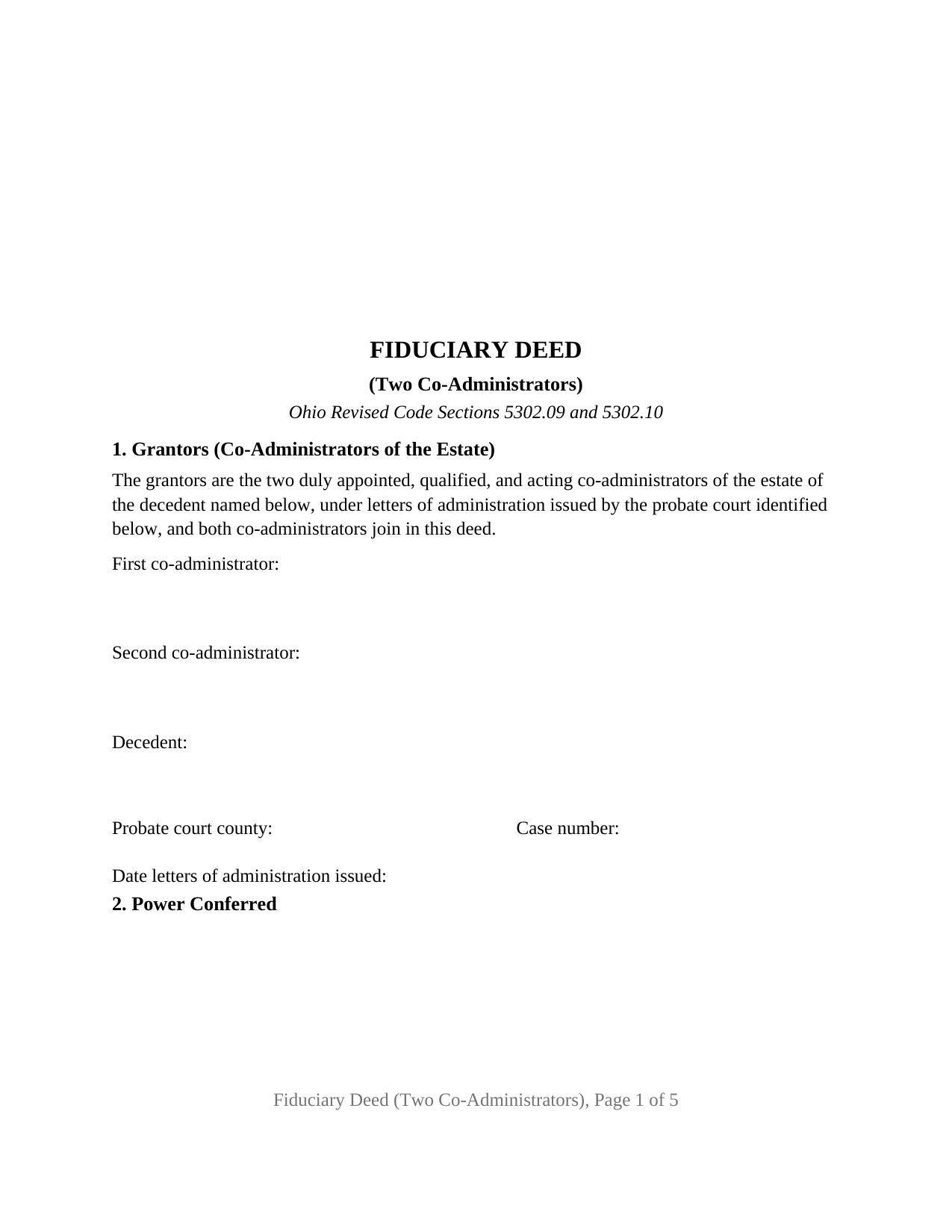
About the Ohio Fiduciary Deed (Two Co-Administrators)
How to Use This Form
- Select your county from the list
- Download the county-specific form
- Fill in the required information
- Have the document notarized if required
- Record with your county recorder's office
What Others Like You Are Saying
"The best people to work with! Thank you for all you do. We send documents from all states to Deeds.c…"
"The fillable form was usable but awkward as most of these forms are. The example and guide were both…"
"Hi When and how will I get the copy of my deed ? Thanks"
"Great service and all seems to be what I was looking for"
"Very simple process to purchase and download. Made it easy to understand the different forms and the…"
4.8/5 from 4,831 reviews. Read all
When two co-administrators sell real estate out of an Ohio decedent's estate, both of them sign the deed. This form prepares an Ohio fiduciary deed, sometimes called an administrator's deed or estate deed, for exactly two co-administrators of one estate, conveying with fiduciary covenants under Ohio Revised Code Sections 5302.09 and 5302.10 on authority from the probate court.
Two fiduciaries, two signatures, two certificates
Section 1 recites, as fixed text, that the grantors are the two duly appointed, qualified, and acting co-administrators of the decedent's estate under letters of administration issued by the probate court identified in the deed, and that both co-administrators join in the deed. The signature section carries two blocks, FIRST CO-ADMINISTRATOR (GRANTOR) and SECOND CO-ADMINISTRATOR (GRANTOR), and two acknowledgment certificates follow, one for each signer. Ohio law does not call for a certificate per signer; the two certificates are this form's layout, so the co-administrators can acknowledge on different days or before different officers. Each certificate uses the Section 147.55(F) short form, and its by-line receives the co-administrator's name and title of position.
Authority that comes from the court, not from a will
An administrator has no testamentary power of sale, so Section 2127.01 sends administrators to the land sale chapter: a civil action in the probate court under Sections 2127.02 and 2127.04, with the surviving spouse, heirs, and lienholders as parties, the property sold free of dower under Section 2127.16, and the sale confirmed and a deed ordered under Section 2127.35, after which the deed is received in all courts as prima facie evidence that the administrators observed the court's direction. The other path is Section 2127.011, under which an administrator may deliver a deed without a court order when the surviving spouse and all heirs file written consents to a power of sale, the price is at least eighty percent of the appraised inventory value, and no heir is a minor. Section 2 of the deed names whichever source applies, and the operative clause conveys by that power and every other power.
What the fiduciary covenants promise
Under Section 5302.10, a grant with fiduciary covenants means the grantors covenant that they are duly appointed, qualified, and acting in the fiduciary capacity described in the deed, that they are duly authorized to make the sale and conveyance, and that in all of their proceedings in the sale they have complied with the requirements of the statutes. The covenants run to the co-administrators' standing and procedure, not to the title the decedent held; the encumbrances, reservations, and exceptions the conveyance is subject to have their own section.
What this configuration recites
The form fixes the grantor side and leaves the grantee side open. It recites exactly two co-administrators of one estate, names the decedent and the probate court and case number, and takes no marital status from either fiduciary, because co-administrators are not seized of estate property in their own right and their spouses hold no dower in it. The grantee section receives one grantee, or two grantees with any designation of how they take title, with the tax-mailing address the county auditor requires. Two adult children appointed together to administer a parent's intestate estate and selling the parent's house under an order of sale, and a surviving spouse and an adult child serving as co-administrators and conveying under the heirs' filed consents, present the pattern this deed recites. A deed by a single administrator, by one remaining co-administrator after the other has resigned or died under Section 2109.27, by co-executors acting under a power of sale in a will, or by three or more fiduciaries presents a different pattern.
Through the auditor to the recorder
A sale for a price ordinarily carries the conveyance fee of Section 319.54(G)(3) and any county transfer tax under Chapter 322 on the consideration stated in Section 3, paid when form DTE 100 is filed with the county auditor, and the auditor's transfer stamp has to be on the deed before the recorder will take it under Section 317.22. The form meets the Section 317.114 format in twelve point type and runs five recorded pages.
The package contains the fillable fiduciary deed, a completed example filled in for two co-administrators of a Summit County estate conveying under a confirmed land sale, and the guide covering each numbered section and the two statutory paths to the administrators' authority. This description and the guide explain the form and the Ohio statutes behind it in general terms and are not legal advice.
Important: County-Specific Forms
Our fiduciary deed (two co-administrators) forms are specifically formatted for each of the 88 counties in Ohio.
After selecting your county, you'll receive forms that meet all local recording requirements, ensuring your documents will be accepted without delays or rejection fees.