Ohio Fiduciary Deed (Executor)
County Specific Legal Forms Validated as recently as October 23, 2026 by our Forms Development Team
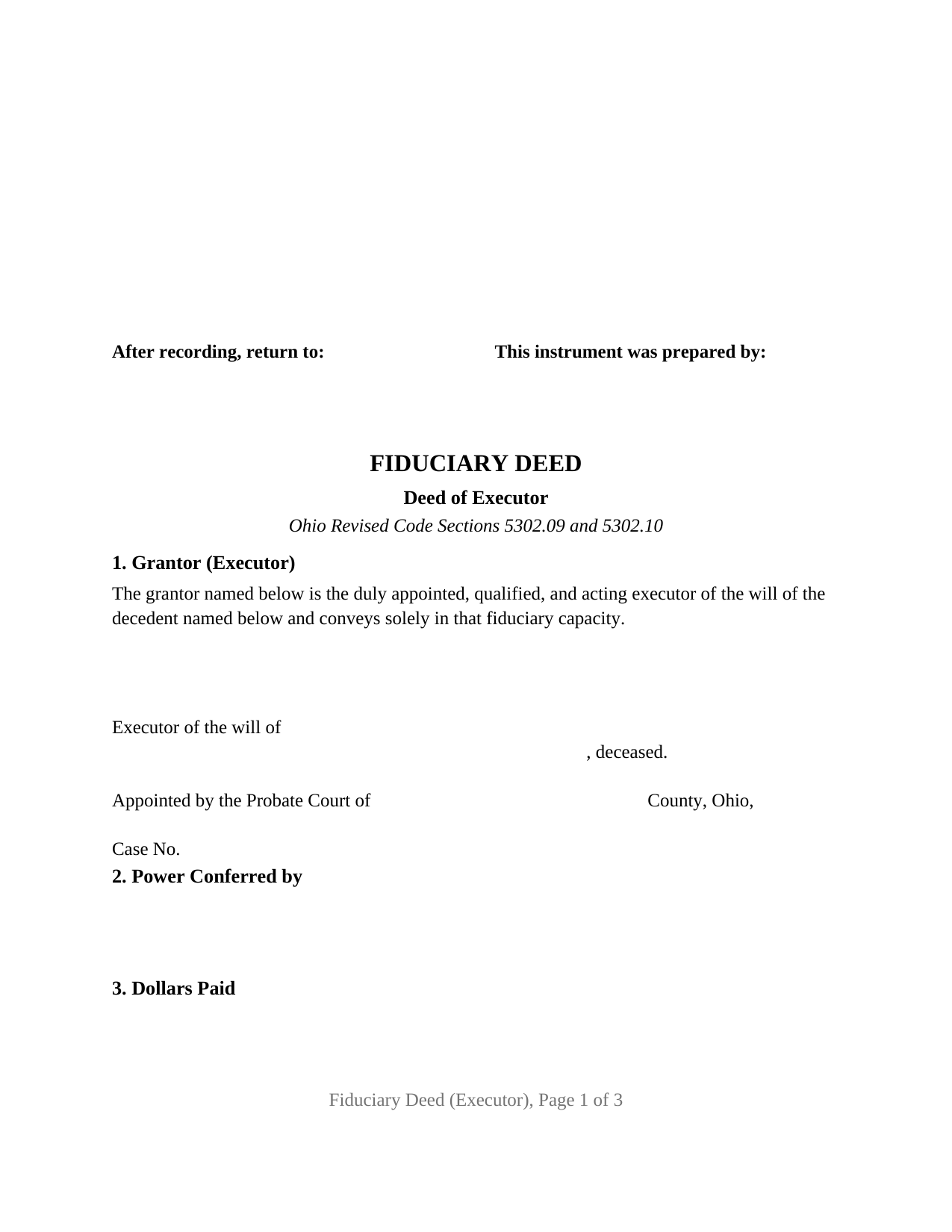
About the Ohio Fiduciary Deed (Executor)
How to Use This Form
- Select your county from the list
- Download the county-specific form
- Fill in the required information
- Have the document notarized if required
- Record with your county recorder's office
What Others Like You Are Saying
"I was able to get all the Forms I required and it was straight forward and easy. Thank you , Walt R."
"Very quick and efficient service! I will continue to use them for future reference."
"Very quick and gave me exactly what I needed! I would have had to go down to the courts and take off…"
"Very thorough with plenty of instructions. Nice to be able to fill in the forms on my computer at my…"
"Easy to use...very informative...ttook care of exactly what I was looking for."
4.8/5 from 4,830 reviews. Read all
An Ohio fiduciary deed signed by an executor conveys real property out of a decedent's estate to a buyer on the strength of a power the deed itself names. This form prepares that deed for one executor appointed under a will, with the fiduciary covenants of Ohio Revised Code Section 5302.10, for recording in any Ohio county.
A deed that recites where the power to sell comes from
Ohio gives an executor three routes to a sale, and the deed form in Revised Code Section 5302.09 leaves a blank for whichever one applies: by the power conferred by, and every other power. Where the will grants a power of sale, Section 2113.39 provides that no probate court order is required and that the power reaches any sale the executor considers to be for the best interest of the estate unless the will limits it. Where the will is silent, Section 2127.011 supplies a power of sale on the written consents of the surviving spouse and every legatee and devisee, filed in the probate court, and Chapter 2127 supplies the court-supervised land sale that ends in an order confirming the sale and directing the deed under Section 2127.35. Section 2 of this form holds that recital; the completed example cites an item of the will, the probate case number, and the date the will was admitted.
Fiduciary covenants reach the office, not the chain of title
The operative words are the statute's own: grants, with fiduciary covenants. Section 5302.10 gives that phrase the full force of a covenant that the grantor is duly appointed, qualified, and acting in the stated fiduciary capacity, is authorized to make the sale and conveyance, and has complied with the statutes governing the sale. Those covenants concern the executor's office and authority, not every prior link in the title. A deed in substance following the Section 5302.09 form takes effect as a deed in fee simple to the grantee, and after a court-confirmed sale Section 2127.35 makes the deed prima facie evidence that the executor followed the court's directions.
One executor, one signature, one certificate
This configuration fixes the grantor's capacity as deed text. Section 1 recites that the grantor is the duly appointed, qualified, and acting executor of the will of the named decedent, identifies the probate court and case number from the letters testamentary, and states that the executor conveys solely in that fiduciary capacity. The deed carries a single signature block and a single acknowledgment certificate in the Ohio statutory short form for a personal representative under Section 147.55(F), completed with the executor's name and title of position. No spouse signs and no dower release appears: the executor conveys in a representative capacity, and a Chapter 2127 sale passes the land free of dower under Section 2127.16. A sole executor selling estate real estate to an outside purchaser, and a surviving spouse serving as executor and buying a parcel under the consent procedure, both present the one-executor pattern this deed recites. The form is not set up as an administrator's, trustee's, or guardian's deed, or as a deed by two coexecutors, each of which recites a different office or a second signer; a distribution to a devisee passes by a probate certificate of transfer, not a deed.
What the auditor and the recorder look for
An executor's sale is a conveyance for value, so the deed travels to the county auditor with the DTE 100 conveyance fee statement before the recorder accepts it. The form carries the two items Section 319.20 makes the auditor's transfer depend on, the grantee's tax-mailing address and a prior instrument reference to the deed by which the decedent took title, plus the survey statement Section 5301.25 describes. The page geometry follows Section 317.114: a three-inch blank first-page top margin for the county stamps and the recorder's endorsement, one-inch side and bottom margins, and a one-and-one-half-inch top margin on later pages, with the preparer's name Section 317.111 requires. The deed prints on three recordable pages behind a non-recorded instructions cover.
The package includes the fillable fiduciary deed, a completed example filled in for a Franklin County estate sale under a testamentary power of sale, and the guide that walks through each numbered section, the sources of an executor's authority, and the auditor and recorder steps. This description and the guide describe the form and the governing Ohio statutes in general terms; they are not legal advice.
Important: County-Specific Forms
Our fiduciary deed (executor) forms are specifically formatted for each of the 88 counties in Ohio.
After selecting your county, you'll receive forms that meet all local recording requirements, ensuring your documents will be accepted without delays or rejection fees.