Ohio Fiduciary Deed (Guardian)
County Specific Legal Forms Validated as recently as October 24, 2026 by our Forms Development Team
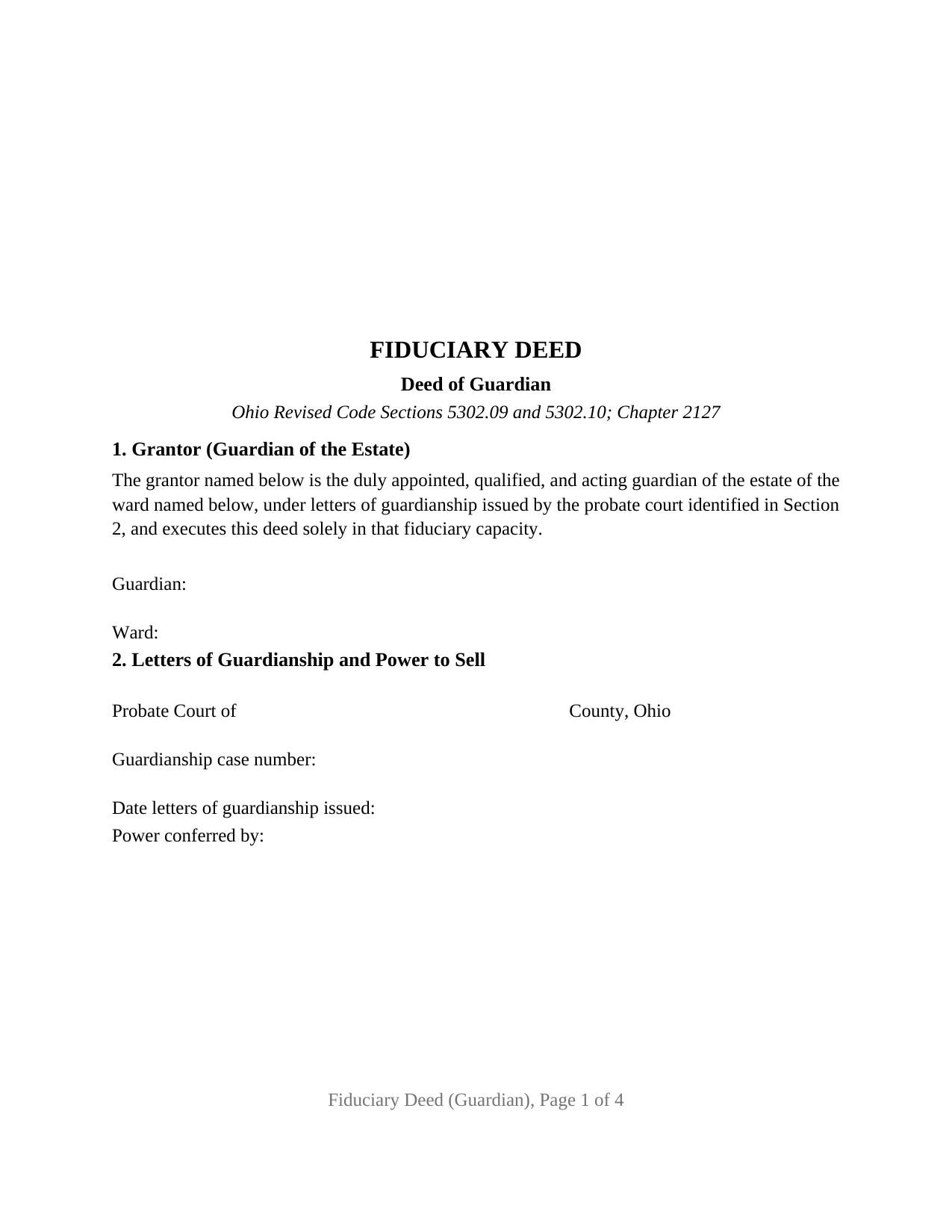
About the Ohio Fiduciary Deed (Guardian)
How to Use This Form
- Select your county from the list
- Download the county-specific form
- Fill in the required information
- Have the document notarized if required
- Record with your county recorder's office
What Others Like You Are Saying
"I did my Lady Bird Deed in a way the instruction indicated to do. The example you provided make it e…"
"Everything great thank you"
"Very easy process and was recorded in a prompt manner. We will be using your services again in the f…"
"i have used you guys once and i am happy with the service i will be using you guys again"
"Good documents. Very helpful."
4.8/5 from 4,833 reviews. Read all
An Ohio fiduciary deed signed by a guardian conveys land the signer does not own. The guardian of a ward's estate holds no title to the ward's real property, only an office created by letters of guardianship and the probate court's authority for the sale. This form prepares that deed, often searched for as a guardian's deed or guardianship deed, under Section 5302.09 of the Ohio Revised Code, for one guardian and one ward.
Two roads to a guardian's power of sale
Chapter 2127 of the Revised Code governs every sale of a ward's land by a guardian. Under Section 2127.05 the guardian of the estate of a minor or an incompetent adult brings a civil action in the probate court for authority to sell when the sale is necessary for the ward's support or debts, to discharge liens, to stop waste, or whenever a sale will benefit the ward; the ward, the ward's spouse, the next of kin, and the lienholders are parties under Section 2127.13, and when the court finds the returned sale legally made, it confirms the sale and orders the guardian to make a deed under Section 2127.35. Section 2127.012 opens a second road with no land sale action: written consents from the ward's spouse and the next of kin filed in the probate court, a price of at least eighty per cent of appraised value, and the bond the court fixes. Section 2 of the deed holds whichever source applies.
Title as if the ward had conveyed it
Section 2127.35 provides that a deed made under the court's confirmation is received in all courts as prima facie evidence that the guardian observed the court's directions and complied with the law, and vests title in the purchaser as if conveyed by the ward free from disability. The ward's spouse signs nothing: Section 2127.16 sells the property free of dower and substitutes a money allowance from the proceeds. The guardian's own marital status never enters the deed; the Section 5302.09 form prints no marital status and no dower release.
One guardian, one ward, one certificate
The form fixes its configuration as deed text. Section 1 recites that the grantor is the duly appointed, qualified, and acting guardian of the estate of the named ward, under letters issued by the probate court identified in Section 2, and signs solely in that capacity. One signature block, headed GRANTOR (GUARDIAN), and one acknowledgment certificate follow; the certificate's open line holds the guardian's name and title of position, the pattern of the Section 147.55(F) short form. A guardian selling an incompetent adult's house under a confirmed sale to pay for the ward's care, and the guardian of a minor's estate selling inherited acreage under consents filed by the minor's next of kin, present the one-guardian pattern this deed recites. The deed is not set up as an executor's, administrator's, or trustee's deed, as a deed by two co-guardians, or as a deed by a guardian of the person only.
What fiduciary covenants leave to the title search
The operative words are the statute's own: grants, with fiduciary covenants. Section 5302.10 expands them into a promise about the guardian, not the land: that the appointment was duly made, that the guardian is acting in the capacity the deed describes, that the sale and conveyance are duly authorized, and that the statutory requirements for the sale were met. That covenant reaches no lien or defect in the ward's chain of title.
A court-ordered sale still pays the conveyance fee
Because a confirmed guardian's sale is a sale, the court-order exemption in Section 319.54(G)(3)(f) does not reach it, and the deed pays the state conveyance fee of ten cents per hundred dollars of price, plus any county transfer tax under Chapter 322, when the DTE 100 statement is filed with the county auditor. The auditor's transferred stamp is what Section 317.22 requires before the recorder accepts the deed, which carries the grantee's tax-mailing address and prior instrument reference under Section 319.20, the survey statement of Section 5301.25(B), and the preparer's name under Section 317.111. The deed prints on four recordable pages to the Section 317.114 format, behind a non-recorded instructions cover.
The package includes the fillable fiduciary deed, a completed example filled in for a Hamilton County guardianship sale confirmed by the probate court, and the guide that walks through every numbered section and the auditor and recorder process. This description and the guide describe the form and Ohio's governing statutes in general terms; neither is legal advice.
Important: County-Specific Forms
Our fiduciary deed (guardian) forms are specifically formatted for each of the 88 counties in Ohio.
After selecting your county, you'll receive forms that meet all local recording requirements, ensuring your documents will be accepted without delays or rejection fees.