Ohio Fiduciary Deed (Trustee Grantee)
County Specific Legal Forms Validated as recently as October 24, 2026 by our Forms Development Team
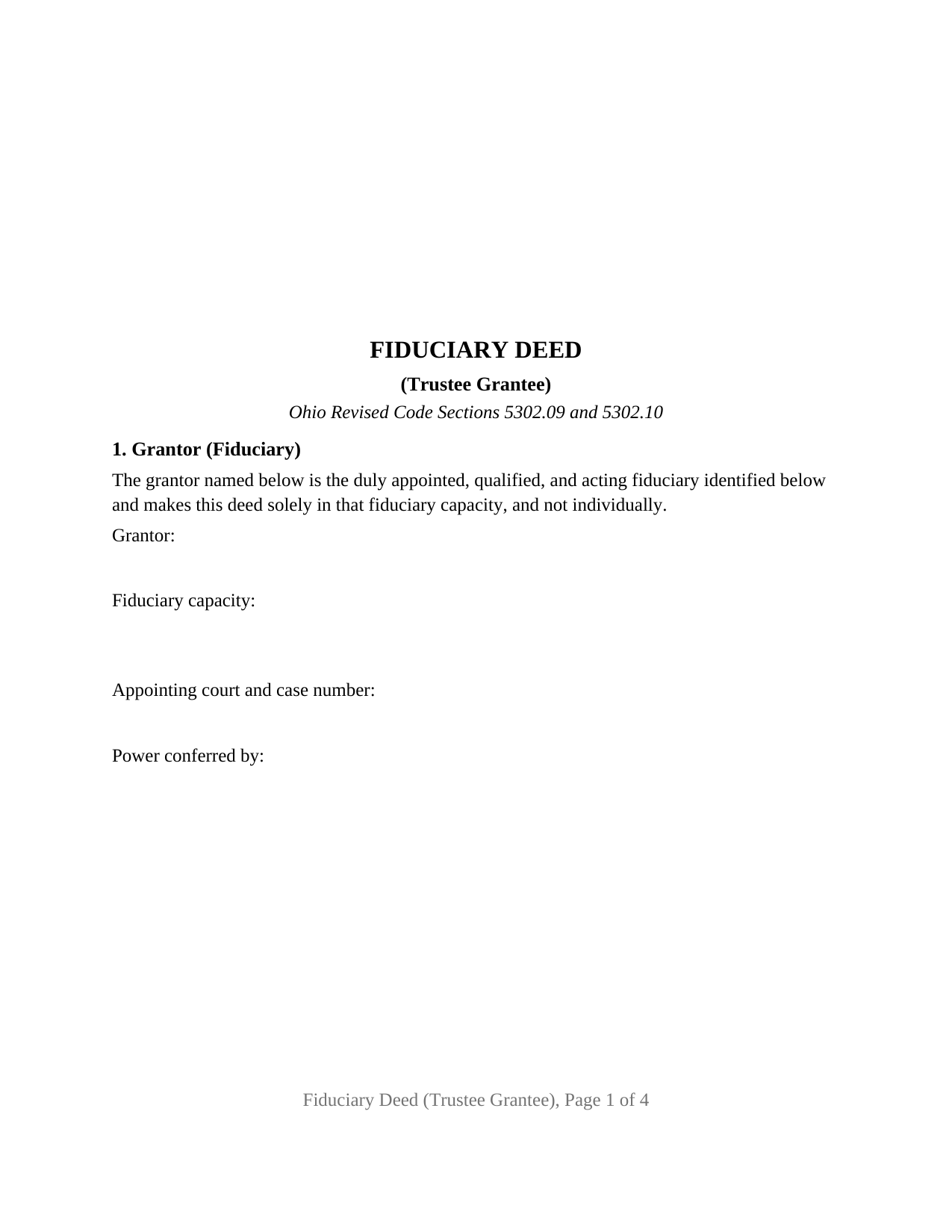
About the Ohio Fiduciary Deed (Trustee Grantee)
How to Use This Form
- Select your county from the list
- Download the county-specific form
- Fill in the required information
- Have the document notarized if required
- Record with your county recorder's office
What Others Like You Are Saying
"Easy and effective...surely saved hundreds by avoiding a lawyer."
"Thanks so much for the TOD Beneficiary Deed with the explanation, supplementary forms and great exam…"
"Awesome , easy-to-use and find exactly what I was needing and saved me alot of headache and money. W…"
"Great forms and info, easy step-by-step guidance."
"Prompt, accurate and professional response. Thank you. Kelin F."
4.8/5 from 4,831 reviews. Read all
An Ohio fiduciary deed to a trustee grantee moves real property that a fiduciary is selling or distributing into a trust the way Ohio's trust-title statutes are written around: by naming the trustee, not the trust, as the grantee. This form prepares that deed under Ohio Revised Code Sections 5302.09 and 5302.10 for one fiduciary grantor and one grantee who takes title as trustee of a named trust, and not individually.
A grantee who holds for someone else
The receiving side of this deed is its defining feature. The grantee section opens with the fixed statement that the grantee takes title as trustee of the trust identified below, and not individually, then collects the trustee's name, the name of the trust, the date of the trust instrument, and the tax-mailing address Section 319.20 puts on every deed the county auditor transfers. The trust date is how Section 5301.255 identifies a trust in a memorandum of trust, which, as amended effective June 16, 2026, a trustee may record when acquiring property and must have of record before later conveying any interest in it. Section 5301.071(E) explains the naming convention: a recorded deed to a trust rather than its trustee counts as a deed to the trustee only if a memorandum describing the property is recorded in the same county.
Covenants about the fiduciary, not the chain of title
The deed grants with fiduciary covenants, a phrase Section 5302.10 defines as a covenant that the grantor holds the office the deed describes by due appointment and qualification, has authority to make the sale and conveyance, and has followed the statutes that govern the sale. Section 5302.03 provides that the word grant alone implies no covenant, so that phrase, printed as fixed text in the conveyance paragraph, is the trustee's covenant, and it reaches the grantor's office and authority rather than liens, easements, or earlier links in the title. The trustee's own power to buy comes from the trust instrument and from Section 5808.16(B) of the Ohio Trust Code.
What this configuration recites
Section 1 recites that the grantor is the duly appointed, qualified, and acting fiduciary identified below and makes the deed solely in that capacity, with lines for the name, office, appointing court, and source of the power to convey. Section 2 fixes the trustee grantee. The deed carries one signature block, headed GRANTOR (FIDUCIARY), and one acknowledgment certificate in the Section 147.55(F) short form for a public officer, trustee, or personal representative; the grantee signs nothing, and no marital status or dower release appears, because the Section 5302.09 form prints neither. An estate purchaser who takes title in the purchaser's revocable living trust, a successor trustee conveying trust real estate to the trustee of a second trust, and a guardian conveying a ward's parcel under court order to a trustee purchaser present the trustee-grantee pattern this deed recites. The form recites exactly one trustee as grantee; co-trustees, a grantee taking individually or as a couple, a company grantee, and a corporate fiduciary signing through an officer present patterns the form is not set up as.
Fee statement first, then the stamps, then the record
Because the grantee is a trustee, the conveyance fee statement the county auditor requires under Section 319.202 gets a closer look. Section 319.54(G)(3) charges ten cents per hundred dollars of value, paid by the grantor, plus a county transfer tax of up to thirty cents under Chapter 322, and a fiduciary's sale for a price pays on that price. The same section exempts a transfer to a trustee when the grantor of the trust has reserved an unlimited power to revoke it, a transfer to a trustee acting for a decedent's minor children, and a transfer for no money or other tangible consideration that is not a gift; the DTE 100EX reports the one the facts support. The auditor's transferred stamp is the condition Section 317.22 places on recording, and the form is built to the Section 317.114 format with the Section 317.111 preparer's name.
The package includes the fillable fiduciary deed, a completed example filled in for a Hamilton County estate sale to the trustee of a revocable trust, and the guide that explains each numbered section, the acknowledgment, and the county auditor and recorder steps. The description and the guide describe the form and the Ohio statutes that govern it in general terms only; they are not legal advice.
Important: County-Specific Forms
Our fiduciary deed (trustee grantee) forms are specifically formatted for each of the 88 counties in Ohio.
After selecting your county, you'll receive forms that meet all local recording requirements, ensuring your documents will be accepted without delays or rejection fees.