Ohio Fiduciary Deed (Bankruptcy Trustee)
County Specific Legal Forms Validated as recently as October 24, 2026 by our Forms Development Team
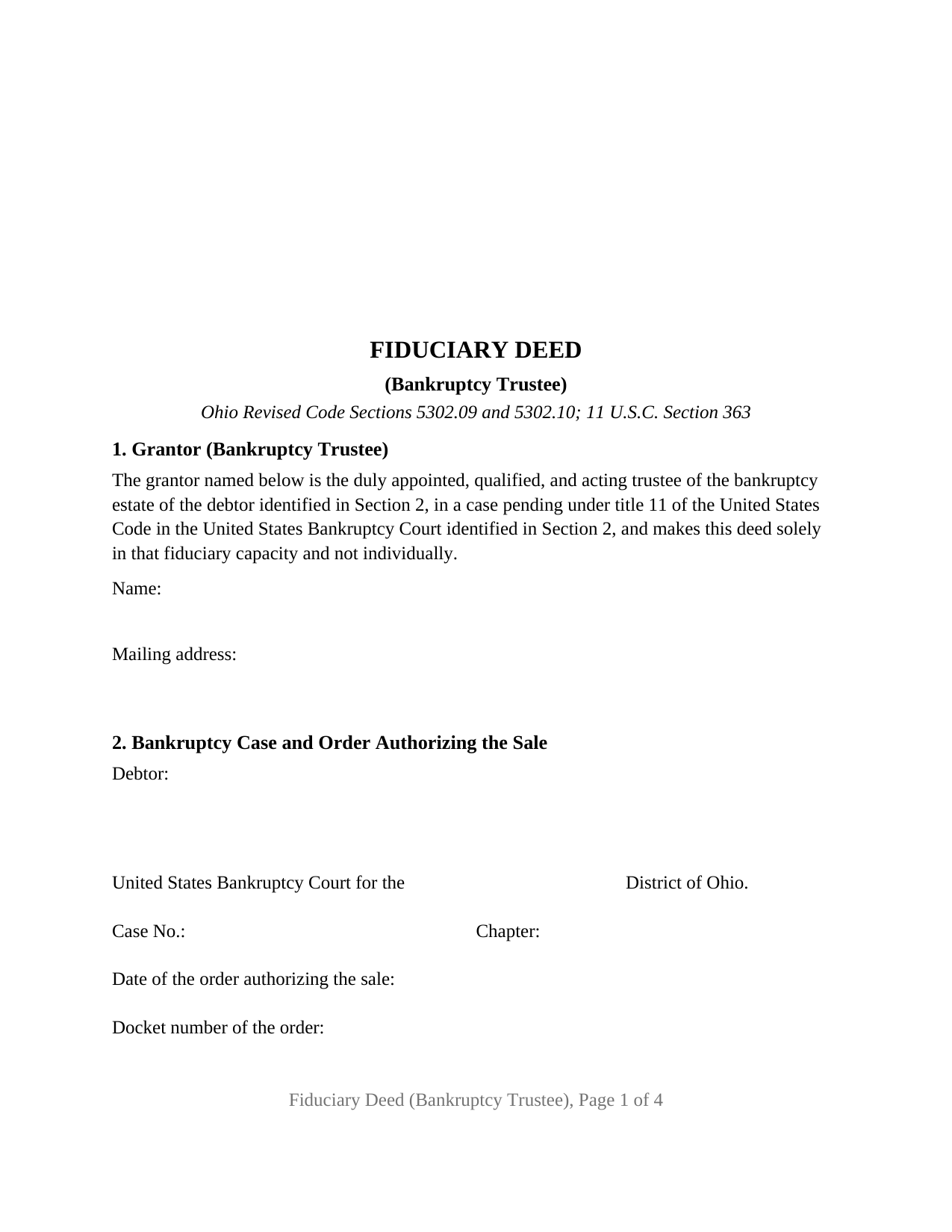
About the Ohio Fiduciary Deed (Bankruptcy Trustee)
How to Use This Form
- Select your county from the list
- Download the county-specific form
- Fill in the required information
- Have the document notarized if required
- Record with your county recorder's office
What Others Like You Are Saying
"All the paperwork I need......Great service"
"Great Help - very satisfied with the service - would recomend 100%"
"Easy and effective...surely saved hundreds by avoiding a lawyer."
"There's nothing to say except it couldn't be easier."
"quick and easy"
4.8/5 from 4,831 reviews. Read all
An Ohio fiduciary deed signed by a bankruptcy trustee conveys real property of the bankruptcy estate to the purchaser on the authority of a court order the deed names by date and docket number. This form prepares that deed, often searched for as a bankruptcy trustee's deed, for one trustee serving in a case under title 11 of the United States Code, on the statutory form in Ohio Revised Code Section 5302.09, which lists a trustee among the fiduciaries who convey with fiduciary covenants.
A deed that points to a docket entry
The statutory form leaves a blank for the power conferred by a named source. On this deed that source is federal: 11 U.S.C. Section 541 places the debtor's interests in property in the estate when the case is filed, Section 323 makes the trustee the estate's representative, and Section 363(b) lets the trustee sell estate property outside the ordinary course after notice and a hearing. Section 2 records the district, case number, chapter, the entry date of the order authorizing the sale, and its docket number, and the operative paragraph conveys by the power conferred by title 11 and by that order, and every other power. Bankruptcy Rule 6004(f)(2) has the trustee sign the transfer document once the sale is complete, and Rule 6004(h) stays the sale order for fourteen days after entry unless the court orders otherwise.
The covenant the trustee gives
The operative words are the statute's own: grants, with fiduciary covenants. Section 5302.10 expands them into a promise about the signer rather than the title: a lawful appointment, authority to make this sale, and compliance with the statutes governing it, here title 11 and the Bankruptcy Rules. The grantee takes no general warranty from a trustee's deed; the sale order, entered under Section 363(f) where one of its five conditions is met, decides which liens and interests the purchaser takes free of, and Section 7 of the deed lists what remains.
Dower resolved by federal law, not by a signature
Ohio gives a married owner's spouse a dower interest under Revised Code Section 2103.02, and a deed by a married person ordinarily carries the spouse's release. A trustee's deed does not: the debtor is not a party to it, and 11 U.S.C. Section 363(g) lets the trustee sell free and clear of any vested or contingent right in the nature of dower, with the spouse's protection moved to the purchase right in Section 363(i) and the share of proceeds in Section 363(j). A co-owner is reached only under the four conditions of Section 363(h). The deed therefore carries no spouse signature block and no dower sentence; the order it identifies states what the sale was free and clear of.
What the trustee's deed fixes as text
The form recites exactly one grantor, the duly appointed, qualified, and acting trustee of the named debtor's bankruptcy estate, conveying solely in that capacity and not individually, under a single signature block headed GRANTOR (BANKRUPTCY TRUSTEE). Its one acknowledgment certificate is drawn in the Section 147.55(F) short form for a trustee, so the by-line carries the trustee's name and office. A chapter 7 trustee liquidating a debtor's house, and a chapter 11 trustee selling a parcel under a Section 363 order, present the one-trustee pattern this deed recites; a debtor in possession conveying in its own name, a trustee of a living trust, and two co-trustees signing together present patterns the form is not set up as.
The auditor's fee on a court-ordered sale
Before the recorder accepts an Ohio deed, the county auditor endorses it under Section 319.202, and the conveyance fee of ten cents per one hundred dollars under Section 319.54(G)(3) applies: the court-order exemption in that section stops short of a sale completed under the order, and the stamp-tax exemption in 11 U.S.C. Section 1146(a) reaches only a transfer under a plan confirmed under Section 1129 or 1191 of that title. The deed follows the Section 317.114 format, with the three-inch blank first-page margin the county offices stamp into, and carries the Section 319.20 tax-mailing address and prior instrument reference and the Section 317.111 preparer name.
The package contains the fillable deed, a completed example filled in for a chapter 7 trustee's sale of a Summit County residence, and the guide that explains each numbered section, the trustee's authority, the certificate, and the auditor and recorder steps. The article and the guide describe the form and the governing statutes generally; neither is legal advice.
Important: County-Specific Forms
Our fiduciary deed (bankruptcy trustee) forms are specifically formatted for each of the 88 counties in Ohio.
After selecting your county, you'll receive forms that meet all local recording requirements, ensuring your documents will be accepted without delays or rejection fees.