Ohio Fiduciary Deed (Two Co-Trustees)
County Specific Legal Forms Validated as recently as October 24, 2026 by our Forms Development Team
About the Ohio Fiduciary Deed (Two Co-Trustees)
How to Use This Form
- Select your county from the list
- Download the county-specific form
- Fill in the required information
- Have the document notarized if required
- Record with your county recorder's office
What Others Like You Are Saying
"easy to use"
"the forms are easy to understand. How do I go about getting the deed recorded and is there a charge."
"I would've done this years ago if I'd known how easy it was! The plus is it's not expensive either. …"
"Great..."
"Worked exactly like it was supposed to. No glitches"
4.8/5 from 4,832 reviews. Read all
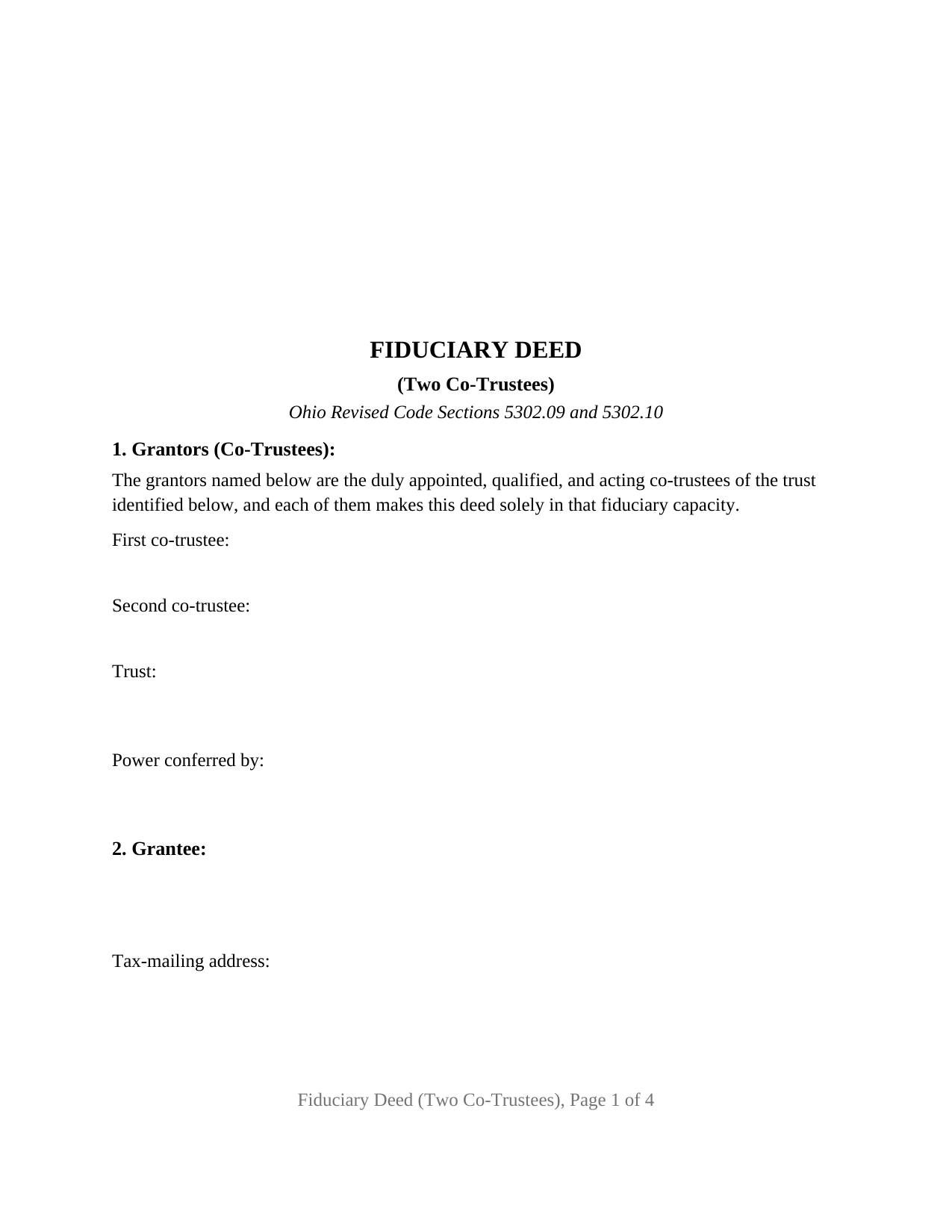
Two co-trustees of one Ohio trust sign this fiduciary deed together. It is the statutory deed of trustee in Section 5302.09 of the Ohio Revised Code, set up for exactly two co-trustees conveying real property the trust holds, with a signature block and an acknowledgment certificate for each of them and a recital that fixes their office as deed text. It answers searches for an Ohio trustee deed or co-trustee deed form.
No majority of two
Section 5807.03(A) of the Ohio Trust Code permits action by majority decision only if there are three or more cotrustees serving, and division (C) requires each cotrustee to participate in a trustee's function unless that cotrustee is unavailable or has properly delegated the function under division (E). A trust with two serving co-trustees therefore conveys on two signatures in the ordinary case; the terms of the trust, which prevail over the Trust Code's default rules under Section 5801.04, are where any different arrangement would be written. The power of sale itself comes from Section 5808.15, subject to the trust's own limits, and Section 5808.16(B) names it expressly.
A memorandum of trust already on the record
Since June 16, 2026, Section 5301.255(A), as amended by Senate Bill 101, provides that a memorandum of trust or other qualifying instrument shall be of record when any interest in real property is conveyed by the trustee of a disclosed trust. That instrument states the trustee's name and address, the date the trust was executed, and the trust's powers over the sale and encumbering of real property. It is a separate instrument, recorded apart from this deed and not included in this package; the completed example cites it by book and page.
What this configuration recites
Section 1 of the form states as fixed text that the two named grantors are the duly appointed, qualified, and acting co-trustees of the trust identified there and that each makes the deed solely in that fiduciary capacity; the blanks under it hold the two names, the trust's name and date, and the source of the power to convey. The operative sentence grants, with fiduciary covenants, the two words Section 5302.10 defines as a covenant that the grantor holds the office the deed describes, is authorized to make the sale and conveyance, and complied with the statutes that govern it. Those covenants do not reach the condition of the title.
Two signature blocks follow, headed GRANTOR (FIRST CO-TRUSTEE) and GRANTOR (SECOND CO-TRUSTEE), each followed by its own certificate in the Section 147.55(F) short form for a trustee, whose by-line carries the signer's name and title of position. The two certificates are the form's layout rather than a statutory command, and they let the co-trustees acknowledge on different days before different officers. No marital status and no dower release appear, because both grantors convey in a representative capacity and the Section 5302.09 form prints no dower sentence. Two adult children serving as successor co-trustees of a parent's revocable living trust, selling the trust's house to an outside buyer after the parent's death, and a settlor serving as co-trustee beside an adult child, selling a trust-owned rental, present the two-co-trustee pattern this deed recites. A sole trustee, three or more co-trustees, a remaining co-trustee acting alone after a vacancy, or a corporate trustee signing through an officer presents a different pattern, and the form is not set up as any of them.
At the auditor's counter
A trustee's sale for money is a conveyance for value, so the deed goes to the county auditor with the DTE 100 conveyance fee statement under Section 319.202 before the recorder will take it. The trust-related exemptions in Section 319.54(G)(3), divisions (t), (u), and (v), cover transfers into a revocable trust, back to its grantor, and out to its beneficiaries, not a sale to a purchaser, so the fee is computed on the price. The deed carries the grantee's tax-mailing address and prior instrument reference under Section 319.20 and the preparer's name under Section 317.111, on four recordable pages laid out to the Section 317.114 margins.
The package contains the fillable deed, a completed example prepared for a Hamilton County sale by two successor co-trustees, and a guide covering each numbered section, the co-trustee signing rule, the memorandum of trust, and the auditor and recorder steps. The description and the guide explain the form and the Ohio statutes behind it in general terms and are not legal advice.
Important: County-Specific Forms
Our fiduciary deed (two co-trustees) forms are specifically formatted for each of the 88 counties in Ohio.
After selecting your county, you'll receive forms that meet all local recording requirements, ensuring your documents will be accepted without delays or rejection fees.