Ohio Fiduciary Deed (Trustee)
County Specific Legal Forms Validated as recently as October 24, 2026 by our Forms Development Team
About the Ohio Fiduciary Deed (Trustee)
How to Use This Form
- Select your county from the list
- Download the county-specific form
- Fill in the required information
- Have the document notarized if required
- Record with your county recorder's office
What Others Like You Are Saying
"The process was so easy and result was excellent and expedient. I will definitely recommend your com…"
"Amazingly easy. Thank you"
"I was impressed with how quick and easy the process was."
"Never know an online service was available for recording county documents. It was so easy and simple…"
"make filing doc so simple and fast saves time and money"
4.8/5 from 4,830 reviews. Read all
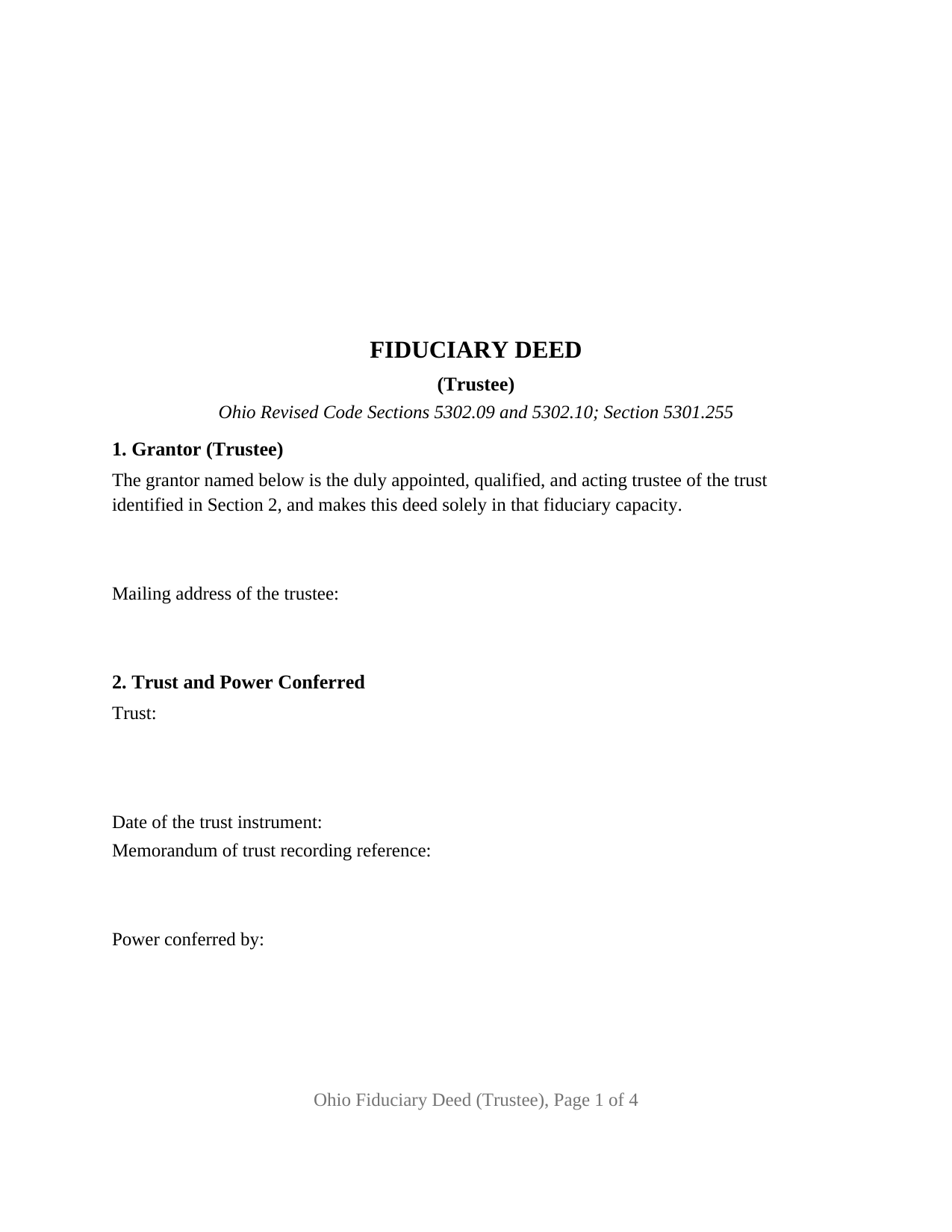
When the trustee of an Ohio trust sells real property the trust holds, the deed that closes the sale names the trust, states where the trustee's power to convey comes from, and points to a memorandum of trust already on the county record. This Ohio Fiduciary Deed (Trustee) is that deed: the statutory deed of trustee in Ohio Revised Code Section 5302.09, set up for one trustee of one trust.
Authority that lives on the record, not only in the deed
A trustee's power to sell is private law until it is recorded. The trust instrument confers it and the Ohio Trust Code backs it: Section 5808.15 lets a trustee exercise, without court authorization, every power the trust confers, and Section 5808.16(B) names the power to sell property at public or private sale. The county record sees none of that unless a memorandum of trust is filed, and since June 16, 2026, Section 5301.255 provides that a memorandum of trust shall be of record when a trustee of a disclosed trust conveys real property. The memorandum, signed and acknowledged by the trustee, states the trustee's name and address, the trust's date, and its powers over the conveyance of real property. Section 2 of this form carries the memorandum's recording reference beside the trust's name and date, so a title examiner finds the recorded instrument behind the trustee's signature; Section 5301.071(F) cures a missing memorandum once the deed has been of record for more than four years.
Fiduciary covenants are promises about the trustee
The operative words, grants, with fiduciary covenants, are the statute's. Under Section 5302.10 they carry a covenant that the grantor holds the fiduciary office the deed describes, is duly authorized to make the sale and conveyance, and has complied with the statutes governing the sale. The promise runs to the trustee's standing and procedure, not to the chain of title. Liens and prior defects are a title examination's work, and Section 5810.12 protects a person who deals with a trustee in good faith and for value, without knowledge that the trustee is exceeding the trustee's powers, from any duty to inquire into those powers.
What this configuration recites
The form recites exactly one grantor, an individual who is the duly appointed, qualified, and acting trustee of the trust identified in Section 2 and who conveys solely in that capacity. Section 2 holds the trust's name, the date of the trust instrument, the memorandum of trust reference, and the power conferred, in the words of the statutory form. One signature block headed GRANTOR (TRUSTEE) and one acknowledgment certificate follow, the certificate in the Section 147.55(F) short form for a trustee. No marital status and no dower release appear: the trustee conveys the trust's title, not the trustee's own. A successor trustee selling the settlor's former residence after the settlor's death, and the trustee of an irrevocable trust selling a rental parcel to an outside buyer, present the one-trustee pattern this deed recites. Two cotrustees signing together, a distribution to the trust's beneficiaries, a settlor funding the trust, and a bank trustee signing through an officer each present a pattern the form is not set up as. The grantee section is open to one or two grantees with any vesting designation Ohio recognizes; the completed example conveys to two purchasers as tenants in common, the Section 5302.19 default.
A sale pays the conveyance fee; the auditor stamps first
An Ohio deed is recorded only after the county auditor has transferred it. The conveyance fee statement, form DTE 100, goes to the auditor under Section 319.202 with the grantee's tax-mailing address and the prior instrument reference Section 319.20 requires, both printed on this form, and the grantor pays the state fee of ten cents per hundred dollars of value under Section 319.54(G)(3). That section's trust exemptions, a transfer into a revocable trust, a transfer back to the settlor, and a distribution to beneficiaries, do not reach a trustee's sale to a purchaser for value. The form is built to the Section 317.114 recording standard, with a three inch blank first-page top margin for the county stamps and the Section 317.111 preparer statement.
The package includes the fillable trustee deed, a completed example filled in for a Franklin County sale by a successor trustee, and the guide covering each numbered section, the trustee's authority, and the auditor and recorder steps. The description and guide describe the form and Ohio's statutes in general terms and are not legal advice.
Important: County-Specific Forms
Our fiduciary deed (trustee) forms are specifically formatted for each of the 88 counties in Ohio.
After selecting your county, you'll receive forms that meet all local recording requirements, ensuring your documents will be accepted without delays or rejection fees.