Ohio Fiduciary Deed (Receiver)
County Specific Legal Forms Validated as recently as October 24, 2026 by our Forms Development Team
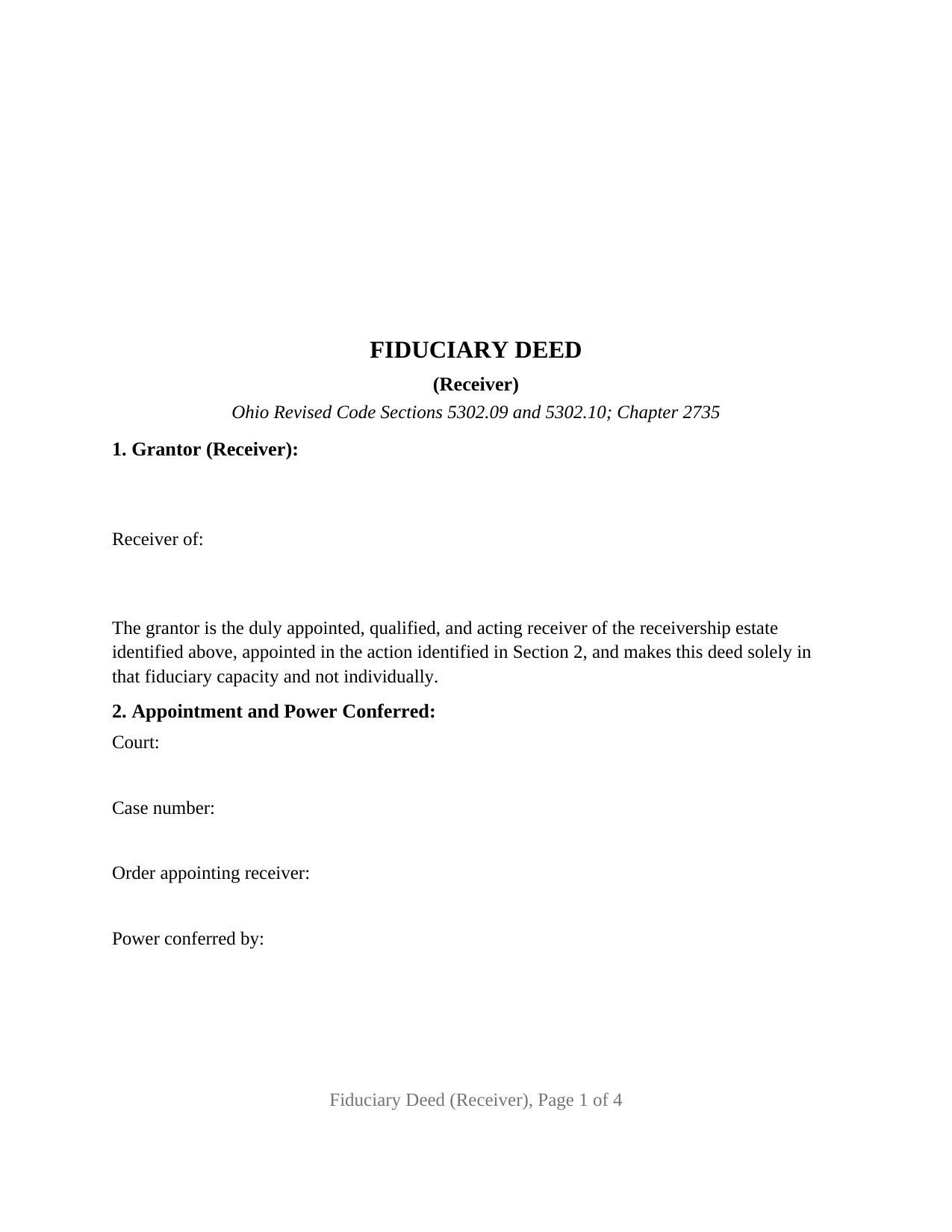
About the Ohio Fiduciary Deed (Receiver)
How to Use This Form
- Select your county from the list
- Download the county-specific form
- Fill in the required information
- Have the document notarized if required
- Record with your county recorder's office
What Others Like You Are Saying
"Most complete and affordable documents that I was able to locate online. Excellent printed out prese…"
"Quick and easy."
"Quick, easy everything that i was looking for and then some."
"It was easy to find and download the documents that I needed."
"Easy to follow directions and complete the Deed."
4.8/5 from 4,830 reviews. Read all
When a court-appointed receiver sells Ohio real property, the deed that closes the sale answers to the court file as much as to the parties. This form prepares that deed: the statutory deed of receiver in Section 5302.09 of the Ohio Revised Code, prepared for one receiver conveying under an order of sale entered in the action that appointed the receiver, with the words grants, with fiduciary covenants, printed in the conveyance.
A deed that points back to the court file
A receiver holds no title of its own. Section 2735.04(A) of the Revised Code places a receiver's powers in the appointing order, and Section 2735.04(D)(2) permits a sale of real property only after an application, ten days' notice to the owners, parties, and lienholders, a hearing opportunity, and an order of sale. The deed therefore identifies, in Section 2, the court, the case, the appointing order, and the order conferring the power to sell, and its operative paragraph recites the Section 5302.09 words: by the power conferred by that order, and every other power.
Liens that lift when the deed is recorded
Under Section 2735.04(D)(3), the court may order the property sold free and clear of all liens other than the county treasurer's lien for real estate taxes and assessments, and upon the recording of the receiver's deed those liens are canceled as to the real property and transferred to the sale proceeds with the same priority. Under Section 2735.04(D)(9), a receiver's deed delivered after a sale conducted under the order has the effect Section 2329.37 gives a judicial sale deed: prima facie evidence of the legality and regularity of the sale.
The covenant a court officer gives
Under Section 5302.10 the two words fiduciary covenants carry a defined promise from the grantor to the grantee: that the grantor holds the fiduciary office the deed describes by due appointment and qualification, is acting in it, has authority to sell and convey the premises, and has followed the statutes that govern the sale. For a receiver that promise speaks to the oath and bond of Section 2735.03, the appointing order, and the order of sale; it is not a warranty of title.
What the receiver configuration recites
The form recites exactly one grantor, an individual acting as receiver of a named receivership estate, and fixes that capacity as deed text: the grantor is the duly appointed, qualified, and acting receiver of the receivership estate identified in the deed, appointed in the action identified in Section 2, and makes the deed solely in that fiduciary capacity and not individually. One signature block headed GRANTOR (RECEIVER) and one acknowledgment certificate follow, the certificate in the Section 147.55(F) short form for a public officer, trustee, or personal representative. No spouse signs and no dower release is printed: Section 2103.041 lets the court subject the dower of the owner's spouse to a creditors' judicial sale in the action itself, so dower is addressed in the court file rather than released on the deed. A lender's receiver selling a foreclosed rental property free and clear of liens, and the receiver of a dissolved limited liability company selling its last parcel, present the pattern this deed recites. Deeds by executors, administrators, trustees, guardians, or commissioners, and deeds by two co-receivers, recite a different office or a second signer, and the form is not set up as any of them.
Conveyance fee first, then the recorder
A receiver's sale is a sale for a price, and the court-order exemption from the state conveyance fee in Section 319.54(G)(3)(f) stops at a transfer that results from a sale completed under the order, so the DTE 100 statement filed with the county auditor reports the price and the fee is paid on it. The deed carries the grantee's tax-mailing address and prior instrument reference of Section 319.20 and the preparer's name of Section 317.111. In a sale to an identified buyer, the receiver's certificate and report of sale under Section 2735.04(D)(10) is filed in the court afterward, prepared separately and not included in this package.
The package contains the fillable deed, a completed example filled in for a Franklin County receiver's sale in a mortgage foreclosure action, and the guide that walks through each numbered section, the receiver's authority under Chapter 2735, and the auditor and recorder process. The description and the guide describe the form and the Ohio statutes that govern it in general terms and are not legal advice.
Important: County-Specific Forms
Our fiduciary deed (receiver) forms are specifically formatted for each of the 88 counties in Ohio.
After selecting your county, you'll receive forms that meet all local recording requirements, ensuring your documents will be accepted without delays or rejection fees.