Ohio Fiduciary Deed (Corporate Fiduciary)
County Specific Legal Forms Validated as recently as October 24, 2026 by our Forms Development Team
About the Ohio Fiduciary Deed (Corporate Fiduciary)
How to Use This Form
- Select your county from the list
- Download the county-specific form
- Fill in the required information
- Have the document notarized if required
- Record with your county recorder's office
What Others Like You Are Saying
"Thank you, thie was very helpful. I did find the forms I needed.Very easy to use.,"
"Nice work. Easy to use site for reasonable price. Thank you."
"I little struggle downloading the forms at first but support helped. After that it was a breeze, hap…"
"An excellent service!"
"I purchased the Notice of Completion form because the City of Chula Vista did not have a "fillable" …"
4.8/5 from 4,831 reviews. Read all
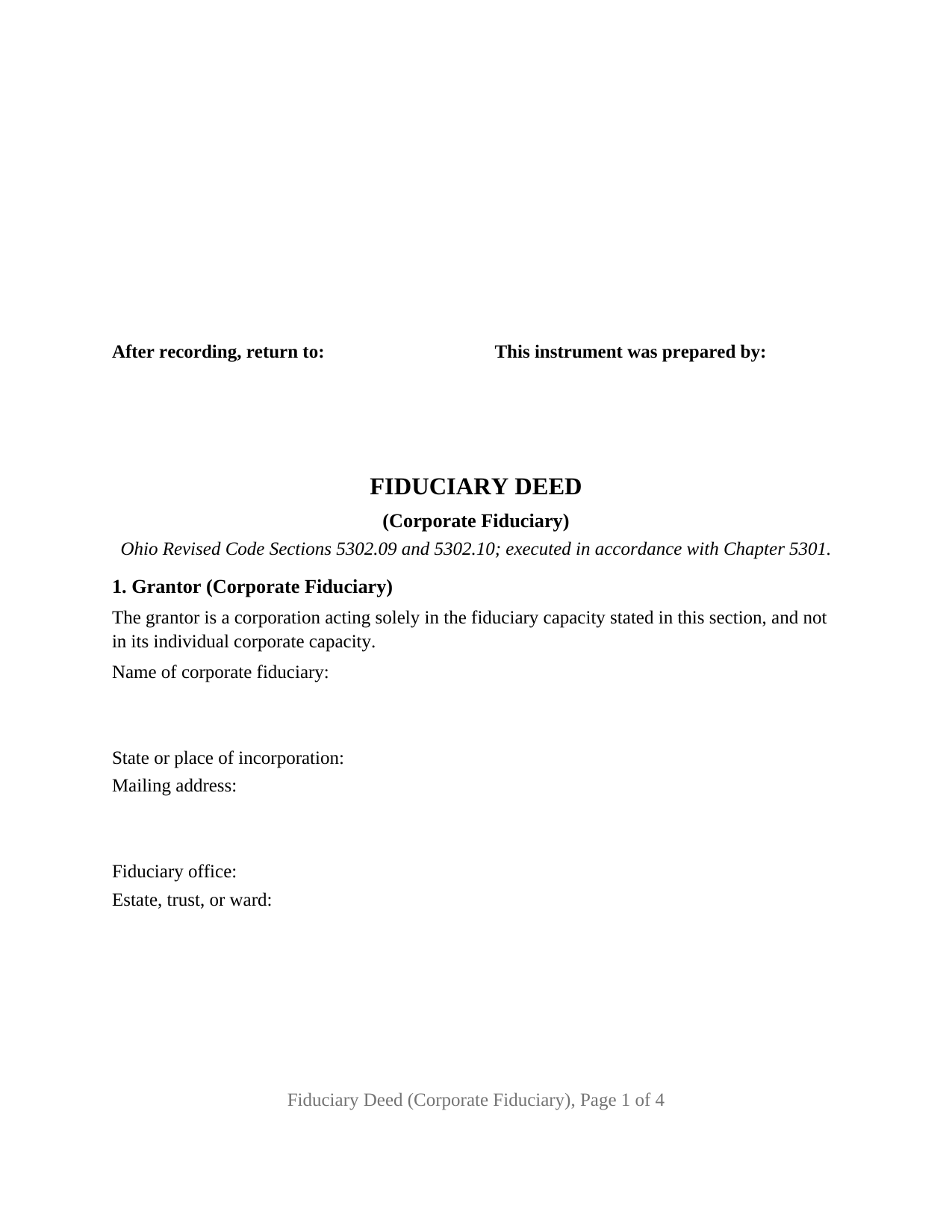
When the fiduciary selling Ohio real property is a bank or trust company rather than a person, the deed changes in two places: the grantor is a corporation that signs through an officer, and the notary certifies that officer's acknowledgment on behalf of the corporation. This Ohio Fiduciary Deed (Corporate Fiduciary) is built around those two facts. It prepares the statutory fiduciary deed of Ohio Revised Code Section 5302.09 for one corporate fiduciary conveying as trustee, executor, administrator, guardian, or receiver, with a signature block for the authorized officer, a line for the officer's title, and the Section 147.55(B) corporate acknowledgment.
A corporation that conveys only in its fiduciary capacity
Section 1 opens with a fixed recital that the grantor is a corporation acting solely in the fiduciary capacity stated in that section and not in its individual corporate capacity, then collects the corporation's name, its state or place of incorporation, its mailing address, the office it holds, and the estate, trust, or ward it serves. The operative section repeats the limit: the corporation conveys in its fiduciary capacity alone, and its covenants are the fiduciary covenants of Section 5302.10, which run to the grantor's appointment, authority to sell, and compliance with the statutes governing the sale, not to the condition of the title. Chapter 1111 of the Revised Code supplies the grantor: Section 1111.11 lets a trust company act as trustee under any instrument and accept court-committed appointments as executor, administrator, guardian, or receiver, and Section 1111.03 extends the same capacities to a national bank or federal savings association with fiduciary powers.
Where the power to sell comes from
Section 2 holds the source of the power conferred, in the words of the statutory form: the trust agreement's sale article together with Section 5808.16(B) of the Ohio Trust Code, which lists the power to sell trust property at public or private sale among a trustee's specific powers; a will with a power of sale, which Section 2113.39 lets the fiduciary exercise without a probate court order; or the court's order of sale and entry of confirmation under Section 2127.35. For a corporate trustee the same section identifies the memorandum of trust that Section 5301.255, as amended effective June 16, 2026, requires to be of record when a trustee of a disclosed trust conveys.
One officer signs, and the notary certifies for the corporation
The deed carries one signature block, headed GRANTOR (CORPORATE FIDUCIARY), with the officer's signature, printed name, date, and title, under a fixed sentence that the grantor executes the deed by its officer who signs below. The single acknowledgment certificate is the Ohio statutory short form for a corporation: acknowledged before the notary by the named officer and title, of the named corporation, a corporation of the stated place of incorporation, on behalf of the corporation. The deed prints no marital status and no dower release; the grantor is a corporation. An Ohio trust company selling a house out of a revocable trust as successor trustee after the settlor's death, a national bank with trust powers conveying estate real estate as executor under a will's power of sale, and a trust company serving as guardian of an incompetent adult's estate conveying under a probate court order all present the pattern this deed recites. The form is not set up as a deed by an individual fiduciary, by two co-fiduciaries, or by a company conveying its own property in its own right.
Through the auditor, then the recorder
A corporate fiduciary's sale is a conveyance for value, so the deed and the DTE 100 conveyance fee statement go to the county auditor under Section 319.202 before the recorder sees it, and Section 317.22 keeps the deed out of the record until the auditor's transferred stamp appears. The deed carries the grantee's tax-mailing address and prior instrument reference of Section 319.20, the preparer's name of Section 317.111, and the survey statement of Section 5301.25(B), laid out to the Section 317.114 standard on four recordable pages behind a non-recorded instructions cover.
Inside the package are the fillable fiduciary deed, a completed example showing an Ohio trust company conveying a Hamilton County residence as successor trustee, and the guide to each numbered section, the sources of a corporate fiduciary's authority, and the county steps. The description on this page and the guide explain the form and the Ohio statutes behind it in general terms and are not legal advice.
Important: County-Specific Forms
Our fiduciary deed (corporate fiduciary) forms are specifically formatted for each of the 88 counties in Ohio.
After selecting your county, you'll receive forms that meet all local recording requirements, ensuring your documents will be accepted without delays or rejection fees.