Ohio Fiduciary Deed (Husband and Wife Grantees)
County Specific Legal Forms Validated as recently as October 23, 2026 by our Forms Development Team
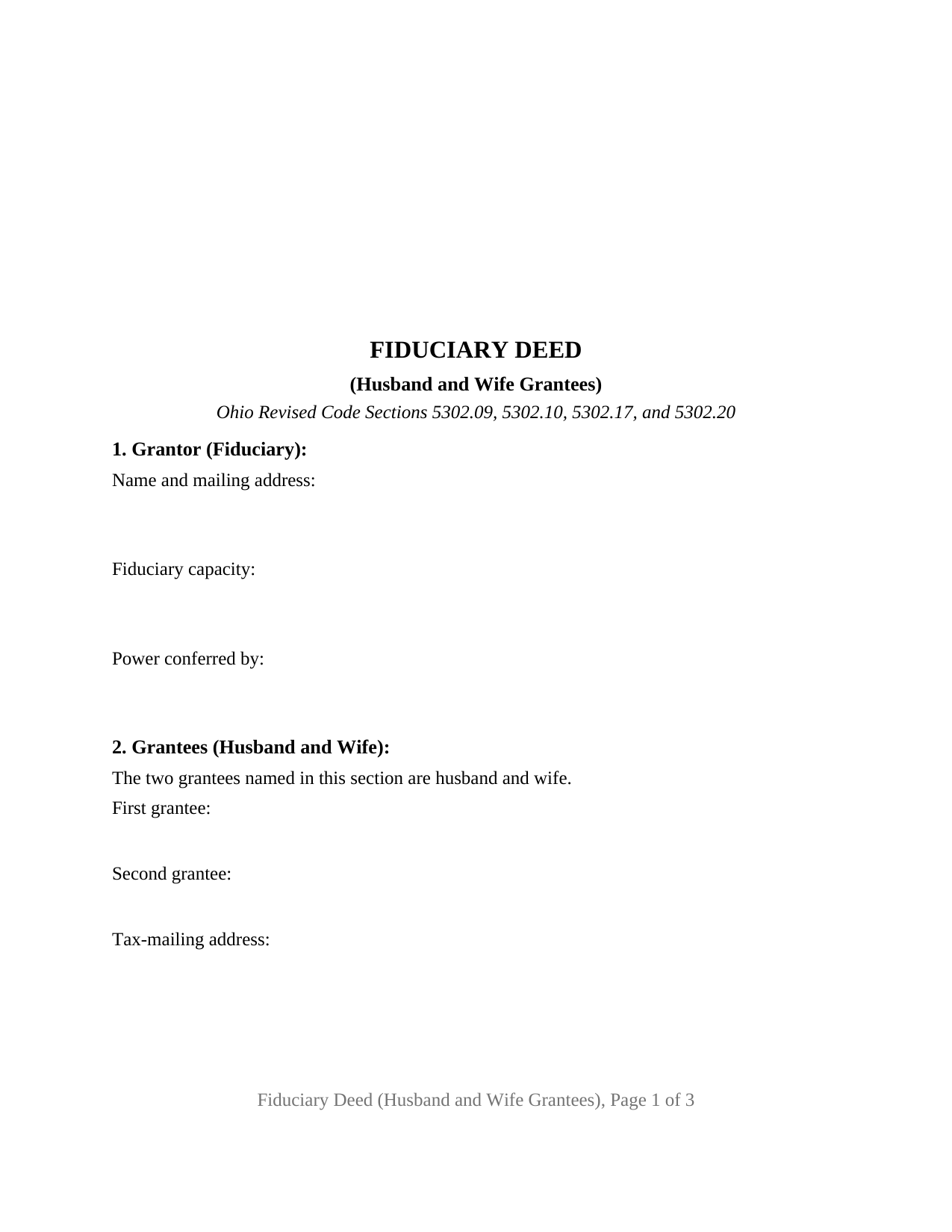
About the Ohio Fiduciary Deed (Husband and Wife Grantees)
How to Use This Form
- Select your county from the list
- Download the county-specific form
- Fill in the required information
- Have the document notarized if required
- Record with your county recorder's office
What Others Like You Are Saying
"GREAT STUFF TKS"
"I wasted a lot of my time because I didn't do any research to know what I needed. Nobody fault but m…"
"Deeds.com is a very Good company. They helped me when I needed the"
"quick, easy and simple. Also thank you for having the e-submission area particularly with the Covid-…"
"Easy fill in the blanks form. Just FYI make sure you have a copy of whatever deed you are changing a…"
4.8/5 from 4,831 reviews. Read all
An Ohio fiduciary deed to husband and wife grantees does two jobs in one instrument. It conveys real property out of an estate, trust, guardianship, or receivership on one fiduciary's signature, and it vests that property in a married couple for their joint lives, remainder to the survivor of them, the statutory words that create an Ohio survivorship tenancy. This form prepares that deed under Ohio Revised Code Sections 5302.09 and 5302.10, with the grantee clause of Section 5302.17, for exactly two grantees who are husband and wife.
One signature, two grantees, one survivor
The fiduciary is the only signer. An executor, administrator, trustee, guardian, receiver, or commissioner signs once, in the capacity the deed recites, and the grantees do not sign. On the receiving side the deed names two spouses and carries the survivorship sentence as fixed text, so the couple takes as survivorship tenants under Section 5302.20: when one spouse dies, the whole title vests in the survivor outside probate, and the death is placed of record under Section 5302.17 by an affidavit with a certified death certificate rather than by a new deed. Without those words, Section 5302.19 would make the two grantees tenants in common.
Fiduciary covenants reach the appointment, not the title
The deed grants with fiduciary covenants, the two words Section 5302.10 expands into a defined promise: that the grantor is duly appointed, qualified, and acting in the fiduciary capacity described in the deed, is duly authorized to make the sale and conveyance, and has complied with the statutes governing the sale. Those are covenants about the fiduciary's own standing and procedure, not the general warranty covenants of Section 5302.06, and they say nothing about liens or defects in the chain of title. Section 1 of the form follows the statutory recital that the fiduciary acts by the power conferred by a named source and every other power: a power of sale in the will, which Section 2113.39 lets an executor exercise without a court order; a land sale proceeding under Chapter 2127; the heirs' and devisees' consents filed under Section 2127.011; the trust instrument, with the memorandum of trust Section 5301.255 requires of record; or the appointing court's order.
What this configuration recites
The form carries one grantor block for the fiduciary, with lines for name, office, and power conferred, and one grantee section that opens with the fixed statement that the two grantees are husband and wife, followed by a name line for each spouse and the tax-mailing address Section 319.20 requires. The operative section preprints the conveyance, with fiduciary covenants, to the grantees for their joint lives, remainder to the survivor of them. One signature block and one acknowledgment certificate follow, the certificate using the Section 147.55(F) short form, whose by-line carries the signer's name and title of position. An executor selling the family home to a married couple under a power of sale in the will, and a trustee selling trust real estate to a married couple, present the pattern this deed recites. The form recites exactly two grantees who are married to each other and fixes the survivorship vesting; a deed to one grantee, to an unmarried pair, to a trust or a company, or to spouses who take as tenants in common presents a different pattern.
The auditor before the recorder
An Ohio deed is not recorded until the county auditor has transferred it. The grantor files the conveyance fee statement, form DTE 100 or the DTE 100EX exemption statement, and pays the state conveyance fee of ten cents per one hundred dollars of value under Section 319.54(G)(3) plus any county transfer tax under Chapter 322; the auditor's transferred stamp is what Section 317.22 requires before the recorder accepts the deed. The recorder charges thirty-four dollars for the first two pages and eight dollars for each additional page under Sections 317.32 and 317.36, before any county surcharge, and the form is built to the Section 317.114 format: a three inch blank top margin on the first page, one inch side and bottom margins, and type no smaller than ten point.
The package includes the fillable fiduciary deed, a completed example filled in for a Franklin County executor's sale to a married couple, and the guide that walks through every numbered section, the fiduciary authority recital, the survivorship tenancy, and the auditor and recorder steps. This description and the guide describe the form and the governing Ohio statutes in general terms; they are not legal advice.
Important: County-Specific Forms
Our fiduciary deed (husband and wife grantees) forms are specifically formatted for each of the 88 counties in Ohio.
After selecting your county, you'll receive forms that meet all local recording requirements, ensuring your documents will be accepted without delays or rejection fees.