Ohio Fiduciary Deed (Commissioner)
County Specific Legal Forms Validated as recently as October 24, 2026 by our Forms Development Team
About the Ohio Fiduciary Deed (Commissioner)
How to Use This Form
- Select your county from the list
- Download the county-specific form
- Fill in the required information
- Have the document notarized if required
- Record with your county recorder's office
What Others Like You Are Saying
"Assuming that the downloads went without a hitch, the system was easy to follow and execute."
"Fastest online reply of nearly anything on the planet. Very impressed!!"
"Thanks again for such expedient and excellent service!"
"Easy"
"EXCELLENT service! Deed came back within minutes!"
4.8/5 from 4,831 reviews. Read all
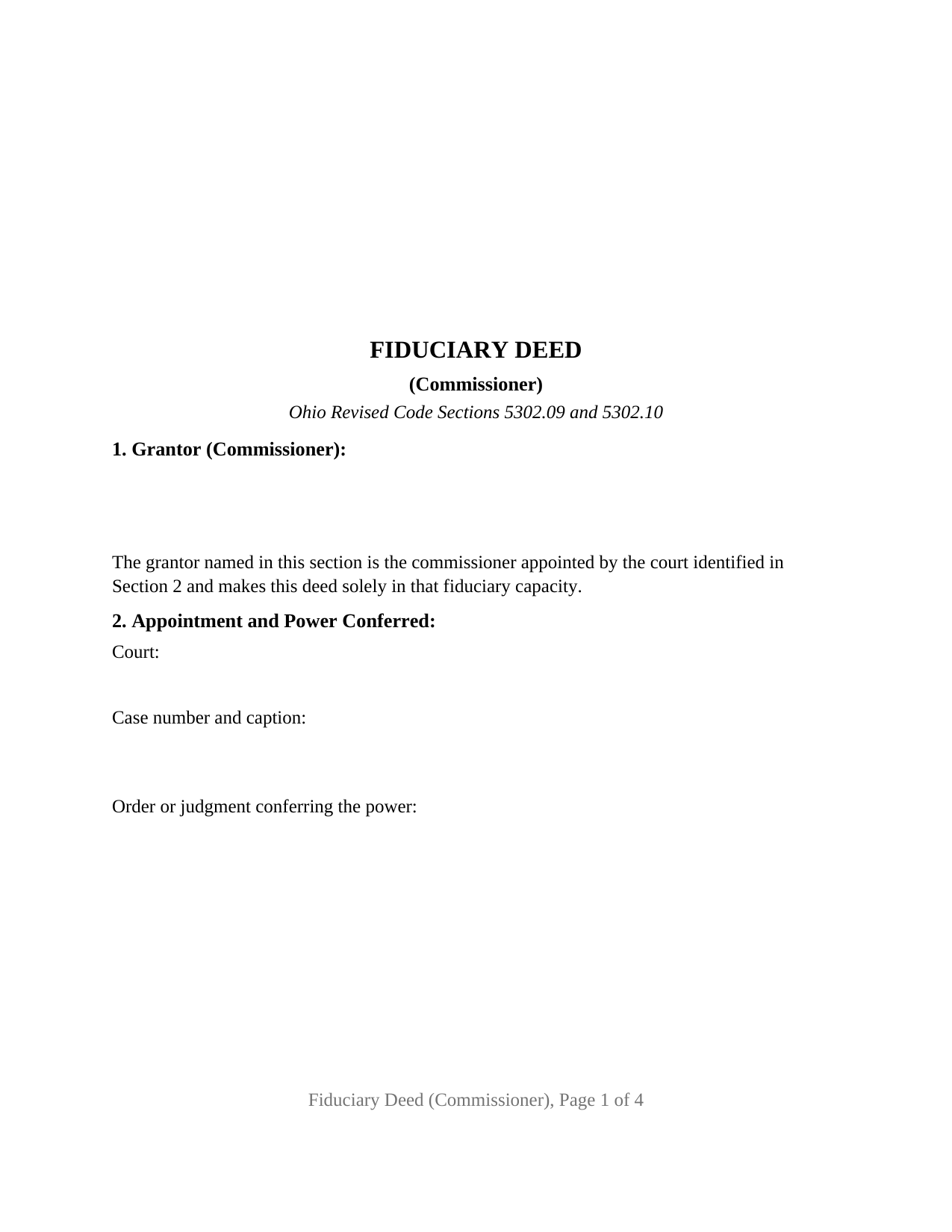
When an Ohio court orders land conveyed and the party ordered to sign will not, or when a court sends a specific parcel to sale by a master instead of the sheriff, the deed that closes the matter is signed by a commissioner the court appointed. This Ohio Fiduciary Deed (Commissioner) prepares that deed: one court-appointed commissioner, conveying under the order or judgment that confers the power, with the fiduciary covenants of Ohio Revised Code Section 5302.10, on the statutory form Section 5302.09 prints for a commissioner.
A power that comes from an order, not from a will or a trust
A commissioner's deed traces its authority to a court order rather than to a will, a trust, or letters from the probate court, and Section 2329.34 limits the occasions: a master commissioner or special master conveys real property only when an order or judgment requires a party to convey it to another, the party neglects or refuses, and the master is directed to convey on the party's failure; or when the master sells specific real property under an order of the appointing court, issued on a judgment creditor's motion for a special reason, written into the order, why the sheriff or a private selling officer is not to make the sale. Section 2113.03(E) adds a probate occasion: in an estate relieved from administration, the court may appoint a commissioner to execute the instruments of conveyance. Section 2 of the form holds whichever source applies, and the operative paragraph conveys by that power and every other power.
What the fiduciary covenants reach
The deed's covenant is the one the phrase fiduciary covenants carries under Section 5302.10: that the grantor was appointed, qualified, and acting in the capacity the deed describes, held the authority to make the sale and conveyance, and followed the statutes that govern the sale. The covenant speaks to the commissioner's office and procedure, not to the chain of title, so the judgment, any order of sale and confirmation, and a purchaser's title examination determine which interests the deed passes free of.
One commissioner signs, and no party to the case does
The form recites exactly one grantor, an individual acting solely as the commissioner appointed by the court identified in the deed, and carries one signature block headed GRANTOR (COMMISSIONER). Its single acknowledgment certificate is the short form Section 147.55(F) prints for a public officer, trustee, or personal representative, so the certificate records the signer's title of position. No party to the underlying action signs, and the deed prints no marital-status recital and no dower release; Section 2329.83 provides that the execution chapters do not impair dower, and what the deed passes is fixed by the judgment and the parties bound by it. A master commissioner conveying a house after a seller refused to perform a specific performance judgment, a special master conveying to the purchaser after a confirmed court-ordered sale, and a probate commissioner conveying from an estate relieved from administration present the single-commissioner pattern this deed recites. A sheriff's deed, a private selling officer's deed, a partition deed, which the sheriff executes under Chapter 5307, a deed by two commissioners, and a judgment that vests title without a conveyance each follow a different pattern, and the form is not set up as any of them.
The fee question a court order raises
Like every Ohio deed of absolute conveyance, this one goes to the county auditor for transfer before the county recorder accepts it under Section 317.22, with the conveyance fee statement under Section 319.202. Section 319.54(G)(3)(f) exempts a transfer made pursuant to court order to the extent the transfer is not the result of a sale effected or completed under the order, so a court-ordered conveyance that is not a sale pays no state fee, while a conveyance that completes a purchase under a judgment, or a confirmed master's sale, pays ten cents per hundred dollars of its price plus any county transfer tax under Chapter 322. The deed carries the grantee's tax-mailing address and prior instrument reference under Section 319.20 and the preparer's name under Section 317.111.
The package contains the fillable deed, a completed example prepared for a Hamilton County conveyance by a master commissioner under a specific performance judgment, and the guide covering each numbered section, the commissioner's authority, and the auditor and recorder steps. The description and the guide state the form and the Ohio statutes in general terms and are not legal advice.
Important: County-Specific Forms
Our fiduciary deed (commissioner) forms are specifically formatted for each of the 88 counties in Ohio.
After selecting your county, you'll receive forms that meet all local recording requirements, ensuring your documents will be accepted without delays or rejection fees.