Arizona Full Release of Real Estate Contract
County Specific Legal Forms Validated as recently as September 29, 2026 by our Forms Development Team
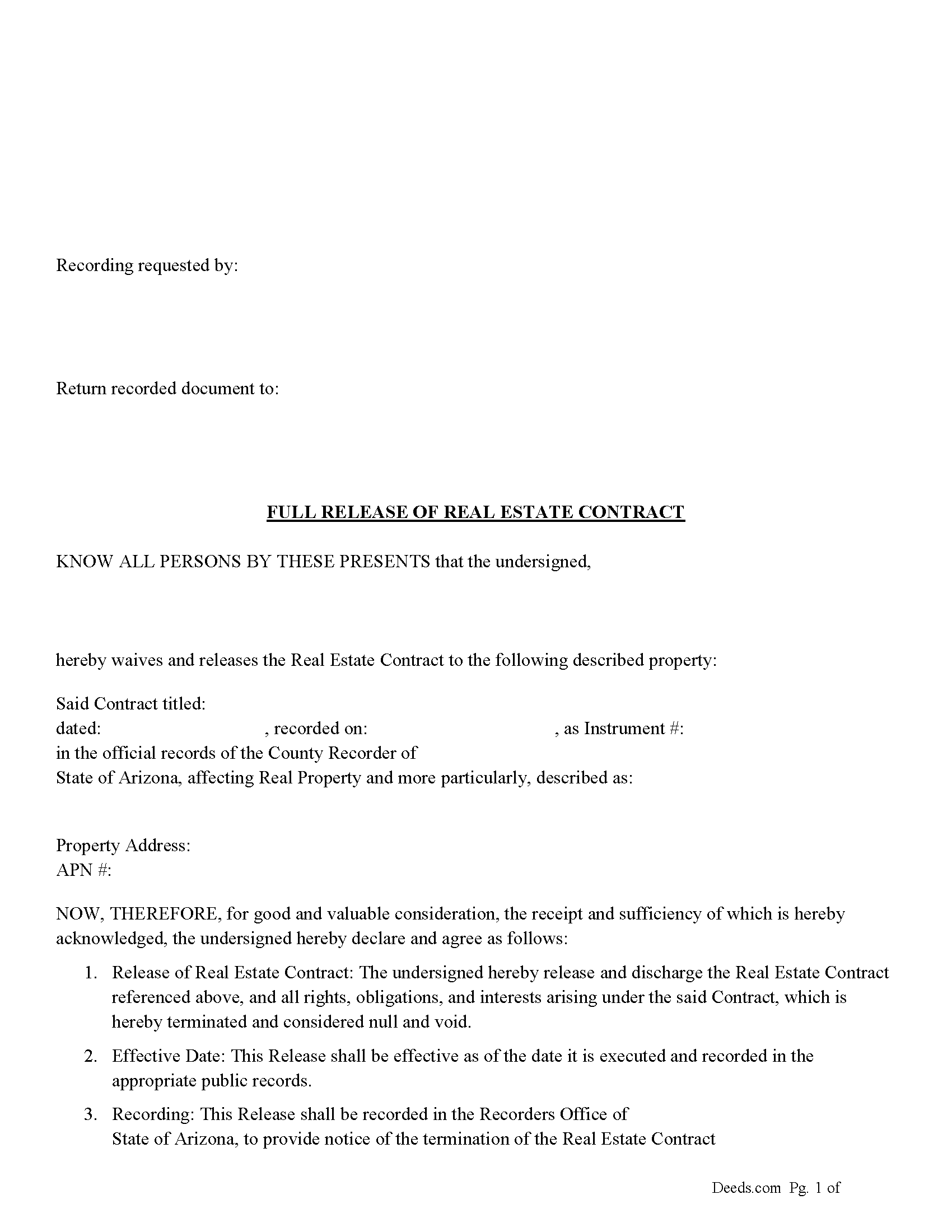
About the Arizona Full Release of Real Estate Contract
How to Use This Form
- Select your county from the list
- Download the county-specific form
- Fill in the required information
- Have the document notarized if required
- Record with your county recorder's office
What Others Like You Are Saying
"Very pleased with all info and forms"
"Quite simple and easy. Only one critique: It would be easier if the names of the PDF would reflect t…"
"Excellent and fast service. I will be using this site as needed in the future."
"I was pleased with the example of a completed beneficiary deed and instructions. It made filling out…"
"Easy to use & cost is great Thank you"
4.8/5 from 4,829 reviews. Read all
The Arizona Full Release of Real Estate Contract is the recorded instrument used to clear a previously recorded real estate contract from the county's chain of title once the parties' obligations under the contract have been fully satisfied or have otherwise terminated. Arizona practice makes heavy use of recorded contracts and memoranda — contracts for deed under ARS 33-741 et seq., land contracts, agreements for sale, buy-sell purchase agreements, lease agreements, and options — all of which leave a cloud on the record until something is recorded to clear them. Because Arizona is a race-notice state under ARS 33-412, the clearing document matters: an unreleased recorded contract continues to encumber the seller's title in the eyes of subsequent purchasers and lenders, regardless of what the parties privately know about the contract's current status.
When the Arizona Full Release of Real Estate Contract Is Used
This form is used whenever a recorded real estate contract needs to be cleared from the record. The most common trigger is successful performance — a contract for deed paid in full, with the payoff deed delivered and recorded, leaving the original contract or memorandum as a stale entry in the chain. Other triggers include mutual rescission of a purchase contract before closing, termination of an option or lease agreement that was recorded, expiration of a buy-sell agreement that was never performed, settlement of disputes where the parties agree to unwind a recorded transaction, and completion of a contract for deed followed by the payoff deed where the parties want belt-and-suspenders clearance of the record. The release is not a substitute for a forfeiture or foreclosure process under ARS 33-742 through 33-748 — those are enforcement remedies against a defaulting purchaser, not consensual releases between parties who agree the deal is over.
The Recording Rule — Why a Release Matters
Arizona's recording system treats any instrument in the chain of title as an encumbrance on that title until something else in the chain says otherwise. A recorded contract for deed, even one that has been fully paid, continues to appear on a title examiner's report and will be flagged as a matter affecting title until a release is recorded. The same is true for recorded lease memoranda, option memoranda, and purchase agreements that were recorded during the due-diligence period and never cleared after closing or termination. A seller who records a contract for deed, collects payments in full, delivers a payoff deed, and then tries to sell the property to a new buyer years later will discover that the title examiner still finds the original contract — and the new buyer's title insurer will require a release before issuing a policy. Recording the release contemporaneously with the final performance avoids scrambling years later to find the other party and get a document signed.
Reference to the Original Contract
A release must tie itself to the specific contract it is clearing. The instrument should identify the original contract by its recording date, recording reference (docket and page or instrument number), county of recording, and the names of the original seller and purchaser (or landlord and tenant, optionor and optionee, as applicable). The legal description of the property should be recited and should match the description in the original recorded instrument. Without an explicit tie, the county recorder's index will not connect the release to the original, and a title examiner running the chain may not find the release when it matters. The tie is not a formality — it is the mechanism by which the release actually does its job of clearing the record.
Who Must Sign
A full release requires, at minimum, the signature of the party whose recorded interest is being released — the purchaser under a contract for deed, the tenant under a recorded lease, the optionee under a recorded option, the buyer under a recorded purchase agreement. That party is giving up whatever rights the recorded instrument gave them, and the release is effective as to their interest when that party signs. Many Arizona releases are executed by both parties to confirm mutual agreement that the contract is fully satisfied or terminated — this belt-and-suspenders approach prevents later disputes about whether the party executing the release had authority to speak for the other side.
When the releasing party is a business entity, a trust, or a fiduciary, the signatory's representative capacity must appear in the signature block, and any underlying authority should be available or referenced in the instrument. When the releasing party is an individual whose marital status has changed since the original recording — marriage, divorce, death of a spouse — the signatures should reflect the current marital status and appropriate spousal joinder. When one of the original parties has died, the personal representative of the estate signs on that party's behalf, and the letters of appointment or comparable document establishing the fiduciary's authority should be recorded or referenced.
Full Release Versus Partial Release
A full release clears the entire recorded contract as to all property described in the original instrument. A partial release clears only a portion of the property — for example, the sale of one parcel out of a larger tract under a blanket contract — while leaving the contract in effect as to the balance. The two are different instruments with different drafting and recording consequences. This form is the full release: it terminates the recorded contract entirely and clears the full legal description from the chain. When the parties want to release only a part of the property or only some of the contract's obligations, a partial release or a formal amendment is the correct vehicle; using a full release in that situation can inadvertently terminate rights the parties intended to preserve.
Relationship to a Payoff Deed
For a contract for deed that has been performed in full, the payoff deed and the release of contract serve different functions and are both typically recorded. The payoff deed conveys the seller's remaining legal title to the purchaser, completing the transfer of fee ownership under ARS 33-741. The release of contract clears the original recorded contract from the record, so future title examiners do not have to reconcile the contract, the deed, and any time gap between them. A payoff deed alone transfers title but does not necessarily remove the contract's cloud; a release alone clears the contract but does not transfer title. Together they produce a clean record. Some practitioners use a combined instrument that recites both the deed and the release in a single document; others use separate instruments recorded consecutively. Either approach works when executed correctly.
Execution and Acknowledgment
Under ARS 33-401, a release affecting real property must be in writing, subscribed by the party releasing, and acknowledged before a notary public or other officer authorized to take acknowledgments. Arizona does not require subscribing witnesses. Acknowledgments taken outside Arizona must comply with ARS 33-501, which recognizes notaries, judges and clerks of courts of record, and any other officer authorized to perform notarial acts in the jurisdiction where the acknowledgment is taken. The release uses the same execution formality as the original recorded instrument — Arizona does not relax the requirements simply because the document is clearing rather than creating an interest.
Affidavit of Property Value Exemption
Arizona requires an Affidavit of Property Value to accompany most instruments affecting interests in real property (ARS 11-1133), but a release of contract typically qualifies for an exemption under ARS 11-1134 because no new transfer is occurring — the release is clearing a previously recorded instrument rather than conveying property. The exemption must be claimed on the face of the release with a statement that the transfer is exempt and a citation to the specific exemption subsection, placed below the legal description. Releases that omit the exemption recital are routinely rejected at the recorder's window, even when the transaction plainly qualifies. When a release is given in exchange for meaningful consideration — a negotiated buyout of an option or lease, for example — the affidavit may actually be required rather than exempt.
Formatting and Recording
ARS 11-480 sets the formatting requirements for every recordable instrument: legible type of at least ten points, white paper no larger than 8.5 by 14 inches, a caption identifying the document (for example, "Full Release of Real Estate Contract"), a top margin of at least two inches on the first page reserved for the recorder's stamp, and minimum half-inch margins elsewhere. Record the release in the same county where the original contract was recorded. When the contract was recorded in more than one county — because the property spans county lines — the release must be recorded in each county where the original appeared. Confirm current recording fees and accepted forms of payment with the recorder's office in advance, and verify that the release has actually been indexed rather than relying on a drop-off or mailing receipt; a release sitting in an in-process pile does not clear the record until the recorder has assigned it a recording number and indexed it against the property.
Race-Notice Consequences of Delayed Recording
Arizona's race-notice rule at ARS 33-412 attaches specific consequences to unrecorded instruments. A release that has been executed but not recorded is effective between the original parties but does not protect against a subsequent purchaser for value who records something first without notice. In practice, this means that a party who has obtained an executed release but has not yet recorded it is still at risk from intervening transfers by the counterparty — the counterparty's judgment creditors, bankruptcy trustee, or subsequent grantees of a real estate interest. Recording the release promptly is the only way to reach the clean record the parties intended.
What's Included in the Download Package
The Arizona Full Release of Real Estate Contract package includes the release form drafted to reference the original recorded contract by its recording information, recite the release of all rights and obligations, and claim the ARS 11-1134 exemption on the face of the instrument, detailed guidelines covering the Arizona-specific drafting and recording requirements, and a completed example showing how the form should look for a typical release. The form is suitable for releasing contracts for deed, land contracts, agreements for sale, buy-sell purchase agreements, lease memoranda, option memoranda, and similar recorded real estate contracts. All files are available for instant download after purchase.
Important: County-Specific Forms
Our full release of real estate contract forms are specifically formatted for each of the 15 counties in Arizona.
After selecting your county, you'll receive forms that meet all local recording requirements, ensuring your documents will be accepted without delays or rejection fees.