Arizona Mineral Deed
County Specific Legal Forms Validated as recently as October 12, 2026 by our Forms Development Team
About the Arizona Mineral Deed
How to Use This Form
- Select your county from the list
- Download the county-specific form
- Fill in the required information
- Have the document notarized if required
- Record with your county recorder's office
What Others Like You Are Saying
"I was in despair as I needed to file two (2) very important documents with the County. Due to Covid …"
"Fast, easy, responsive."
"I highly recommend Deeds.com to be your go-to search website. I was able to get the information that…"
"The forms are simple to follow. I was hoping I would be able to add my personal info. That would mak…"
"I got what I was looking for! Turned out well and like I thought it would."
4.8/5 from 4,832 reviews. Read all
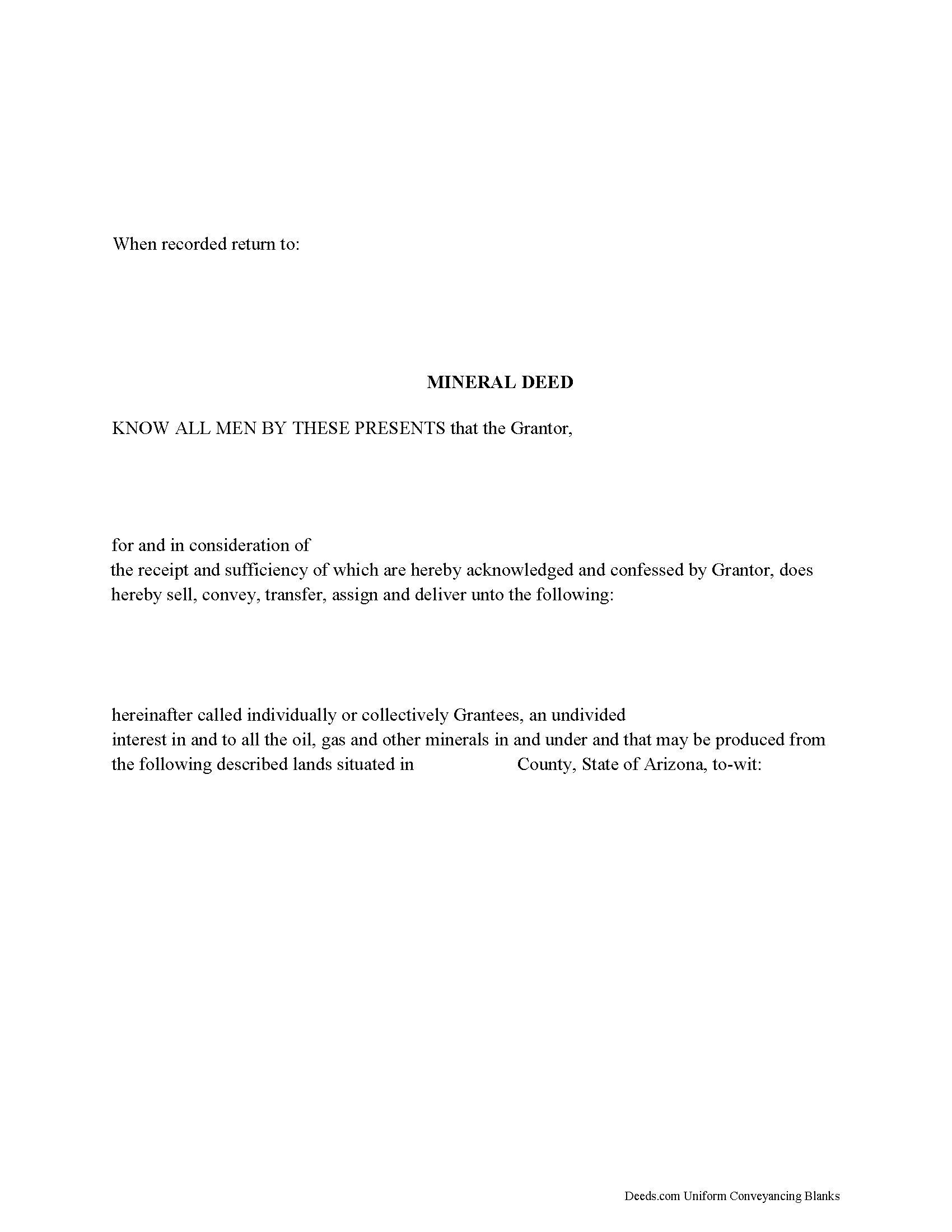
The Arizona Mineral Deed conveys oil, gas, and other mineral rights from a grantor to a grantee with a general warranty of title under ARS 33-402. Arizona is not principally an oil-and-gas state — it is one of the largest hard-rock mining jurisdictions in the country, producing more copper than any other state and holding substantial reserves of silver, gold, molybdenum, uranium, and industrial minerals. A "mineral deed" in Arizona therefore reaches a broader set of interests than in states where the form is used almost exclusively for oil and gas, and the deed's grant of the right to mine, drill, explore, operate, and develop matters for both extraction categories. This instrument is not a lease — it transfers ownership of the mineral estate itself, subject to any valid existing lease, and the effect on the grantor's property rights is permanent.
When the Arizona Mineral Deed Is Used
Arizona mineral deeds are used to transfer ownership of a mineral estate from one party to another outside the leasing context. Typical uses include sales of severed mineral interests in areas with active mining or exploration, family and estate transfers of long-held mineral rights on family ranches or parcels that were previously severed, consolidation of fractional mineral interests by an investor or operator building a block for development, gifts and charitable transfers of mineral interests, and contributions of mineral rights to a trust or family limited partnership as part of estate planning. The deed is used when the parties want to transfer the mineral estate itself rather than grant a term right to extract under a lease.
What the Deed Conveys
The deed transfers the grantor's interest in oil, gas, and other minerals of every kind and nature — coal, copper, uranium, metals, industrial minerals, and similar substances, depending on what is included in the grant language. It also conveys the associated financial rights: royalties, overriding royalties, net profits interests, and other payments arising out of or with respect to those minerals. In addition to the ownership interest, the deed conveys the access rights necessary to make the mineral estate usable — the right to enter the land for mining, drilling, exploring, operating, and developing the minerals, and for storing, handling, transporting, and marketing what is extracted. Without those access rights, a mineral estate can be owned on paper but not economically reached, so the access grant is functionally inseparable from the mineral grant.
The grantor may convey the entire mineral estate or a fractional interest. Arizona mineral interests are commonly held in fractions — 1/2, 1/4, 1/16 — particularly after several generations of family transfers have divided the original interest among heirs. The deed should state the fractional interest being conveyed with precision, together with the interest the grantor is representing it holds, so any discrepancy between what the grantor actually owns and what the deed attempts to convey is visible on the face of the instrument.
Warranty of Title Under ARS 33-402
The deed uses "warrants and will defend the title" language, which pulls in ARS 33-402's full general warranty. Two layers of protection attach. First, the word "convey" (or "grant") alone triggers the implied covenants under ARS 33-435: that the grantor has not previously conveyed the same interest to anyone other than the grantee, and that the estate is free from encumbrances made by the grantor. Second, the warrant-and-defend language extends the grantor's promise to cover defects arising outside the grantor's ownership — competing mineral claims, prior unreleased leases or assignments, earlier severances the grantor was not aware of. Mineral title chains are typically longer and more fragmented than surface title chains, so the warranty is doing real work: a defect two or three generations back in the mineral chain can invalidate the grantor's interest entirely, and the warranty is the grantee's contractual recourse.
Severed Mineral Estates and Surface Access
Arizona recognizes the severance of mineral and surface estates as a bedrock property-law concept. When mineral rights are severed from a parcel, the mineral estate becomes a separate property interest that can be owned, conveyed, and encumbered independently of the surface. The mineral estate is also the dominant estate: its owner has the implied right to use so much of the surface as is reasonably necessary to develop the minerals, even over the surface owner's objection. This dominance is subject to reasonable-use limitations and to any surface-damage obligations specifically imposed by contract or statute, but the default rule is that surface activity to access the minerals is permitted.
For Arizona properties where the mineral and surface estates are still unified — meaning the current owner holds both — a mineral deed severs them prospectively. After the deed is recorded, the surface parcel continues to be owned by the grantor (or a subsequent purchaser from the grantor), but with the mineral estate removed and the development rights granted to the mineral owner. Surface owners purchasing Arizona parcels should always confirm the mineral status of the property before closing, because an inherited severance can materially affect use, value, and lender acceptance.
"Subject To" Existing Leases
When the mineral estate is already leased to an operator — whether an oil and gas lease, a hard-rock mining lease, or another extraction agreement — the mineral deed conveys the grantor's interest subject to that existing lease. The grantee takes the property with the operator's rights still in place, and the grantee steps into the grantor's position for royalty and rental payments going forward. The deed should expressly recite that the conveyance is subject to any valid and subsisting lease of record, and the grantee should review those leases before closing, because the terms, royalty percentages, expiration provisions, and any outstanding bonus or shut-in payments affect the value of what the grantee is acquiring. Arizona oil and gas leases are also subject to the jurisdiction of the Arizona Oil and Gas Conservation Commission under ARS Title 27, which regulates well spacing, production, and related operational matters independent of the private deed and lease chain.
State Trust Land and Federal Land
Large portions of Arizona are not privately owned. State trust land — administered by the Arizona State Land Department — covers roughly nine million acres, with distinct rules for mineral development under ARS Title 37. Mineral rights on state trust land are not reachable through private conveyance; they are leased by the State Land Department under competitive procedures, and private mineral deeds have no effect on state trust minerals. Federal land in Arizona, administered by the Bureau of Land Management, the Forest Service, and other federal agencies, covers a similarly large footprint, and federal minerals are subject to the General Mining Law of 1872 (for hardrock minerals on public domain lands), federal leasing statutes (for oil, gas, and certain leasable minerals), and federal regulations. Private mineral deeds on parcels that include or adjoin state trust or federal land reach only the privately owned minerals and do not extend to the adjacent public mineral estate. This is an area where drafting errors or unchecked assumptions can create overclaims, and careful scoping of what the grantor actually owns is essential before the deed is executed.
Community Property and Spousal Joinder
Arizona is a community property state, and mineral interests acquired by either spouse during marriage are presumed to be community property unless a separate-property exception applies (ARS 25-211). When the mineral interest being conveyed is community property, both spouses must sign the deed — a conveyance by one spouse alone is voidable by the other. When the interest is the separate property of one spouse (typically by inheritance, gift, or acquisition before marriage), the separate owner can sign alone, but the marital status of the grantor belongs in the conveyancing clause so the record establishes the basis for the solo signature. When the grantor is an entity — a family LLC, a trust, a closely held corporation — the signatory's representative capacity and underlying authority should appear in the signature block and be documented by a resolution or statement of authority where the transaction depends on it.
Execution and Acknowledgment
Under ARS 33-401, the deed must be in writing, subscribed by the grantor, and acknowledged before a notary public or other officer authorized to take acknowledgments. Arizona does not require subscribing witnesses. Acknowledgments taken outside Arizona must comply with ARS 33-501, which recognizes notaries, judges and clerks of courts of record, and other officers authorized to perform notarial acts in the state where the acknowledgment is taken. Mineral deeds are frequently signed out of state — the grantor may be a non-resident investor or heir — and the acknowledgment must satisfy Arizona's rules for foreign acknowledgments to be recordable.
Affidavit of Property Value
Arizona requires an Affidavit of Property Value, signed by both grantor and grantee, to accompany most instruments transferring an interest in real property (ARS 11-1133), and mineral deeds fall within that requirement. The affidavit reports the consideration paid and transaction details for use by county assessors, and the stated consideration on the deed must reconcile with the affidavit (ARS 11-1131(2)). When the mineral deed qualifies for an exemption under ARS 11-1134 — a gift of minerals, a transfer to or from a revocable trust by the trustor, a transfer between entities under common control — the exemption must be claimed on the face of the deed with a citation to the specific subsection, placed below the legal description. Mineral deeds that omit the exemption recital are regularly rejected at the recorder's window even when the transaction plainly qualifies.
Formatting, Recording, and Priority
ARS 11-480 sets formatting requirements for every recordable instrument: legible type of at least ten points, white paper no larger than 8.5 by 14 inches, a caption identifying the document (for example, "Mineral Deed"), a top margin of at least two inches on the first page reserved for the recorder's stamp, and minimum half-inch margins elsewhere. Record the deed in each county where the underlying land is located — mineral estates are often held on parcels that span multiple counties, and recording in only one creates gaps in the title record.
Arizona's race-notice rule at ARS 33-412 applies to mineral deeds as to any other conveyance: an unrecorded deed is void as against a subsequent purchaser for value who records first without notice. ARS 33-411.01 also imposes an affirmative duty on the transferor to record within sixty days of the transfer. Because mineral chains of title are long and fragmented, prompt recording is particularly important — an unrecorded mineral deed that is discovered years later in a grantor's files may have been cut off entirely by an intervening recorded conveyance to someone else.
What's Included in the Download Package
The Arizona Mineral Deed package includes the deed form built around the ARS 33-402 general warranty and drafted to convey the mineral estate together with the royalty and access rights necessary to make it usable, detailed guidelines covering the Arizona-specific drafting and recording requirements, and a completed example showing how the form should look for a typical mineral conveyance. All files are available for instant download after purchase.
Important: County-Specific Forms
Our mineral deed forms are specifically formatted for each of the 15 counties in Arizona.
After selecting your county, you'll receive forms that meet all local recording requirements, ensuring your documents will be accepted without delays or rejection fees.