Florida Termination, Cancellation of Easement / Right of Way
County Specific Legal Forms Validated as recently as September 24, 2026 by our Forms Development Team
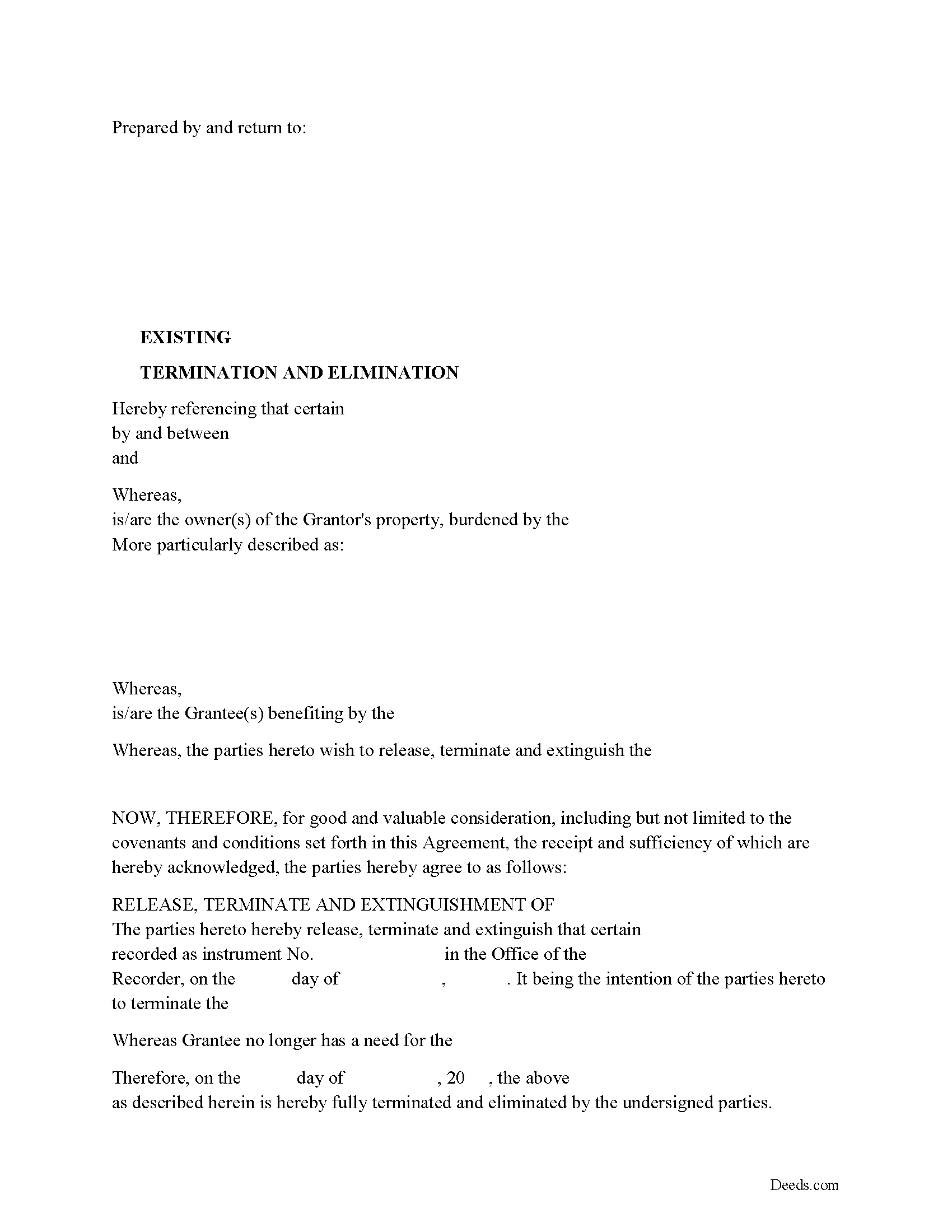
About the Florida Termination, Cancellation of Easement / Right of Way
How to Use This Form
- Select your county from the list
- Download the county-specific form
- Fill in the required information
- Have the document notarized if required
- Record with your county recorder's office
What Others Like You Are Saying
"When I brought this deed to the county assessor, they were so impressed that I had done it correctly…"
"Thanks so much for the TOD Beneficiary Deed with the explanation, supplementary forms and great exam…"
"Deed.com was so easy to use to file my Quit Claim deed. They instructed me on how to send them my do…"
"The forms worked well for entering information. I have finished without much trouble. Since the form…"
"Easy to use. I especially am thankful for the guide."
4.8/5 from 4,825 reviews. Read all
Florida's Termination, Cancellation of Easement / Right of Way is a recorded instrument that releases a previously recorded easement — a driveway, access road, utility line, drainage easement, or general right of way — from the title of the burdened parcel. What separates Florida's version from other states is the execution standard. An instrument that conveys or releases an interest in real property must be signed in the presence of two subscribing witnesses and acknowledged before a notary (Fla. Stat. § 689.01). Most states require only notarization. A release missing the second witness will be rejected at recording, and until the document is filed, the easement continues to appear in the chain of title and bind subsequent purchasers and lenders (Fla. Stat. § 695.01).
When to Use This Document in Florida
This form is used when a recorded easement is no longer needed and both the burdened owner and the easement holder want it removed from the property's title record. Common scenarios include a utility easement (power, gas, water, sewer, telecommunications) where service has been rerouted or abandoned; a drainage easement replaced by a different stormwater arrangement; a private access road or driveway easement that has fallen out of use because alternative access exists; and a general right of way the holder has decided to relinquish. Until the release is recorded, a title examiner running the chain on the burdened parcel will still flag the easement, which can hold up a sale, refinance, or title insurance commitment even when no one is actually using the easement.
Execution Requirements Under Florida Law
The signature requirements for a Florida easement release are stricter than the national norm. Two subscribing witnesses must be present when the document is signed (Fla. Stat. § 689.01). Acknowledgment must then be taken by an authorized officer — typically a Florida notary public, or an authorized official in another jurisdiction for documents signed out of state (Fla. Stat. § 695.03). The notary may also serve as one of the two witnesses, but must sign separately in each capacity. Both the owner of the burdened (servient) parcel and the holder of the easement (the dominant estate, or the utility company in the case of a utility easement) sign the release, since the document terminates an interest the holder owns. If either side is held by more than one party — co-owners on the burdened parcel, joint easement holders, or multiple grantee utilities — every party with an interest signs.
Florida Recording Requirements
Florida imposes specific formatting requirements on documents submitted for recording (Fla. Stat. § 695.26). The release must:
- Print, type, or stamp the name of each person who executes the instrument legibly beneath that person's signature
- Include the post office address of each party with a property interest affected by the document
- Identify the person who prepared the instrument by name and address on the face of the document
- Provide a 3-inch by 3-inch space at the top right corner of the first page for the Clerk's recording stamp, with at least a 1-inch margin on the remaining pages
A release that omits the preparer block or the recording margin is routinely bounced back by Florida Clerks. The release should also identify the easement being terminated by reference to its original recording — book and page or instrument number — so the chain of title clearly ties the release back to the encumbrance it extinguishes.
Florida-Specific Traps
Documentary stamp tax
Florida levies documentary stamp tax on instruments that transfer an interest in real property (Fla. Stat. § 201.02). A release given for no consideration is generally taxed at the minimum, but if the burdened owner is paying the easement holder to release the easement, the consideration is the tax base. Doc stamps are paid to the Clerk at recording. Miami-Dade County applies an additional surtax under its own structure, so a release recorded there carries a different total than the same release recorded in any other county.
Homestead
If the burdened parcel is the owner's homestead under Article X, Section 4 of the Florida Constitution, and the owner is married, both spouses must join in any instrument that alienates an interest in the homestead. While a release is technically extinguishing an outside interest rather than conveying the owner's, the cautious practice on a homestead parcel is to have both spouses sign so the title examiner has nothing to question later.
Marketable Record Title Act
Florida's Marketable Record Title Act (Fla. Stat. Chapter 712) can extinguish certain easements 30 years after the root of title if no notice of preservation was filed. Before paying for or negotiating a release, it is worth checking whether MRTA has already cleared an old easement. If MRTA has not run — or the easement is one MRTA does not reach, such as a public utility easement — recording an explicit termination is the clean way to clear title.
Plat-referenced easements
Many Florida easements are created not by a separate instrument but by dedication on a recorded plat. Releasing a plat-dedicated easement requires the release to identify the plat by name, plat book, and page, and to describe the easement area as shown on that plat. A generic release that does not tie back to the specific plat reference will not give the title examiner what they need to remove the encumbrance from the parcel's title summary.
Recording the Release
The completed release is filed with the Clerk of the Circuit Court in the Florida county where the burdened property is located. Florida has 67 counties, each with its own Clerk's office. Recording fees include a per-page charge plus an indexing fee for each name beyond the first four (Fla. Stat. § 28.24), in addition to any documentary stamp tax owed at recording. Once recorded, the release joins the chain of title and gives constructive notice to subsequent purchasers and lenders (Fla. Stat. § 695.01). Recording promptly matters because Florida is a notice-recording state: an unrecorded release is not effective against a subsequent purchaser or lender for value who takes without notice. Until the release is in the public record, the easement continues to encumber the parcel for title purposes regardless of any side agreement between the parties.
What's Included in the Download Package
The Florida Termination, Cancellation of Easement / Right of Way package includes:
- The form, formatted to Florida recording requirements with the 3x3 Clerk space, signature blocks, two witness lines, and notary acknowledgment
- Line-by-line guidelines explaining what goes in each blank
- A completed example showing the form filled in correctly
The forms are prepared by Deeds.com's forms development team and delivered as an instant download in Adobe PDF.
Important: County-Specific Forms
Our termination, cancellation of easement / right of way forms are specifically formatted for each of the 67 counties in Florida.
After selecting your county, you'll receive forms that meet all local recording requirements, ensuring your documents will be accepted without delays or rejection fees.