Alabama Termination, Cancellation of Easement / Right of Way
County Specific Legal Forms Validated as recently as October 22, 2026 by our Forms Development Team
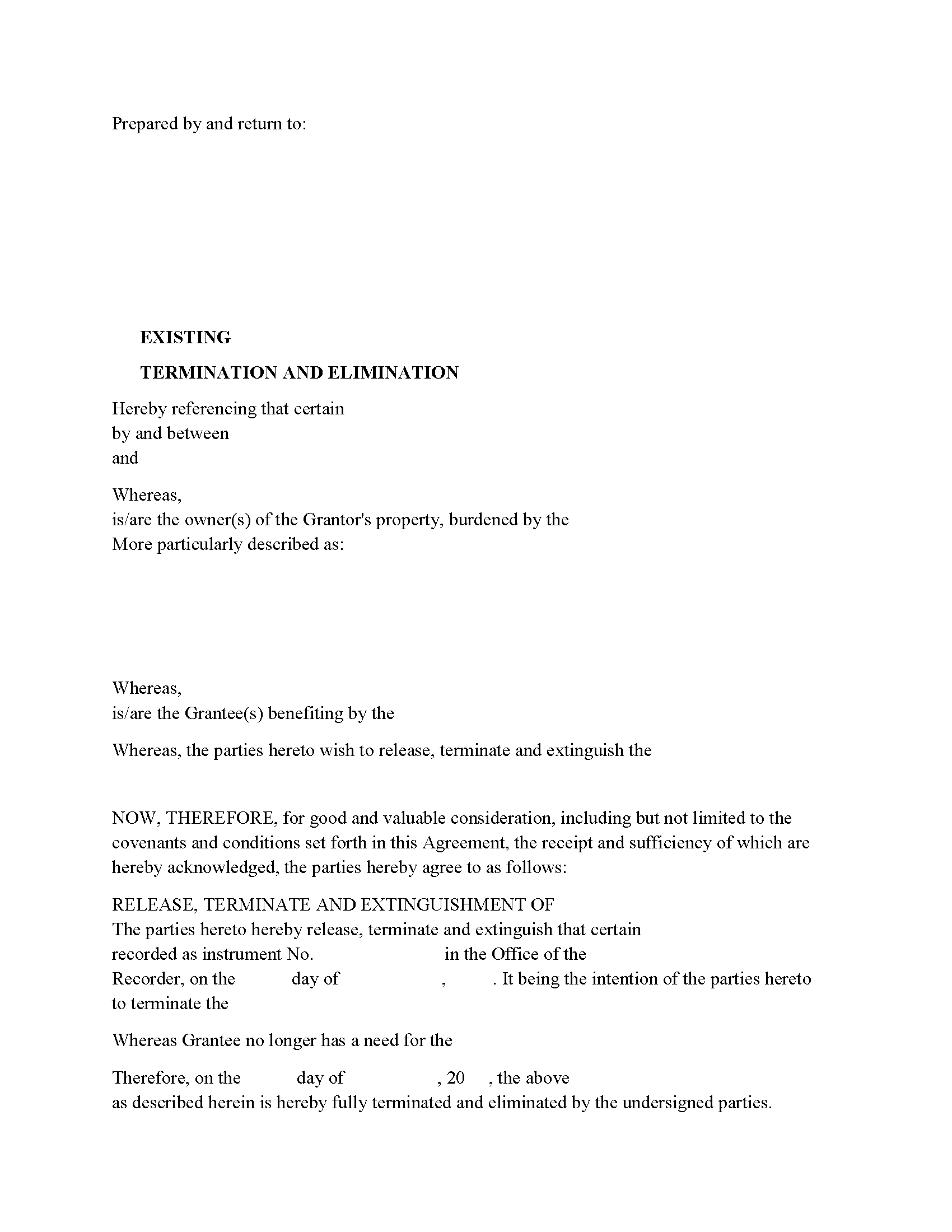
About the Alabama Termination, Cancellation of Easement / Right of Way
How to Use This Form
- Select your county from the list
- Download the county-specific form
- Fill in the required information
- Have the document notarized if required
- Record with your county recorder's office
What Others Like You Are Saying
"Easy, quick and very proficient. I am glad I used Deeds."
"This process was so easy."
"Wonderful service, very fast and great customer service will be using you guys from now on. Thanks a…"
"Downloaded and used the Ladybird Warranty Deed for a county in Florida with no issues. Cost for the …"
"This service is WONDERUL. I spent 14 years trying to get a deed recorded properly. Deeds.com kept su…"
4.8/5 from 4,832 reviews. Read all
In Alabama, an easement that has been recorded in the county probate records does not disappear on its own — not when the access road goes unused, not when a neighbor puts up a fence, and not when both parties simply agree it is no longer needed. An Alabama Termination of Easement / Right of Way is the instrument that makes a mutual agreement to end an easement legally binding and, critically, visible in the public record. Because Alabama is a notice-recording state, an easement that remains in the title chain continues to affect marketability and can complicate future sales, refinancing, or development, even if the parties abandoned the underlying use years ago.
What This Form Does and When It Is Used
The Alabama Termination of Easement / Right of Way formally extinguishes a previously recorded access interest — including easement deeds or agreements, access road easements, rights of way, utility easements (electric, gas, water, sewer), and drainage easements — by mutual agreement of both the party burdened by the access (the servient estate owner) and the party that holds the right (the dominant estate holder or easement grantee). Once executed, notarized, and recorded in the probate office of the county where the property is located, the release removes the encumbrance from the property's title chain, cleaning the record for the servient landowner.
Alabama Execution Requirements
Alabama requires all recordable instruments to meet specific execution standards. Under Alabama's general recording statutes, a written instrument conveying or releasing an interest in real property must be signed by the releasing party (here, the easement holder) and acknowledged before a notary public or attested by two witnesses. In most Alabama counties, a properly stamped and signed notarial acknowledgment satisfies the witnessing requirement in place of two separate witnesses — but the safer practice, particularly in counties that still expect both, is to have the document signed in front of a notary and two witnesses.
Alabama Act 2023-548 (effective September 1, 2023) added new content requirements to notarial acts on publicly recorded instruments. The notary's acknowledgment must now identify the county in which the notary is commissioned and in which the act is being performed, typically reflected as "Acting in ___ County." A notarial certificate that omits this county designation may be rejected or flagged at the probate office.
Alabama-Specific Traps to Avoid
Preparer Identification
Every instrument recorded in Alabama must identify the individual who prepared it by name and address (Ala. Code §§ 35-4-110 and 35-4-113). This requirement applies to easement terminations as it does to deeds. An instrument that omits preparer identification is subject to rejection at the probate office.
Marital Status
Alabama requires that instruments identify the marital status of individual grantors. Because the easement holder is the party releasing and extinguishing their interest, the holder's marital status must be stated. If the easement is held by a married individual and the right of way was acquired during the marriage, consider whether a spousal signature is prudent to prevent a later claim that a marital interest was not properly released.
Reference to the Original Recorded Easement
The termination instrument must specifically identify the easement being extinguished by reference to its recording information — the book and page number (or instrument number), the recording date, and the county in which it was recorded. A vague reference to a general access arrangement is not sufficient to remove the encumbrance from the title record. If the original easement was recorded in a different county than where the property is currently located, verify the correct filing county for the termination.
Legal Description
Alabama counties require a complete legal description in recorded instruments. The legal description in the termination should mirror the description used in the original easement — referring to the same metes and bounds, subdivision plat reference, or section/township/range identification. Dale County and several others specifically require that the legal description include the plat book reference or the full section, township, and range designation where applicable. Using the tax assessor's abbreviated parcel description is not a substitute; tax descriptions are for assessment purposes only and are routinely insufficient for recording.
Deed Transfer Tax
Alabama's deed transfer tax of $0.50 per $500 of value applies to instruments conveying an interest in real property. A termination of easement extinguishes an interest rather than conveying one for consideration, and in most cases no deed transfer tax is due. However, probate offices vary in how they classify and process these instruments. Confirming treatment with the specific county probate office before presenting the document avoids unexpected delays.
RT-1 Real Estate Sales Validation Form
Alabama Act 2012-494 requires submission of the Real Estate Sales Validation Form (RT-1) with deeds that transfer property for consideration. Because an easement termination does not involve a sale of real property, the RT-1 is generally not required — but confirm this with the local probate office, as some counties have specific policies on instrument classification.
Recording Office and Priority
All instruments affecting title to Alabama real property are recorded with the Judge of Probate in the county where the property is located (Ala. Code § 35-4-50). Alabama's race-notice recording statute means that a recorded termination is effective as public notice from the date and time of recording. Until the termination is recorded, the easement remains a valid encumbrance against all subsequent purchasers and lenders who search the title — even if both parties have long since stopped using or honoring it. Prompt recording protects both the servient landowner and the title record.
Both Parties Must Sign
An easement termination in Alabama requires agreement from both sides: the owner of the burdened property (servient estate) and the holder of the easement right (dominant estate or grantee). If the easement is held by an entity — a utility company, a municipality, or a business — the termination must be executed by an authorized representative of that entity, with evidence of authorization attached if required by the county. If either party cannot be located or refuses to sign, a recorded mutual release is not available and other legal remedies would need to be pursued.
What Is Included in the Download Package
The Alabama Termination of Easement / Right of Way package includes the termination form formatted to meet Alabama recording requirements, a completed example showing a correctly filled-out instrument, and step-by-step instructions for preparation and filing with the Judge of Probate in your county.
Important: County-Specific Forms
Our termination, cancellation of easement / right of way forms are specifically formatted for each of the 67 counties in Alabama.
After selecting your county, you'll receive forms that meet all local recording requirements, ensuring your documents will be accepted without delays or rejection fees.