Alabama Full Release of Memorandum and Notice of Agreement
County Specific Legal Forms Validated as recently as October 1, 2026 by our Forms Development Team
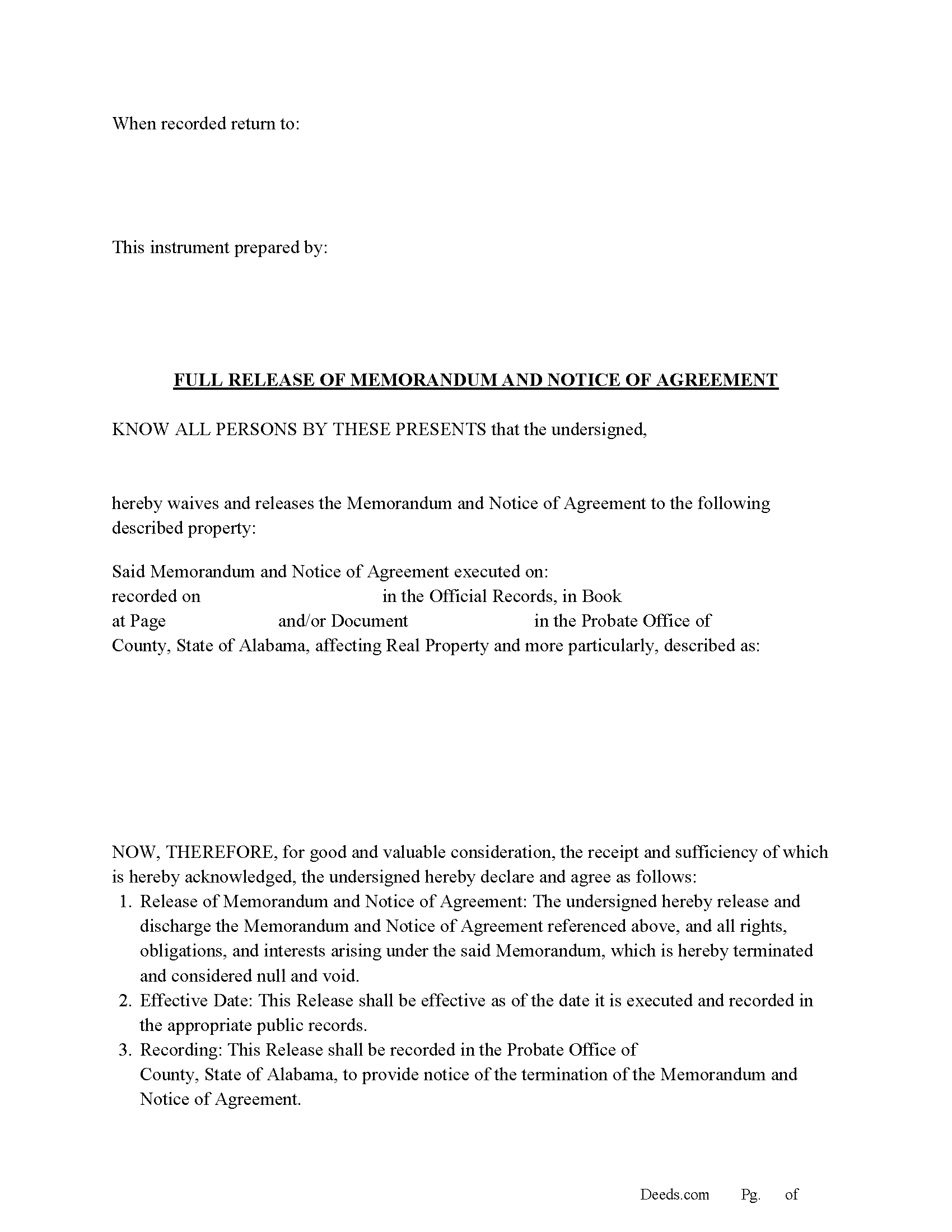
About the Alabama Full Release of Memorandum and Notice of Agreement
How to Use This Form
- Select your county from the list
- Download the county-specific form
- Fill in the required information
- Have the document notarized if required
- Record with your county recorder's office
What Others Like You Are Saying
"Very easy process!"
"easy to use once i found out i could fill it out right on the deeds website instead of downloading i…"
"Very helpful."
"Thanks for the efficient process and instructions."
"It's okay, seems you need to make it easier to search deeds on properties without having to go throu…"
4.8/5 from 4,832 reviews. Read all
An Alabama Full Release of Memorandum and Notice of Agreement is used to remove a previously recorded memorandum of contract or notice of agreement from the county probate records after the underlying purchase agreement has been terminated or completed. This matters in Alabama because recorded memoranda are indexed in the probate office and can cloud title until formally released. Alabama recording rules—such as required acknowledgments, preparer identification, marital-status recitals, and county-based indexing—mean the release must be properly executed and recorded to clear the public record and restore marketable title.
What the Alabama Full Release of Memorandum and Notice of Agreement does
This document formally cancels a recorded memorandum or notice that referenced a real estate purchase agreement. In Alabama, memoranda are often recorded to give public notice that a property is under contract. When the contract is fulfilled, expires, or is terminated, the recorded notice remains in the chain of title until a release is recorded. The release removes that cloud so the property can be sold, refinanced, or otherwise conveyed without the prior agreement appearing as an active claim.
Alabama statutory framework and recording status
In Alabama, instruments affecting real property are recorded in the office of the Judge of Probate in the county where the property is located (Ala. Code § 35-4-62). Recording serves as public notice of the contents of the instrument (Ala. Code § 35-4-63), and priority is governed by Alabama's recording statute protecting later purchasers and lenders without notice (Ala. Code § 35-4-90). Because a memorandum of agreement can impair title, recording a proper release in the same county is the step that removes that notice from the public record.
Execution requirements for an Alabama release
An Alabama Full Release of Memorandum and Notice of Agreement must be executed with the same care as other recordable real-estate instruments. The releasing party—often the buyer named in the original memorandum, or both parties depending on how the memorandum was drafted—must sign the release. Alabama requires execution to be attested by at least one witness if the signer writes his or her name, unless a proper acknowledgment is used (Ala. Code § 35-4-20). Acknowledgment before a notary public satisfies the statutory execution requirement for recording (Ala. Code § 35-4-23).
Names should match the parties listed in the recorded memorandum exactly, including any entity designations or capacity language. If the original memorandum included multiple parties, the release should address all parties whose interests are being cleared to avoid leaving partial clouds in the title record.
Alabama-specific traps that cause recording or title problems
- Marital-status recital: Alabama requires that the marital status of the grantor or releasing party be stated before the probate judge records the instrument (Ala. Code § 35-4-73). Omitting this can delay recording.
- Preparer identification: The name and address of the person who prepared the document must appear on the instrument (Ala. Code § 35-4-110). This is a common rejection point for generic forms.
- Reference to the original recording: The release should clearly identify the previously recorded memorandum by recording information (book/page or instrument number). Without this, probate staff may not be able to index the release properly.
- County-specific recording: The release must be recorded in the same county where the original memorandum was recorded. Recording in the wrong county does not clear the title where the property is actually located.
- Exact name matching: Differences between the names in the memorandum and the release can cause indexing errors or leave unresolved title questions in Alabama’s grantor-grantee index system.
- Execution completeness: If the original memorandum involved multiple parties, failing to obtain all necessary signatures for the release can leave the memorandum partially effective in the public record.
- Plat or legal description consistency: If the memorandum referenced a subdivision or recorded plat, the release should be consistent with that description so the probate office can properly connect the documents (Ala. Code § 35-4-74).
Recording process in Alabama
The completed release is recorded with the Judge of Probate in the county where the property is located. Recording promptly is important because the memorandum remains part of the public record—and a potential title issue—until the release is indexed and recorded. Once recorded, the release provides notice that the prior agreement no longer affects the property.
Alabama probate offices collect recording fees and may assess recordation taxes depending on the nature of the instrument presented under Title 40, Chapter 22. While a release typically does not carry the same tax implications as a deed or mortgage, the probate office determines the applicable fees at the time of recording (Ala. Code §§ 40-22-1, 40-22-2).
Vesting considerations in Alabama
Although this form does not transfer ownership, it must align with the parties who held rights under the recorded memorandum. Alabama requires clear identification of parties in recorded instruments, and survivorship is not presumed in co-ownership unless expressly stated in the creating instrument (Ala. Code § 35-4-7). Matching the parties and their capacities ensures the release effectively clears the title record without ambiguity.
What is included in the download package
The Alabama Full Release of Memorandum and Notice of Agreement package includes the form, detailed instructions, and a completed example. It is designed for Alabama recording requirements, addressing probate-office filing, acknowledgment or witness compliance, preparer identification, marital-status recitals, and proper reference to the original recorded memorandum.
Important: County-Specific Forms
Our full release of memorandum and notice of agreement forms are specifically formatted for each of the 67 counties in Alabama.
After selecting your county, you'll receive forms that meet all local recording requirements, ensuring your documents will be accepted without delays or rejection fees.