Alabama Full Release of Real Estate Contract
County Specific Legal Forms Validated as recently as October 16, 2026 by our Forms Development Team
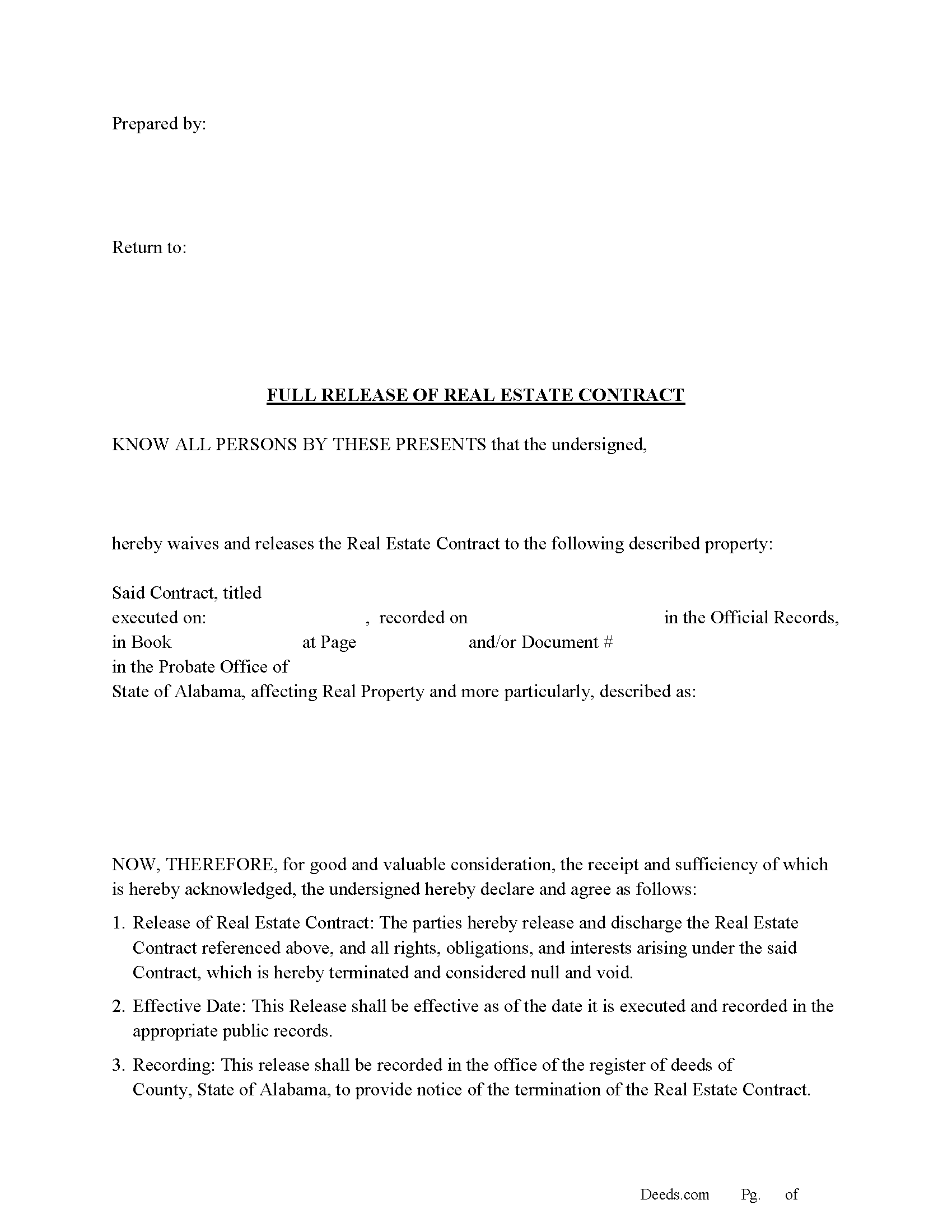
About the Alabama Full Release of Real Estate Contract
How to Use This Form
- Select your county from the list
- Download the county-specific form
- Fill in the required information
- Have the document notarized if required
- Record with your county recorder's office
What Others Like You Are Saying
"Really nice deed form and guide the whole process was super easy."
"Your PDF form Personal Representative's Deed was exceedingly helpful."
"Found exactly what I was looking for and it helped tremendously."
"Good service...deed release form as required."
"simple to follow and easy to use. Thanks"
4.8/5 from 4,829 reviews. Read all
An Alabama Full Release of Real Estate Contract is used to formally terminate and remove a previously recorded contract for deed or similar installment land agreement from the county probate records. In Alabama, this step is critical because recorded contracts create a visible claim against the property in the public record. Until a proper release is executed and recorded in the probate office, that prior contract can continue to cloud title, interfere with future sales or financing, and raise questions during title searches.
What the Alabama Full Release of Real Estate Contract does
This document confirms that a real estate contract—often a land contract, agreement for deed, or installment sale—has been satisfied, canceled, or otherwise terminated. In Alabama, these contracts commonly involve seller financing where the deed is transferred only after payment is complete. Once the contract ends, the release removes the buyer’s recorded interest so the property can be conveyed or refinanced without the prior agreement appearing as an active encumbrance in the public record.
Alabama statutory framework and recording status
Alabama requires instruments affecting real property to be recorded in the office of the Judge of Probate in the county where the property is located (Ala. Code § 35-4-62). Recording provides constructive notice to third parties (Ala. Code § 35-4-63), and Alabama follows a race-notice system that protects later purchasers and lenders without notice (Ala. Code § 35-4-90). A release that is not recorded may not protect against subsequent claims, leaving the prior contract visible in the title chain.
Alabama law also requires certain real estate-related agreements and releases to be in writing to be enforceable under the Statute of Frauds (Ala. Code § 8-9-2). Recording the release ensures that the termination of the contract is reflected in the same public system where the original interest was recorded.
Execution requirements for an Alabama release
The Alabama Full Release of Real Estate Contract must be signed by the party or parties holding the interest being released—often the buyer under the contract, and in some cases both buyer and seller depending on how the original agreement was structured. Alabama requires execution to be attested by at least one witness if the signer writes his or her name, unless the document is acknowledged before a notary public (Ala. Code § 35-4-20). A proper acknowledgment satisfies the witness requirement for recording (Ala. Code § 35-4-23).
The names of the parties should match the original recorded contract exactly. If the contract involved multiple buyers or entities, the release should address all interests to ensure the title record is fully cleared.
Alabama-specific traps that cause recording or title problems
- Marital-status recital: Alabama requires that the marital status of the grantor or releasing party be stated before the probate judge records the instrument (Ala. Code § 35-4-73). Missing this recital can delay or prevent recording.
- Preparer identification: The document must include the name and address of the person who prepared it (Ala. Code § 35-4-110). This is a mandatory Alabama requirement often omitted on generic forms.
- Reference to the original contract: The release should clearly identify the recorded contract by book/page or instrument number. Without this, the probate office may not be able to properly index the release against the original record.
- Homestead considerations: If the property is homestead property and the owner is married, Alabama’s homestead laws may require spousal involvement in instruments affecting the property (Ala. Code § 6-10-3). Ignoring this can create enforceability issues.
- Exact name matching: Any mismatch between the names in the original contract and the release can create indexing problems or leave questions about whether the interest has been fully released.
- County-specific filing: The release must be recorded in the same county where the property is located and where the original contract was recorded. Recording elsewhere does not clear the title in the correct jurisdiction.
- Legal description consistency: The property description should match the original contract and include any necessary plat references for proper indexing (Ala. Code § 35-4-74).
Recording process in Alabama
The completed Alabama Full Release of Real Estate Contract is recorded with the Judge of Probate in the county where the property is located. Recording should be done promptly after the contract is fulfilled or terminated to prevent title complications. Once recorded, the release provides public notice that the prior contract no longer affects the property.
Recording fees apply, and Alabama probate offices may assess applicable recordation taxes depending on the nature of the instrument under Title 40, Chapter 22. The probate office determines the appropriate fees and any required tax stamps at the time of filing.
Vesting considerations in Alabama
Although a release does not transfer ownership, it must align with the parties who held the interest under the contract. Alabama requires clear identification of parties in recorded instruments, and survivorship is not presumed in co-ownership unless expressly stated (Ala. Code § 35-4-7). Ensuring that all parties with a recorded interest are properly addressed in the release helps eliminate any remaining clouds on title.
What is included in the download package
The Alabama Full Release of Real Estate Contract package includes the form, step-by-step instructions, and a completed example. It is designed to meet Alabama probate recording requirements, including acknowledgment or witness compliance, preparer identification, marital-status recitals, and proper reference to the original recorded contract.
Important: County-Specific Forms
Our full release of real estate contract forms are specifically formatted for each of the 67 counties in Alabama.
After selecting your county, you'll receive forms that meet all local recording requirements, ensuring your documents will be accepted without delays or rejection fees.