Ohio Memorandum and Notice of Agreement
County Specific Legal Forms Validated as recently as November 3, 2026 by our Forms Development Team
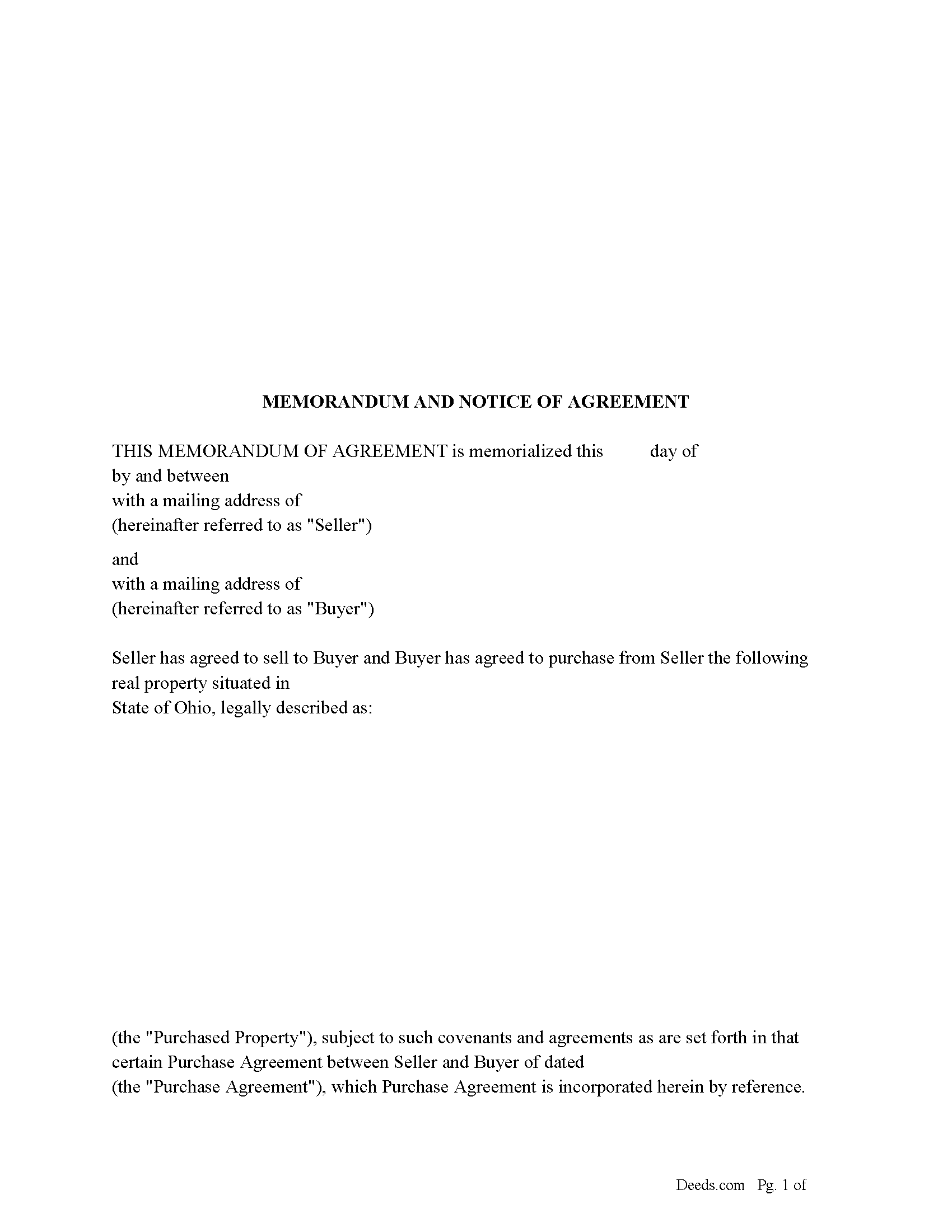
About the Ohio Memorandum and Notice of Agreement
How to Use This Form
- Select your county from the list
- Download the county-specific form
- Fill in the required information
- Have the document notarized if required
- Record with your county recorder's office
What Others Like You Are Saying
"Looks like all forms are available. Hope they are as easy to use as it was to obtain. Thank you."
"got the forms needed plus all the information needed to fill them out."
"5 star review. Was able to order and download what I wanted in just a few minutes without any glitch…"
"Fillable documents, after a download, would be helpful. Very good to have all these forms online and…"
"Easy to download this form. I will use it when the time comes to transfer title of my house."
4.8/5 from 4,844 reviews. Read all
An Ohio Memorandum and Notice of Agreement puts the existence of a signed purchase agreement into the county land records while the agreement itself stays private. The seller and the buyer sign a short summary that names them, describes the parcel, identifies the agreement by date and title, and states that it was recorded to give notice of the agreement and of the buyer's rights under it. The price never reaches the public record. This form prepares that memorandum, also searched for as a memorandum of purchase agreement or memorandum of contract, for Ohio property.
Notice without disclosure
Between the signing of a purchase agreement and the delivery of the deed, the buyer's position rests on a contract nobody else can see. Ohio equity treats a binding contract to sell land as vesting equitable title in the buyer, with the seller holding legal title for the purchaser until closing, a rule the Supreme Court of Ohio stated in Gilbert v. Port in 1876 and the Eleventh District restated in Estate of Hovanick in October 2026. Ohio Revised Code Section 317.08 directs the recorder to record instruments by which land may be conditionally sold or affected, together with memoranda of instruments entitled to record, and Section 5301.25 protects a subsequent bona fide purchaser against an unrecorded instrument. The memorandum places the agreement in the chain of title and gives notice of what it contains; the terms it leaves out stay in the unrecorded contract.
A notice that clears itself
A recorded memorandum clouds the seller's title until something removes it. Section 6 of this form fixes an expiration date, chosen by the parties, after which the memorandum no longer gives notice unless a deed from the seller to the buyer or an acknowledged extension was recorded first, the same idea Ohio applies by statute to recorded options. The buyer signs alongside the seller, so both parties' assent to that date goes on the record with it.
What the memorandum recites
The instrument identifies the parties with their mailing addresses; the property by county, legal description, parcel number, street address, and the seller's deed of record; and the agreement by date, title, and stated closing date. Its operative section recites that the parties entered into the agreement and record the memorandum to give notice of it, then states the limits: it is not a conveyance and transfers no title, the agreement controls over any summary of it, and information about the agreement may be obtained from the buyer. The memorandum releases no dower and does not stop the seller from signing a later deed; its work is to put the buyer's claim of record so that anyone who takes afterward takes with notice.
Two parties, up to four signers
The form carries one or two sellers and one or two buyers, each a natural person signing in that person's own right, in free-form party blocks that preprint no vesting, status, or capacity language. Four signature blocks follow, the second on each side left blank when one person signs, each with its own acknowledgment certificate in the Ohio statutory short form. A married couple selling the home they own together and two unmarried buyers present the pattern the completed example recites. An entity party, a fiduciary, a signer acting under a power of attorney, and three or more parties on a side are configurations this form is not set up as.
Built for the Ohio recorder
The memorandum is recorded with the county recorder where the property lies, at 34 dollars for the first two pages and 8 dollars for each additional page before any county surcharge, and it meets the Section 317.114 format standard, including the three inch blank top margin on the first page. Because it conveys nothing, the auditor's transfer stamp and conveyance fee statement that precede a deed do not attach to it under state law, though county intake practice varies. Once the sale closes, the deed supersedes the notice; if it does not close, a separately prepared release, not included in this package, clears the record before the expiration date.
The package includes the fillable Memorandum and Notice of Agreement form, a completed example filled in for a Franklin County fact pattern with two sellers and two buyers, and a guide that walks through every section, the signing and acknowledgment rules, and the recording process. The description and the guide describe the form and the governing Ohio law in general terms; they are not legal advice.
Important: County-Specific Forms
Our memorandum and notice of agreement forms are specifically formatted for each of the 88 counties in Ohio.
After selecting your county, you'll receive forms that meet all local recording requirements, ensuring your documents will be accepted without delays or rejection fees.