Ohio Transfer on Death Designation Affidavit
County Specific Legal Forms Validated as recently as November 8, 2026 by our Forms Development Team
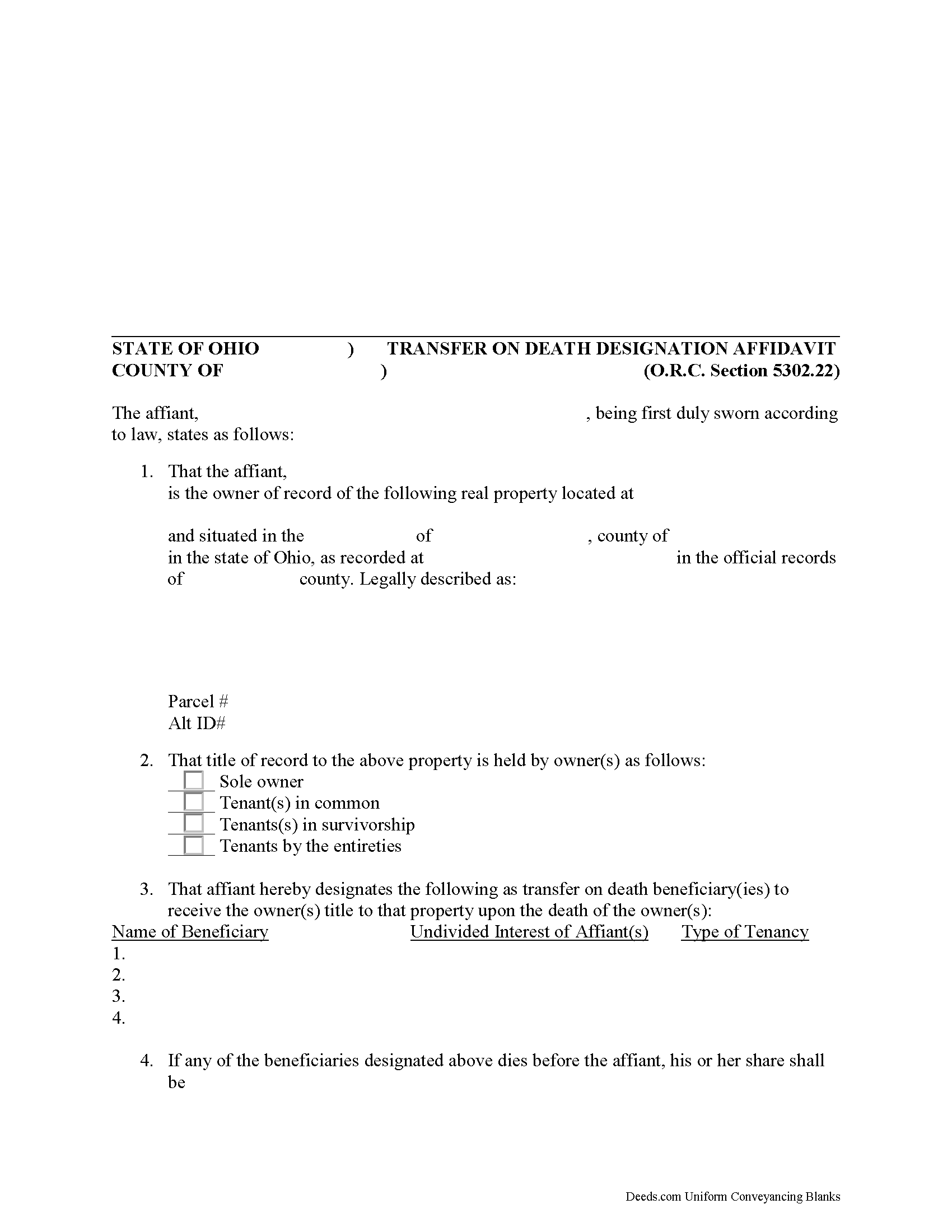
About the Ohio Transfer on Death Designation Affidavit
How to Use This Form
- Select your county from the list
- Download the county-specific form
- Fill in the required information
- Have the document notarized if required
- Record with your county recorder's office
What Others Like You Are Saying
"Great and quick service!"
"Swift and Concise Process!!! I would recommend, as well as, use again!"
"The Executor's Guide needs more info about what to put for grantee (estate of deceased or my name as…"
"Downloaded and completed these quit claim forms in less than one cup of coffee, quick easy and stres…"
"Quick and easy, and a good value for the money. Thanks, Deeds.com!"
4.8/5 from 4,863 reviews. Read all
This download supplies a fill-in Ohio Transfer on Death Designation Affidavit prepared under Ohio Revised Code Sections 5302.22 and 5302.23, together with a section-by-section guide and a completed example. The instrument is a sworn affidavit, not a deed; Ohio uses an affidavit where most states use a transfer on death deed. Through it, one or two individual owners of Ohio real property name, by name, the person or persons who take the owner's interest when the owner dies. The affidavit prints the recording notice from Section 5302.22(F): it is effective only if recorded with the county recorder of the county where the property is located before the death of the owner who signed it. The statute requires no consideration and no delivery to the beneficiary.
The purchase also includes an alternative configuration, the Transfer on Death Designation Affidavit (Revocation or Change), with its own blank form, guide, and completed example. The two configurations are versions of the same statutory affidavit: the general form establishes a designation, and the Revocation or Change form replaces a designation already on record. The same statewide forms are delivered for every Ohio county.
What the download contains
- Transfer on Death Designation Affidavit: fillable blank form (a removable instructions page followed by six recorded pages), a seven-page guide, and a completed example.
- Transfer on Death Designation Affidavit (Revocation or Change): fillable blank form in the same six-page layout, its own guide, and a completed example.
All six files are PDFs with fillable fields, built to the margin and type-size standards of Section 317.114 for recorded instruments. The guides also cover printing the forms and continuing an entry that outgrows its field on an attached exhibit page recorded with the affidavit.
How the affidavit form is built
The blank form carries each element Section 5302.22(D) requires in a transfer on death designation affidavit: the owner's identity and marital status with a fixed statement that the signer is the owner of record, a description of the real property with a reference to the recorded instrument containing it, the interest designated (the entire interest unless a lesser interest is stated), the beneficiary designation with a separate box for contingent beneficiaries, and a married owner's spouse's statement that dower rights are subordinate to the vesting of title in the beneficiaries. The statutory statements are fixed text; the owner, property, beneficiary, and spouse entries are free-form boxes, and nothing about how title is held is preprinted.
Because Section 5302.22(D) requires the affidavit to be verified before an officer authorized to administer oaths, each of the form's three signature blocks (owner, second owner, and spouse) is followed by its own jurat certificate (sworn to and subscribed before me) rather than an acknowledgment. The separate spouse block is provided for the spouse of a married owner who does not hold record title; the guide explains that a spouse who is also an owner makes the dower statement by signing as an owner. The guide notes that one certificate per signer is the form's design rather than a separate statutory requirement, and that the certificates print no online-notarization statement.
Owners the form is set up for
The guide describes four ownership patterns that fit the form's blanks: a sole owner, a tenant in common, two survivorship tenants completing one affidavit together, and spouses holding as tenants by the entireties under a deed recorded between February 9, 1972 and April 3, 1985. It also addresses one survivorship tenant signing alone and the consequence Section 5302.23(B)(7)(b) attaches to a designation made without the last surviving tenant's joinder. The form carries two owner blocks and one spouse block, following the statute's language of an individual executing together with the individual's spouse. Both guides state that the forms are not set up for an owner that is a corporation, limited liability company, or other entity, for a trustee holding title to a trust, for a person signing under a power of attorney, or for three or more owners on one affidavit.
What the guide explains
The guide works through the form section by section, identifying the source document each entry is drawn from (the recorded vesting deed or the county auditor's parcel record) and quoting the completed example's entry for that section, so every blank can be read alongside one filled-in version. In general terms it explains that the designation has no effect on present ownership and gives the beneficiary no interest until the owner's death; that multiple beneficiaries take equal shares as tenants in common unless the affidavit specifies otherwise, with contingent beneficiaries taking the share of a beneficiary who does not survive; that a survivorship tenant's designation made without the last surviving tenant's joinder is nullified automatically when that tenant dies first; and why dower is the reason a married owner's spouse joins. Its signing, printing, and recording sections cover the jurat certificates, recording fees and the Section 317.114 format, and the varying county practice on whether the affidavit is reviewed by the county auditor before recording, describing published practice in several county offices and noting that each office's current instructions govern.
What the completed example shows
The completed example fills every section of the general form for a two-owner survivorship scenario: a widowed mother and her married son, holding as survivorship tenants, designate their entire interest in a platted Franklin County lot to two beneficiaries in equal shares as tenants in common, name a contingent beneficiary for one of those shares and none for the other, and the son's spouse signs the spouse block. All three jurats are completed. The example demonstrates an owner entry for survivorship tenants with different marital statuses, a legal description with parcel number and prior-deed reference, a contingent designation tied to a single share, and a spouse joining without holding title.
The Revocation or Change configuration
Under Section 5302.23(B)(5), a recorded designation is revoked or changed by executing and recording, before the owner's death, a new transfer on death designation affidavit stating the revocation or change; the new affidavit automatically supersedes prior recorded designation affidavits for the same property, provided the prior affidavit was executed before the later one. The Revocation or Change form is that new affidavit. It carries the same owner, property, interest, beneficiary, spouse, and signature sections and the same per-signer jurats as the general form, and adds a section identifying the prior recorded affidavit (date executed, date recorded, and recording reference) with a fixed statement of revocation under Section 5302.23(B)(5). Its recording notice adds one sentence on that section's timing.
This form is not a stand-alone cancellation that leaves the property with no designation. It carries the Section 5302.22(D)(4) designating statement and a beneficiary box for the new designation; its guide notes that the chapter prints no form of affidavit stating a revocation without a designation, and that a beneficiary from the prior affidavit who continues is named again because the prior designation is revoked in full. The guide also states that the fixed text of the prior-affidavit section names a prior designation affidavit, so the form is not set up to identify a transfer on death deed recorded before December 28, 2009. The variant's completed example reuses the parties, property, and vesting deed of the general example and changes the designation recorded six months earlier: one original beneficiary moves to a contingent position, the original contingent beneficiary becomes a primary beneficiary, and the son's spouse again signs the spouse block. The two examples read as one sequence of recordings on a single parcel.
What the affidavit does not do
The guides explain that the affidavit transfers nothing during the owner's life, creates no survivorship between signing owners, reaches only the real property it describes, does not clear liens or encumbrances (a beneficiary takes the interest subject to all encumbrances, and no lienholder's rights are affected), is not a will and does not revoke one, and does not release dower for a lifetime sale or mortgage or substitute for a spouse's signature on a later deed or mortgage. If no designated or contingent beneficiary survives the owner, the interest passes through the probate estate.
The affidavit also does not itself move title at death. Under Section 5302.222, the transfer is recorded after the owner's death through an affidavit of confirmation executed by a beneficiary, verified before an officer authorized to administer oaths and accompanied by a certified copy of the death certificate. That instrument and the Medicaid estate recovery form described in Section 5302.221 are prepared after the owner's death and are not included in this package.
This description and the included guides provide general information about the forms and the statutes they follow; they do not apply the law to any particular situation and are not legal advice.
Important: County-Specific Forms
Our transfer on death designation affidavit forms are specifically formatted for each of the 88 counties in Ohio.
After selecting your county, you'll receive forms that meet all local recording requirements, ensuring your documents will be accepted without delays or rejection fees.