Florida Claim of Lien
County Specific Legal Forms Validated as recently as October 1, 2026 by our Forms Development Team
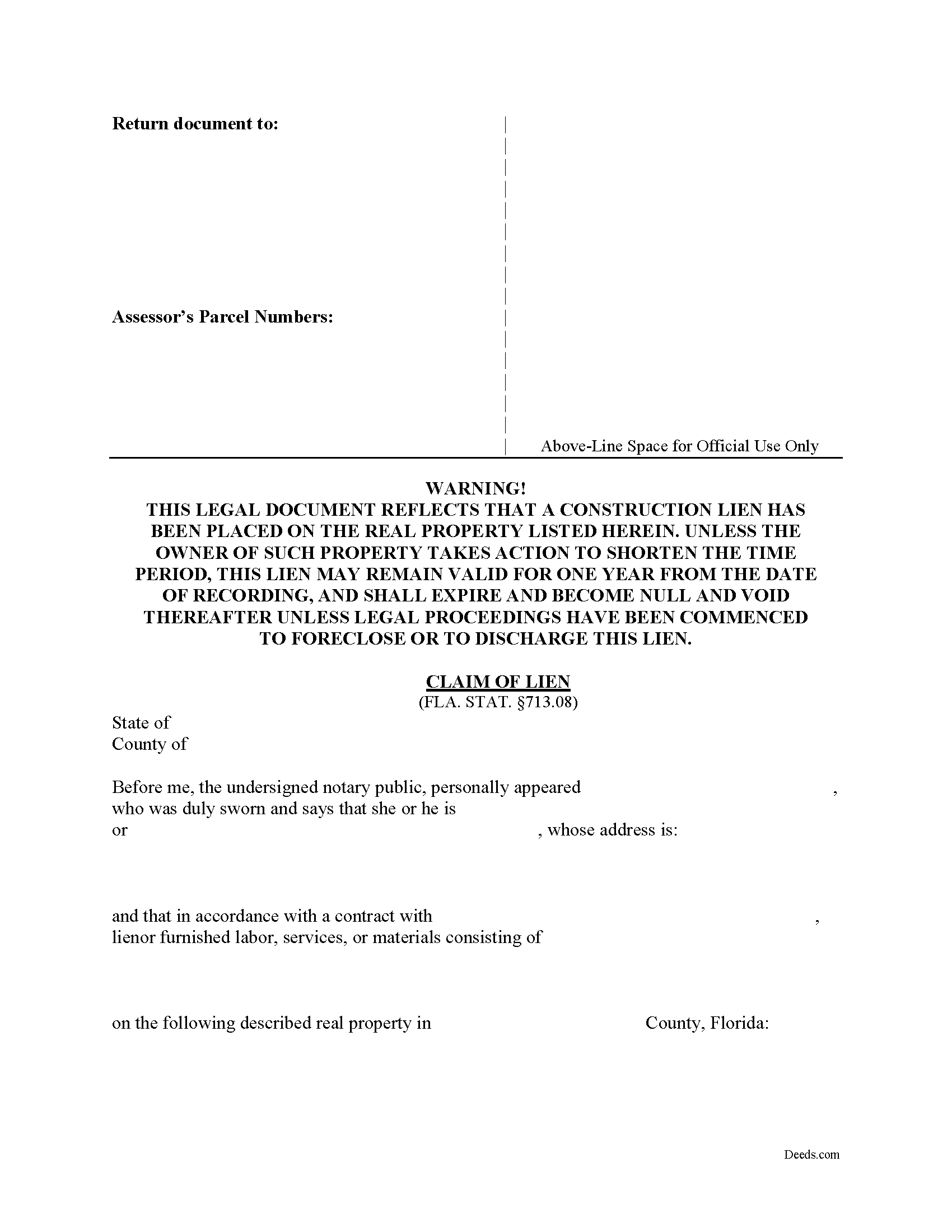
About the Florida Claim of Lien
How to Use This Form
- Select your county from the list
- Download the county-specific form
- Fill in the required information
- Have the document notarized if required
- Record with your county recorder's office
What Others Like You Are Saying
"Quality platform! Five Stars for sure and easy to navigate!"
"you are awesome never had such a great expriance will be back with other transfers you the best"
"Good information for solving my issue..."
"Easy and fast"
"Like the setup Good idea on forms that help at a great price"
4.8/5 from 4,823 reviews. Read all
A Florida Claim of Lien is used to record a construction lien under Florida's Construction Lien Law when labor, services, materials, or certain professional services furnished to improve Florida real property remain unpaid. Florida's version is not a generic mechanic's lien form: it must be sworn, must include the statutory construction-lien warning, must identify the first and last furnishing dates, and must show Notice to Owner service information when Florida law requires that preliminary notice.
When a Florida Claim of Lien Is Commonly Used
A Florida Claim of Lien is commonly used by a contractor, subcontractor, sub-subcontractor, laborer, material supplier, or qualifying professional lienor to place a recorded encumbrance against privately owned Florida real property improved by the lienor's work or materials. Recording the claim does not transfer title, but it gives public notice of the unpaid claim and preserves the lienor's ability to pursue lien enforcement under Chapter 713, Part I, Florida Statutes.
Florida Claim of Lien Requirements
Florida requires a recorded claim of lien to state specific information, not merely the amount owed. The claim must include the following items (Fla. Stat. § 713.08(1)):
- The lienor's name and the address where notices or process may be served on the lienor.
- The name of the person with whom the lienor contracted or by whom the lienor was employed.
- The labor, services, or materials furnished, together with the contract price or value.
- A separate statement for specially fabricated materials made away from the improvement site but intended for incorporation into the improvement.
- A description of the real property sufficient for identification.
- The name of the owner.
- The time when the first and last item of labor, services, or materials was furnished.
- The unpaid amount claimed for labor, services, materials, and any unpaid finance charges due under the lienor's contract.
- For a lienor not in privity with the owner, the date and method of service of the Notice to Owner.
- For a lienor not in privity with the contractor or subcontractor, the date and method of service of any required copy of the notice on the contractor or subcontractor.
The Florida statutory form also requires a prominent warning stating that a construction lien has been placed on the property and that, unless the owner shortens the time period, the lien may remain valid for one year from recording unless foreclosure or discharge proceedings are commenced (Fla. Stat. § 713.08(3)).
Notice to Owner and Florida Timing Rules
Florida separates preliminary notice from the recorded claim of lien. A lienor under section 713.06 who is not in privity with the owner, except a laborer, must serve a Notice to Owner before commencing work or not later than 45 days after commencing to furnish labor, services, or materials, and in any event before the owner's final payment after the contractor furnishes the final payment affidavit. Sub-subcontractors and certain material suppliers must also serve required copies on the contractor or subcontractor. The Notice to Owner is not a lien and does not replace recording the claim (Fla. Stat. § 713.06(2)).
The claim of lien may be recorded during the progress of the work or after the work, but it must be recorded not later than 90 days after the lienor's final furnishing of labor, services, or materials. If the original contract is terminated under Florida's priority statute, the deadline can be the earlier of 90 days after termination or 90 days after final furnishing (Fla. Stat. § 713.08(5)). If the last day falls on a Saturday, Sunday, legal holiday, clerk-observed holiday, or a day affected by an emergency clerk closure, Florida's computation rules may extend or toll the period (Fla. Stat. § 713.011).
After the claim is prepared, Florida requires the claim of lien to be served on the owner before recording or within 15 days after recording. Service must follow Florida's construction-lien service statute, which allows hand delivery, common carrier delivery, registered mail, Global Express Guaranteed, certified mail with evidence of delivery, or posting at the improvement site when the other methods cannot be accomplished (Fla. Stat. §§ 713.08(4)(c), 713.18).
Signing, Notarization, and Recording Format
A Florida claim of lien may be prepared by the lienor, the lienor's employee, or the lienor's attorney, and it must be signed and sworn to or affirmed by the lienor or by the lienor's agent who is acquainted with the facts stated in the claim (Fla. Stat. § 713.08(2)). Because the document is sworn, the signature section uses a notarial jurat rather than the two-witness execution format used for many Florida deeds.
Florida recording law also affects the appearance of the document. An instrument that encumbers an interest in real property must show the printed, typewritten, or stamped name and post-office address of each person who executes it, the name and post-office address of the natural person who prepared it or supervised its preparation, the printed name of the notary or other officer taking the acknowledgment or proof, and reserved recording space at the top right of the pages (Fla. Stat. § 695.26). If witnesses appear on an instrument, Florida recording rules require their printed names and addresses, but section 713.08 does not make witnesses part of the claim-of-lien execution requirement.
Recording, Priority, and Enforcement in Florida
The claim of lien is recorded in the clerk's office for the county where the improved real property is located. If the property lies in more than one Florida county, the claim must be recorded in each county. Recording the claim gives constructive notice of its contents and effect, and Florida states that the owner's insolvency, bankruptcy, or death before recording does not affect the validity of the lien or the right to record it (Fla. Stat. § 713.08(5)).
Priority is tied to Florida's Notice of Commencement system. Liens under sections 713.05 and 713.06 attach and take priority as of the recording of the Notice of Commencement; if no Notice of Commencement is recorded, they attach and take priority as of the recording of the claim of lien. Liens for professional services and subdivision improvements under sections 713.03 and 713.04 attach and take priority when the claim of lien is recorded (Fla. Stat. § 713.07).
A Florida construction lien generally does not continue for more than one year after the claim of lien is recorded unless an action to enforce the lien is commenced within that period. An owner or the owner's attorney may shorten that period by recording a Notice of Contest of Lien, after which the lienor has 60 days from service of the notice to file suit or the lien is extinguished automatically. An interested party may also file a complaint that requires the lienor to show cause within 20 days after service of the summons why the lien should not be enforced or canceled (Fla. Stat. §§ 713.21, 713.22).
Florida-Specific Issues That Can Affect a Construction Lien
Florida lien law contains several rules that can affect whether a recorded claim is enforceable or how far it reaches:
- Fraudulent or exaggerated liens: A willfully exaggerated lien, a lien that includes work not performed or materials not furnished, or a claim compiled with willful and gross negligence may be treated as a fraudulent lien. A fraudulent lien is a complete defense to enforcement, can result in forfeiture of lien rights, and willful filing is a third-degree felony (Fla. Stat. § 713.31).
- Homestead property: Florida homestead protection does not bar obligations contracted for the purchase, improvement, or repair of the homestead, or obligations for house, field, or other labor performed on the realty. For married owners, a spouse who contracts for improvements may be deemed the agent of the other spouse for purposes of subjecting that spouse's interest to construction liens, unless the noncontracting spouse gives the contractor and records a notice of objection within 10 days after learning of the contract (Fla. Const. art. X, § 4; Fla. Stat. § 713.12).
- Leased property: A lien generally reaches only the right, title, and interest of the person who contracts for the improvement. If a lessee contracts for improvements, the lessor's interest can be affected when the improvement is made under an agreement with the lessor, but Florida allows lessor-liability limitations when lease language or a statutory notice is properly recorded before the Notice of Commencement (Fla. Stat. § 713.10).
- Unlicensed contractors: Florida provides that no lien exists in favor of an unlicensed contractor, subcontractor, or sub-subcontractor as described in the contractor-licensing statutes (Fla. Stat. § 713.02(7)).
- Notice of Commencement and bonds: Florida's Notice of Commencement is central to priority and owner payment rules. For improvements that are not exempt, it is recorded before the work begins and must include the legal description, owner or lessee information, contractor information, lender information if any, and any payment bond information. A recorded payment bond can affect whether claims proceed against the real property or against bond security (Fla. Stat. §§ 713.13, 713.23).
- Property description and plat references: The claim of lien must describe the Florida property sufficiently for identification. A street address or tax parcel number alone may not match the legal description used in the official records, especially for platted lots, condominium units, subdivisions, or property spanning county lines.
- Recording costs and documentary stamp tax: Florida recording fees vary by county, and Florida documentary stamp tax rules apply to recorded mortgages, liens, and other evidences of indebtedness under Chapter 201. Recording offices may review tax and fee requirements before accepting a claim for recordation.
- Amendments: A recorded claim may be amended only during the period allowed for recording the original claim, and the amendment must be recorded in the same manner as the original claim (Fla. Stat. § 713.08(4)(b)).
What Is Included in the Download Package
The Deeds.com Florida Claim of Lien download package includes:
- A county-specific Florida Claim of Lien form prepared by Deeds.com's forms development team.
- Step-by-step instructions for completing the form with Florida recording and service requirements in mind.
- A completed example showing how the lienor, owner, property, furnishing dates, amount claimed, and Notice to Owner information appear on the form.
- A recording checklist to help organize the sworn signature, notary section, preparer information, legal description, owner service, county recording, and post-recording follow-up.
Important: County-Specific Forms
Our claim of lien forms are specifically formatted for each of the 67 counties in Florida.
After selecting your county, you'll receive forms that meet all local recording requirements, ensuring your documents will be accepted without delays or rejection fees.