Florida Personal Representative Deed (Testate)
County Specific Legal Forms Validated as recently as October 13, 2026 by our Forms Development Team
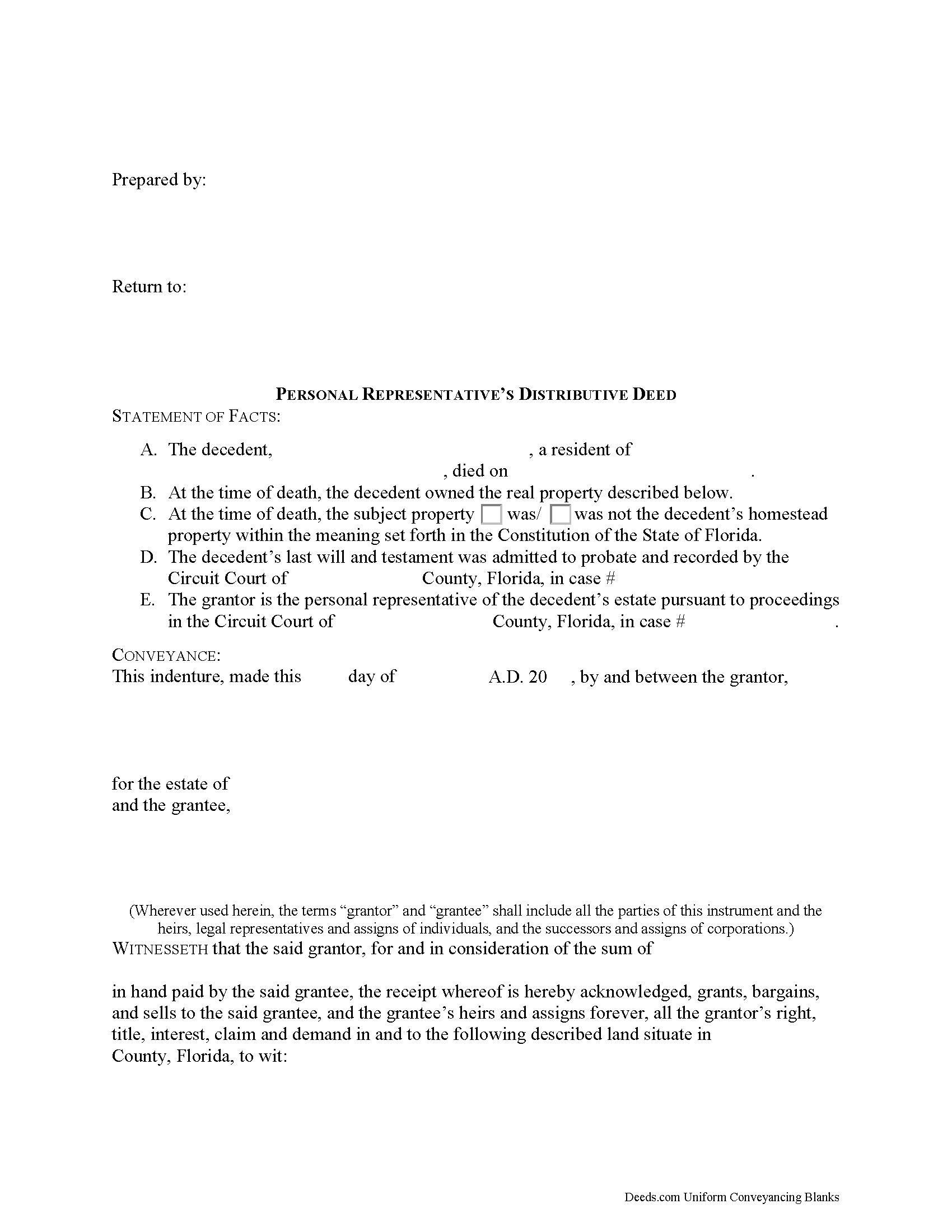
About the Florida Personal Representative Deed (Testate)
How to Use This Form
- Select your county from the list
- Download the county-specific form
- Fill in the required information
- Have the document notarized if required
- Record with your county recorder's office
What Others Like You Are Saying
"Loved every step of the process, from the detail explanation of the services/products provided, to t…"
"Very helpful. Worth the cost. Hopefully we will be able to proceed without expense of an attorney."
"Looks like all forms are available. Hope they are as easy to use as it was to obtain. Thank you."
"very efficient and easy to use online platform. I reviewed several different sites before I settle o…"
"Five Stars!"
4.8/5 from 4,828 reviews. Read all
When a Florida decedent left a will, the Florida Personal Representative Deed (Testate) puts the court-appointed personal representative’s probate authority into a deed that can be recorded in the Florida county where the land is located. Florida’s version is different from many states because the deed must fit Florida’s probate terminology, including court-issued “letters of administration” even in a testate estate, while also satisfying Florida’s two-witness deed execution rule, witness-address recording rule, documentary stamp tax review, and homestead restrictions that can limit what a will alone may transfer (Fla. Stat. §§ 731.201(24), 689.01, 695.26, 201.02, 732.4015).
What the Florida Personal Representative Deed (Testate) Does
A Florida Personal Representative Deed (Testate) is commonly used when real property in a probate estate is being conveyed under a valid will by the personal representative appointed by the Florida court. The deed identifies the estate, the deceased owner, the personal representative’s fiduciary capacity, the Florida probate proceeding, the real property being transferred, and the person or entity receiving title, creating one recordable instrument for a sale or distribution connected to the testate estate.
Florida Probate Authority for a Testate Estate
In Florida, a person nominated in a will does not act as personal representative for recording purposes until the probate court appoints that person and issues letters. Florida law defines “letters” as the court authority granted to the personal representative and states that all such letters are designated “letters of administration,” even though other states may use the term letters testamentary (Fla. Stat. § 731.201(24)).
For real property sales, Florida separates transfers made under a will’s power of sale from transfers that require court approval. If the will gives the personal representative a specific power to sell or mortgage real property, or a general power to sell estate assets, the personal representative may sell, mortgage, or lease estate real property without separate court authorization or confirmation (Fla. Stat. § 733.613(2)). If the will does not give that power, or the power is too limited to be conveniently exercised, title does not pass until the court authorizes or confirms the sale (Fla. Stat. § 733.613(1)).
Florida also treats protected homestead differently from ordinary probate property. The personal representative’s general power over estate property excludes protected homestead, although the statute allows limited possession for preserving, insuring, and protecting property that appears to be homestead while status is determined (Fla. Stat. § 733.608).
Florida Execution Rules: Signature, Witnesses, and Notary
The personal representative signs the deed in a fiduciary capacity, not as an individual owner. The signature block should make that capacity clear, using the personal representative’s name and estate role. Florida deeds conveying real property must be signed in the presence of two subscribing witnesses, a requirement that is stricter than the rule in many states (Fla. Stat. § 689.01).
To be recorded, the deed must also be acknowledged or proved in a form recognized by Florida law (Fla. Stat. § 695.03). In practice, that means the personal representative’s signature is typically notarized, and the notary certificate must be complete. Florida recording law also requires the notary’s printed, typed, or stamped name immediately beneath the notary signature (Fla. Stat. § 695.26).
Florida Recording Requirements That Can Delay Acceptance
Florida county clerks review deeds for specific recording elements before accepting them. The Florida Personal Representative Deed (Testate) should be prepared with these state requirements in mind:
- Printed names and addresses below signatures: The printed, typed, or stamped name and post-office address of each person signing must appear immediately beneath that signature (Fla. Stat. § 695.26).
- Witness names and addresses: Florida requires the printed, typed, or stamped name and post-office address of each witness immediately beneath the witness signature (Fla. Stat. § 695.26).
- Preparer identification: The deed must show the name and post-office address of the natural person who prepared the instrument or supervised its preparation (Fla. Stat. § 695.26).
- Grantee address: For deeds other than mortgages, the name and post-office address of each grantee must appear in the instrument (Fla. Stat. § 695.26).
- Clerk recording space: Florida requires a 3-inch by 3-inch space in the top right corner of the first page and a 1-inch by 3-inch space in the same area on later pages for clerk use (Fla. Stat. § 695.26).
- Legal description: The deed should use the full legal description, including lot, block, subdivision, plat book and page, metes and bounds, condominium unit, or other recorded description as applicable. A parcel identification number alone is not a substitute for the legal description.
Florida Homestead, Marital Status, and Will-Based Transfers
Florida homestead rules are a major title issue in testate estate transfers. A homestead is not freely devisable if the owner is survived by a spouse or minor child, except that it may be devised to the surviving spouse if there is no minor child (Fla. Stat. § 732.4015). If the homestead is not validly devised, Florida law provides a separate descent rule for the surviving spouse and descendants, including a life estate for the spouse with vested remainder to descendants unless the spouse makes the statutory election for a one-half tenant-in-common interest (Fla. Stat. § 732.401).
Because of these rules, Florida deeds connected to estates often need clear recitals about the decedent’s marital status, surviving spouse, minor children, and whether the property was protected homestead. Florida’s constitution also requires a married owner’s spouse to join in a lifetime sale, mortgage, or gift of homestead property, which is why homestead and spousal rights are closely reviewed in estate conveyances involving a former residence.
Documentary Stamp Tax and County Recording
Florida imposes documentary stamp tax on deeds and other instruments that transfer an interest in Florida real property, with tax generally based on consideration (Fla. Stat. § 201.02). The usual statewide rate is 70 cents per $100, or fraction of $100, of consideration, while Miami-Dade County has a different deed tax structure, including a surtax that does not apply to a document transferring only a single-family dwelling. County recording offices commonly review the stated consideration or stamp tax information before recording.
Florida’s former statewide DR-219 transfer return is no longer the standard form required with deeds, but the repeal of that form did not eliminate documentary stamp tax. For probate-related deeds, the consideration clause, supporting probate authority, and county recording fee calculation should be consistent so the clerk can determine what tax, if any, is due at recording.
Recording the Deed in the Florida County Land Records
After execution, the deed is recorded with the clerk of the circuit court in the county where the Florida real property is located. Recording matters because an unrecorded conveyance is not effective against creditors or later purchasers for value without notice unless it is recorded according to law (Fla. Stat. § 695.01). Prompt recording also places the probate transfer into the public land records, connects the estate deed to the chain of title, and helps future title searches locate the personal representative’s authority.
Florida Vesting and Survivorship Language
Florida does not automatically give survivorship rights to multiple grantees just because they take title together. Except for estates by the entirety, a conveyance to two or more persons creates a tenancy in common unless the deed expressly provides for a right of survivorship (Fla. Stat. § 689.15). For a personal representative deed, the vesting clause should clearly state each grantee’s name and the intended form of ownership, especially when the grantees are spouses, multiple beneficiaries, or buyers taking title with survivorship language.
What Is Included in the Florida Personal Representative Deed (Testate) Download Package
The Florida Personal Representative Deed (Testate) package includes materials prepared for Florida recording requirements and testate probate transfers:
- The Florida Personal Representative Deed (Testate) form
- Florida-specific completion guidelines
- A completed example showing how the deed is typically filled out
Important: County-Specific Forms
Our personal representative deed (testate) forms are specifically formatted for each of the 67 counties in Florida.
After selecting your county, you'll receive forms that meet all local recording requirements, ensuring your documents will be accepted without delays or rejection fees.