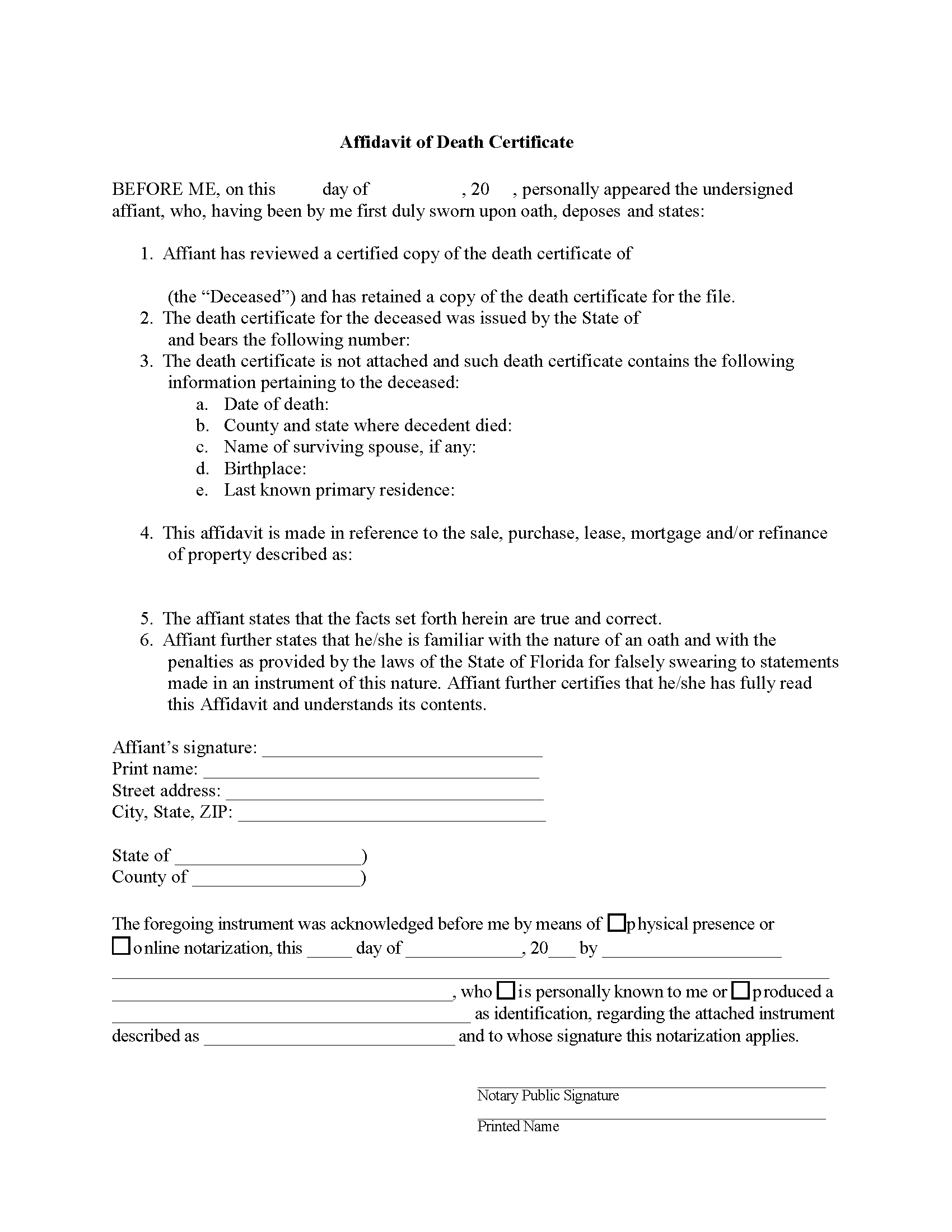
Florida Affidavit of Death Certificate
County Specific Legal Forms Validated as recently as September 15, 2026 by our Forms Development Team
About the Florida Affidavit of Death Certificate
How to Use This Form
- Select your county from the list
- Download the county-specific form
- Fill in the required information
- Have the document notarized if required
- Record with your county recorder's office
What Others Like You Are Saying
"This was my first time using Deeds.com It was very easy to understand and use. I was pleasantly supr…"
"Clear and easy instructions. Prompt processing and confirmation. I am still in the middle of submitt…"
"For better grammatical structure you should add the word "BE" after the first three words.…"
"I was very impressed with the quick responses I received from my questions. Usually when forced to c…"
"The website was very easy to navigate and I found it easy to get the documents I needed. I also foun…"
4.8/5 from 4,823 reviews. Read all
Florida death certificates carry confidentiality restrictions that other states do not impose. Under F.S. 382.025, the cause of death portion of a Florida death certificate is removed from publicly issued copies and is released only to a defined group — the decedent's spouse, parent, child, grandchild, sibling, or a legal representative — for 50 years after the death. When a real estate transaction touches a deceased Florida property owner, the title company or recording party often needs confirmation that a death certificate exists and what it says, but cannot attach the document to a public file without raising privacy issues. The Florida Affidavit of Death Certificate is a sworn statement from someone who has personally reviewed the certified original. It captures the date of death, certificate number, issuing state, and other identifying details so the file is complete without the certificate itself going on the record.
How the Florida Affidavit of Death Certificate is used
This affidavit is used when a Florida title company, lender, recorder, or other party in a real estate transaction needs verification that a death certificate exists for a deceased grantor, joint tenant, or other party of interest, but does not need — or cannot accept — the certificate itself. Common situations include closings on property previously held by joint tenants with right of survivorship, transactions involving an enhanced life estate (Lady Bird) deed where the life tenant has died, and underwriting files where the title insurer needs proof of death without including the full vital record. The affiant — typically a family member, executor, or someone with custody of the original — swears under oath that they have seen the certified document and recites its key contents.
Florida death certificate access rules
Under F.S. 382.025(1), the Florida Department of Health issues two kinds of death certificate copies. The "without cause of death" version is available to any applicant who can identify the decedent. The full version, including cause of death, is restricted for 50 years from the date of death and is released only to specific family members and legal representatives listed in the statute. This split creates the everyday problem this affidavit solves: a recorder or title file may need confirmation of the death without ingesting the cause-of-death information into a public document. The affiant verifies what the certificate says without the document itself becoming part of the record.
What this affidavit is and is not
This is a verification document, not a title instrument. It does not transfer Florida real property, remove a deceased owner from title, vest survivorship in a surviving joint tenant, or open or close a probate estate. It does not function as an affidavit of heirs, an order of summary administration under F.S. 735.201, or a recorded death certificate used to clear a tenancy by the entirety or joint tenancy with right of survivorship under F.S. 689.15. It is narrower than that — a sworn recital of what the affiant saw on a death certificate.
Execution requirements in Florida
Because this is an affidavit rather than a deed, Florida's two-witness requirement for deeds under F.S. 689.01 does not apply. The affiant signs in the presence of a notary public, and the notarial certificate must be a jurat — the form used when the signer takes an oath or affirmation — not the acknowledgment block used on deeds. F.S. 117.05 governs the form of notarial certificates and the information the notary must include. Florida also recognizes online notarization under F.S. 117.201 through 117.305, so the affidavit may be executed remotely before a Florida-commissioned online notary. Under F.S. 92.525, a written declaration signed under penalty of perjury can substitute for a notarized affidavit in some contexts; whether that substitute is acceptable depends on what the recipient — title company, recorder, or court — will accept.
Recording the affidavit in Florida
Whether this affidavit is recorded depends on the requesting party. Some title companies retain it in the underwriting file only; others require it recorded alongside a deed or other instrument. If recorded, it must comply with F.S. 695.26: the name of each signer must be typed or printed beneath the signature, the preparer's name and address must appear on the first page, and the first page must have a 3-inch top margin with 1-inch margins elsewhere to accommodate the recorder's stamp. Florida county recorders charge by the page under F.S. 28.24, so removing extra blank pages before recording reduces cost.
Florida-specific traps
- Wrong notarial certificate. Affidavits require a jurat. A Florida acknowledgment block — common on deeds — does not satisfy the oath requirement and may cause the recipient to reject the document.
- Confusing this with an Affidavit of Heirs. A Florida Affidavit of Heirs identifies who inherits when there is no probate. This affidavit only verifies a death certificate. They are different documents serving different purposes and are not interchangeable.
- Homestead complications. Florida homestead under Article X, Section 4 of the Florida Constitution descends to a surviving spouse and minor children outside of probate, and clearing title to homestead property usually requires more than a death verification. This affidavit alone will not resolve a homestead descent issue.
- Mismatched details. Title companies compare the affidavit's recital of the certificate number, date of death, and place of death against their other file evidence. Transcription errors — a wrong middle initial, a transposed digit in the certificate number — are a common reason the affidavit is sent back.
- Recording margin and preparer block omissions. If the affidavit is being recorded, F.S. 695.26 violations cause Florida recorders to reject the document or charge a non-standard recording fee.
- Cause-of-death disclosure. Reciting the cause of death in the affidavit puts that confidential information into a public record if the affidavit is recorded. Most uses of this form do not require the cause of death; the affiant should include only the details the recipient actually needs.
What is included in the download package
The Florida Affidavit of Death Certificate package contains the fillable form, a guidelines document explaining how to complete and execute it under Florida law, and a completed example for reference. Files are delivered as immediate downloads after purchase and can be reused.
Important: County-Specific Forms
Our affidavit of death certificate forms are specifically formatted for each of the 67 counties in Florida.
After selecting your county, you'll receive forms that meet all local recording requirements, ensuring your documents will be accepted without delays or rejection fees.